Why Traditional Local SEO is Failing Texas Businesses in 2026: The AI Shift
Why Traditional Local SEO is Failing Texas Businesses
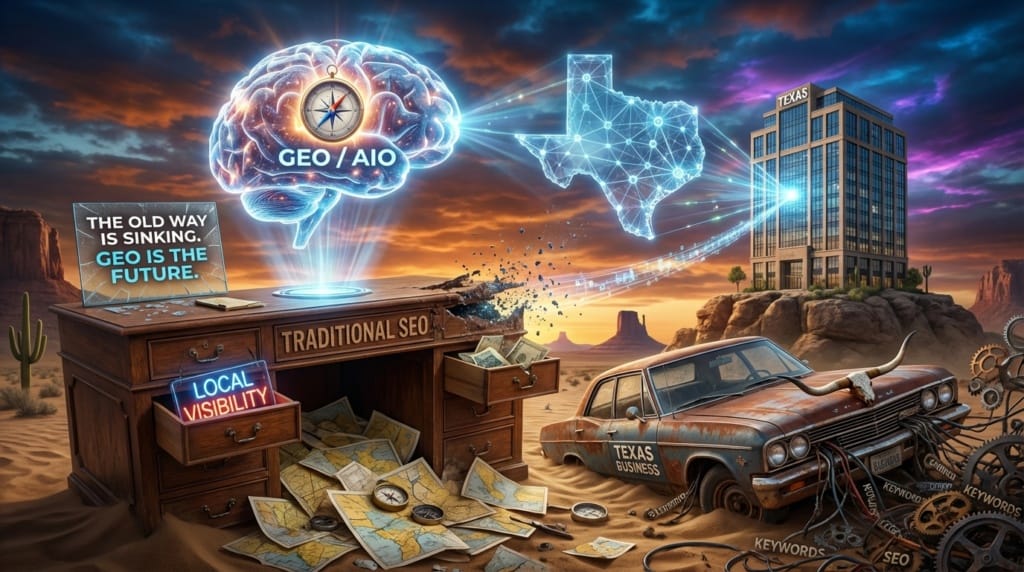
Traditional local SEO is failing Texas businesses because AI Overviews and Large Language Models (LLMs) now prioritize semantic relevance and entity authority over simple proximity or keyword matching. With AI Overviews appearing in 15–20% of searches and zero-click behaviors dominating, businesses relying solely on Google Maps rankings lose visibility to competitors optimized for AI citations and answer engines like Perplexity AI and ChatGPT.
Jump to Passage. . .
The New Era of Local SEO: AI Overviews in the Lone Star State
The digital marketing playbook that worked for Dallas plumbers and Houston retailers in 2023 is now obsolete. We are standing firmly in 2026, and the shift from "searching" to "answering" has fundamentally broken the old model of local visibility. For years, Texas business owners could rely on a well-optimized Google Business Profile (GBP) and a handful of local citations to keep the phone ringing. That safety net is gone.
The disruption isn't coming; it is already here. Search Generative Experience (SGE) has matured into fully integrated AI Overviews, and users are no longer scrolling past ten blue links. They are getting synthesized answers directly at the top of the interface. If your brand isn't the source of that answer, you are invisible. This is particularly brutal in competitive Texas markets like Austin and San Antonio, where tech-savvy consumers adopt these new search behaviors faster than the national average.
Understanding this shift requires acknowledging a hard truth: ranking #1 on a map pack no longer guarantees a click. The user journey has shortened, and the gatekeepers have changed from simple algorithms to complex neural networks that "read" and "understand" content rather than just indexing it. This guide dissects exactly why the old methods are failing and provides the blueprint for survival in the Texas market of 2026.
📉 Understand the Impact of AI on Search
The most immediate threat to traditional SEO strategies is the sheer dominance of AI Overviews. These AI-generated summaries push organic results even the local map pack further down the page, often below the fold on mobile devices. For a business in Fort Worth or El Paso, this means that being on the first page is no longer enough if you aren't part of the AI conversation.
The metrics are alarming for those who haven't adapted. Data confirms that AI Overviews appear on 15–20% of searches, dropping organic click-through rates by 61%. This massive reduction in click-through rate (CTR) signifies that users are satisfied with the summary provided by Google's Gemini or similar models. They get the phone number, the hours, or the pricing estimate directly from the AI, rendering your website's "Contact Us" page less relevant as a landing destination.
This shift hits service-based industries the hardest. If a user asks, "Who is the most reliable HVAC technician in Plano?" and the AI provides a synthesized recommendation based on aggregated sentiment, the user has no reason to scroll down to the directory listings. The traffic that used to flow to your site to verify your credibility is now being intercepted by the search engine itself.
🚫 Thrive Amidst Zero-Click Searches
The phenomenon of "Zero-Click Searches" has evolved from a trend into the standard user behavior of 2026. A zero-click search happens when a user's query is answered directly on the search results page (SERP), requiring no further action. For Texas businesses, this effectively creates a wall between them and their potential customers.
Current analysis indicates that zero-click searches reach 60–75% of queries. This staggering statistic means that for every ten people searching for your services, up to seven of them will never visit your website. They will consume your data—your address, your reviews, your pricing—without ever entering your digital ecosystem. This forces a change in how we measure success. Traffic is no longer the primary KPI; "share of voice" within the AI response is.
To survive this, your content must be structured to feed the AI exactly what it needs to construct an answer. This involves "data reconstruction" ensuring that your business details are not just text on a page but structured data entities that machines can parse with 100% accuracy. If the AI is unsure about your hours of operation because of conflicting data on Facebook versus your website, it will simply omit you from the answer to avoid hallucinating incorrect information.
| Feature | Traditional Local SEO | AI & LLM Optimization |
|---|---|---|
| Primary Goal | Rank #1 in Map Pack | Be cited in AI Answer |
| Key Signal | Proximity & Keywords | Semantic Relevance & Trust |
| User Behavior | Click through to website | Zero-click consumption |
| Content Focus | Keyword density | Entity relationships |
🧠 Embrace Semantic Relevance with AI
The logic governing how businesses are recommended has shifted from "where you are" to "what you mean." In the past, being the closest coffee shop to the user was often enough to secure a top ranking. Today, Large Language Models (LLMs) like Perplexity AI and Google's Gemini act as decision engines that evaluate the semantic relevance of a business to the user's specific intent.
Research into this new ranking logic reveals that LLMs prioritize semantic relevance over traditional local signals for "near me" queries. This means an LLM analyzes the context of a query like "quiet coffee shop for working in downtown Houston" and prioritizes businesses that are semantically linked to concepts like "workspace," "strong wifi," and "quiet atmosphere," even if they are slightly further away than a noisy espresso bar next door.
This is a critical pivot for Texas businesses. You cannot simply stuff "near me" into your title tags. You must build content that establishes a semantic connection between your business entity and the specific attributes your customers are searching for. If you run a boutique hotel in San Antonio, your content needs to explicitly and implicitly link your brand to entities like "Riverwalk access," "luxury bedding," and "concierge service" so that the AI understands the context of your existence, not just your coordinates.

🚀 Elevate Your AI Citation Strategy
If rankings are the currency of the past, citations are the currency of the future. But these aren't the directory citations of 2015 (like Yelp or YellowPages). These are "AI Citations" instances where an LLM references your brand as a credible source of information or a verified solution. The goal is to be the source the AI pulls from when generating its answer.
The path to achieving this is surprisingly traditional but requires higher standards. Studies show that 92% of successful AI Overview citations come from domains already ranking in the top 10 organic positions. This debunks the myth that you can ignore traditional SEO entirely. You still need a strong organic foundation to be "seen" by the AI. The difference is that being in the top 10 is the entry ticket, not the victory.
To convert that top 10 ranking into an AI citation, your content must be authoritative and structured for extraction. This means using clear headings, concise answer paragraphs (like the one at the top of this article), and verifiable data points. Texas businesses that publish vague, fluffy content will be ignored by the AI in favor of competitors who provide direct, data-backed answers that the model can easily summarize.
🤠 Optimize for Texas-Specific Hyper-Local Content
Texas is not a monolith. The search behavior in the sprawling metroplex of DFW is distinct from the border dynamics of El Paso or the hill country vibes of Austin. "Near me" searches have exploded, but the intent behind them has become hyper-specific. Users aren't just looking for "restaurants"; they are looking for "dog-friendly patio restaurants with live music near me."
The data underscores this urgency: "Near me" searches grew 136% year-over-year, driven by mobile usage and voice search. To capture this traffic, you need hyper-local content that goes beyond city-level targeting. You need neighborhood-level granularity. A real estate agent in Houston shouldn't just target "Houston homes"; they need pages dedicated to "The Heights," "Montrose," and "River Oaks."
- Create Neighborhood Landing Pages: Target specific subdivisions or districts relevant to your Texas city.
- Incorporate Local Vernacular: Use terms locals use (e.g., "Inside the Loop" in Houston, "The Metroplex" for DFW).
- Highlight Local Landmarks: Reference proximity to well-known entities (e.g., "Located 5 minutes from the Alamo").
- Address Local Pain Points: Discuss specific local issues like "clay soil foundation repair" or "hail damage roofing."
This hyper-local approach signals to the AI that you are deeply relevant to the user's physical context. When a user in Plano asks Perplexity for a recommendation, the AI looks for signals that confirm you actually serve that specific micro-location, not just the general region.
⚙️ Technical Excellence: A Must for AI Visibility
In 2026, technical SEO is no longer just about keeping your site running; it is about keeping your data accessible to non-human visitors. AI crawlers and LLM bots consume your site differently than a human browser does. They strip away the design and look at the raw structure. If that structure is messy, your chances of being cited drop to zero.
Technical hygiene is the bedrock of AI visibility. This includes having a flawless schema markup strategy. You must use Organization, LocalBusiness, and Service schemas to explicitly tell the AI who you are and what you do. Furthermore, your site speed (Core Web Vitals) directly impacts how efficiently these bots can crawl your site. If your server is slow or your code is bloated, the AI might time out before it extracts the value it needs.
🛡️ Combat Review Fraud to Maintain AI Context
Review signals have always been important, but AI has changed how they are processed. Traditional algorithms looked at star rating and volume. AI models read the text of the reviews to understand sentiment and context. They can distinguish between a generic "Great service!" review and a detailed narrative about a specific employee's helpfulness.
However, this comes with a dark side. Review fraud and outdated signals can sabotage AI context, as AI tends to spotlight negative sentiment if it detects a pattern. If your business has a cluster of 1-star reviews mentioning "hidden fees," the AI will likely include a warning in its summary: "Users frequently report unexpected charges." This can kill conversion rates instantly.
Texas businesses must actively monitor their review profiles across all platforms, not just Google. AI engines pull data from Yelp, Facebook, BBB, and industry-specific directories. A discrepancy in sentiment across platforms (e.g., 5 stars on Google but 2 stars on Yelp) is a red flag for AI, signaling potential manipulation. Authenticity and consistency are your best defenses.
📊 The Visibility Gap: Google vs. AI
One of the most shocking revelations for business owners in 2026 is the lack of correlation between their old rankings and their new AI visibility. You can be #1 in the Local Pack and invisible in ChatGPT. This "Visibility Gap" is a major blind spot for agencies still reporting on vanity metrics.
Research indicates that there is only a 45% overlap between traditional search and AI engine visibility in retail. This means more than half of the brands winning in traditional search are losing in AI search. The AI engines are using a different set of criteria likely weighing brand authority, entity trust, and cross-platform consistency much heavier than simple link metrics.
To bridge this gap, you must treat your brand as an entity. Ensure your "Knowledge Graph" is complete. This means your business information must be identical across every data point on the web. If Perplexity AI sees your phone number is different on your LinkedIn profile than your GBP, it lowers your trust score. In the AI era, consistency is a proxy for trustworthiness.
🔮 Utilize Core Web Vitals and Structured Data
The technical requirements for ranking in 2026 have intensified. Google's Core Web Vitals (CWV) are now a baseline expectation, not a bonus. But beyond speed, the implementation of structured data (Schema.org) has become the primary language of communication with search engines. You are essentially handing the AI a business card written in its own native code.
For a Texas business, this means implementing "LocalBusiness" schema that includes specific "areaServed" properties defined by zip codes or city names. It means using "hasOfferCatalog" to detail your services in a machine-readable format. Predictive analytics also play a role here; by analyzing search trends, you can structure your data to answer questions before they are even asked, positioning your brand as the proactive solution provider.
Adapting to the Texas AI Frontier
The failure of traditional local SEO in Texas is not a sign of the industry dying, but of it evolving into something sharper, faster, and more demanding. The days of easy wins with keyword stuffing and basic citations are over. In 2026, the Texas businesses that thrive are those that respect the intelligence of the AI and the intent of the user.
We have moved from a game of visibility to a game of validity. It is no longer enough to be seen; you must be trusted. By focusing on semantic relevance, maintaining impeccable technical hygiene, and building a brand entity that withstands the scrutiny of multiple AI models, you can secure your place in the new digital landscape. The tools have changed, but the goal remains the same: connecting with the Texans who need your services the most.
Are you ready to rebuild your digital foundation for the age of AI, or will you let your competitors own YOUR answers?
Questions People Ask
What are AI Overviews in 2026?
AI Overviews are AI-generated summaries at the top of search results that synthesize answers from multiple sources, often removing the need for users to click on websites.
Why is my Texas business ranking but getting less traffic?
You are likely a victim of zero-click searches. Users are getting their answers directly from the AI or local pack without needing to visit your website.
How do I rank in Perplexity or ChatGPT?
Focus on brand entity consistency, high-quality structured data, and being cited by authoritative sources that these LLMs already trust and index.
Does Google Maps still matter for Texas SEO?
Yes, but it is no longer the only factor. Maps visibility must be combined with semantic relevance to appear in AI-driven "near me" recommendations.
What is the "Visibility Gap" in local SEO?
This refers to the discrepancy where businesses rank well in traditional Google Search but fail to appear in AI-generated recommendations and answer engines.
How does review fraud affect AI rankings?
AI models analyze review sentiment patterns. If they detect fraud or consistent negative themes, they may exclude your business from recommendations to protect user trust.
What is semantic relevance in local search?
It is the alignment between a user's intent and your content's meaning. AI prioritizes businesses that contextually match the search, not just those that match keywords.
 SEO SOLUTIONS TEXAS BLOG
We are a results-driven digital marketing and AI SEO agency focused on increasing website traffic, improving online visibility, and generating high-quality leads for our clients.
🏆 Our Services:
Get Access To Our Texan Newsletter
Outrank. Outplay. Outperform.
We deliver elite Texas AI SEO and digital marketing strategies that amplify your presence across search engines, social media, and the platforms that matter most—so you get cited, attract ready-to-buy customers, and turn visibility into unstoppable brand growth.