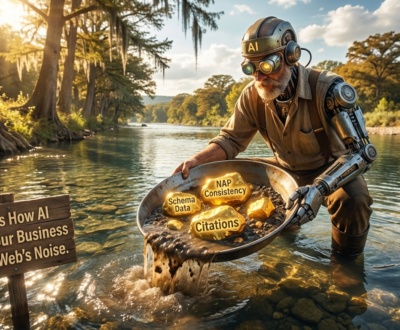
Mathematical Elimination of Digital Noise: The AI Trust Protocol for Texas Businesses
Why 92% of Brands Invisible to ChatGPT Even With Heavy SEO Investment?
Brands are invisible to AI because they drown in unstructured digital noise instead of using mathematical entity mapping via knowledge graphs to create semantic signals AI engines trust. Without a coherent entity footprint, ChatGPT's probabilistic algorithm defaults to citing competitors with stronger knowledge graph presence.

Jump to Passage. . .
Elimination of Digital Noise Crisis: Why Your SEO Efforts Are Getting Lost
Unstructured data—text, images, videos—explodes across websites, social media, and databases, creating a chaotic digital landscape. Traditional SEO focuses on keywords and backlinks, but AI models like ChatGPT parse this noise to understand entities, relationships, and context. When your business entities are fragmented, contradictory, or missing from authoritative sources, the AI cannot verify your identity, expertise, or relevance. This results in invisibility across AI-powered search engines and knowledge panels. The proliferation of unstructured data demands a shift from keyword stuffing to semantic connectivity, where every piece of information contributes to a unified, machine-readable graph of your brand's ecosystem.
The $3.92 Billion Knowledge Graph Surge: Mathematical Elimination Is No Longer Optional
The enterprise knowledge graph market is projected to grow by USD 3.92 billion from 2026-2030 at a CAGR of 33.4%, driven by the proliferation of unstructured data and the requirement for semantic connectivity. enterprise knowledge graph market growth at 33.4% CAGR demonstrates explosive demand for systems that transform chaotic data into actionable insights. As Technavio analysts note, "Proliferation of unstructured data and requirement for semantic connectivity will drive the enterprise knowledge graph market."
This growth reflects a fundamental shift: businesses must adopt mathematical elimination techniques—using graph databases, schema markup, and entity alignment—to cut through noise and establish algorithmic confidence. Without this, AI models cannot independently verify your business, leading to competitive displacement in generative answers.
Automating the Impossible: How Entity SEO Tools Cut Mapping Time by 50%
Manually auditing all your pages, extracting entities, mapping relationships, and adding precise schema markup is impractical even for medium-sized sites. Entity SEO tools automate discovery, create or enrich knowledge graphs, and generate structured data at scale. entity SEO tools like WordLift and InLinks step in to handle this complexity. These platforms use NLP to identify entities, suggest internal linking strategies, and deploy schema markup programmatically.
For engineering teams, graph databases like Neo4j store custom SEO knowledge graphs, while open-source tools like spaCy offer named-entity recognition for bespoke solutions. A centralized knowledge graph serves as the single source of truth, enabling programmatic schema generation and powering on-site search. This automation reduces mapping time from months to minutes, ensuring your digital footprint is coherent and machine-intelligible.
Essential Entity SEO Tools for Texas Businesses
| Tool | Best For | Pricing |
|---|---|---|
| WordLift | Content-heavy CMS sites | Paid |
| InLinks | Publishers and e-commerce with many URLs | Paid |
| Neo4j | Engineering teams with complex graphs | Freemium/Enterprise |
| spaCy | Custom ML-driven entity SEO | Free |
| Kalicube Pro | Brands targeting knowledge panels | Paid |
The $108 Billion SEO Mirage: Why Rankings Can't Save You from AI Overviews
Despite the global SEO services market reaching $108.28 billion in 2026, up 32.9% from $81.46 billion in 2024, traditional keyword SEO fails in the AI era. SEO services market at $108 billion highlights massive investment but not effectiveness against generative engines. Gartner predicts a 25% drop in search engine volume by 2026 due to generative AI, as users shift to ChatGPT and similar tools for answers. Gartner predicts 25% drop. AI Overviews appear in 60% of U.S. Google searches, creating zero-click erosion where rankings hold but traffic vanishes.
The keyword vs entity debate intensifies: keywords evolve into semantic signals, but entities provide mathematical precision for AI confidence. end of keywords for B2B. Fragmented SERPs with generative search demand entity signals over exact-match phrases. fragmented SERPs with generative search. Additionally, the SEO platforms market is expected to reach $2.31 billion by 2025 from $1.29 billion in 2021, reflecting tool investment for semantic analysis. SEO platforms market to reach $2.31 billion. This data proves that without entity optimization, even heavy SEO spending leads to invisibility in AI responses.
Common Mistakes That Keep You Invisible
- Focusing solely on on-site keywords while neglecting off-site entity signals.
- Manual entity extraction that cannot scale with site growth.
- Failing to build a centralized knowledge graph as a single source of truth.
- Overlooking schema markup for key entities and relationships.
From Keywords to Things: The 2012 Google Knowledge Graph Revolution
The shift from keyword-centric to entity-centric search began with the Google Knowledge Graph launch in 2012. This marked a move from strings to things, powering Knowledge Panels and reducing reliance on exact-match keywords. The foundation was laid by Semantic Web Technologies in the early 2000s, which introduced RDF and OWL standards for representing entity relationships.
Between 2020-2024, enterprise knowledge graphs gained traction, integrating with AI amid unstructured data explosion. The market base year 2025 reflects maturity, but many businesses still operate with legacy SEO mentalities. This historical context is critical: if you ignore entity relationships, you remain in the 92% of brands invisible to AI. The 2012 revolution is now a mandatory evolution, not an option.
Kalicube's 70 Million Entity Graph: How to Achieve 10x Wikipedia Authority
Kalicube solved the scalability problem by building a knowledge graph with 70 million entities, over 10x larger than Wikipedia's 6 million articles. Google holds 54 billion entities, with Wikipedia at a mere 0.01% share. Kalicube 70 million entities. This massive entity coverage strengthens brand authority in knowledge panels, making businesses visible to ChatGPT and other AI. Given that 92% of brands are invisible to ChatGPT according to the 2026 Fuel AI Index, scaling beyond Wikipedia is essential. Kalicube Pro helps brands monitor and strengthen entities across the web, turning fragmented mentions into a coherent graph. The takeaway: entity scale beats traditional authority; your digital footprint must be mathematically comprehensive to be trusted by AI.
Beyond Marketing: How Knowledge Graphs Deliver 15% Fraud Detection Gains
A financial services firm leveraged an enterprise knowledge graph for entity mapping and semantic connections, achieving 15% greater accuracy in fraud detection and 25% reduction in compliance reporting costs. This case study from Technavio shows knowledge graphs excel at revealing entity relationships traditional databases miss. The integration of knowledge graphs with generative AI reduces factual errors by providing semantic context, enabling real-time insights.
Data fabric architectures further enhance this by creating holistic views across silos, supporting applications like digital twins and personalization. This ROI extends beyond marketing: any industry with complex, interconnected data—healthcare, logistics, finance—can use entity mapping to cut costs and improve decision-making. The mathematical elimination of noise isn't just for SEO; it's a competitive necessity for data-driven operations.
The Entity Discovery Audit: Your First Step Toward Mathematical Clarity
Before building a knowledge graph, you must conduct an Entity Discovery Audit to map your current digital footprint. This audit identifies gaps, contradictions, and missing schema that cause AI confusion. Start by crawling your website to extract all entities (people, products, locations, etc.) using tools like spaCy or MarketMuse. Then, audit your schema markup: is it present, accurate, and comprehensive? Next, analyze off-site signals: do authoritative sources like Wikipedia, news sites, and industry databases reference your entities consistently? Finally, check internal linking: are related entities connected via contextual links? This audit reveals the noise—unstructured, conflicting, or absent data—that your AI trust score suffers from.
Identity Architecture: Building Canonical Claims That AI Cannot Ignore
After the audit, engage in Identity Architecture interventions. This involves establishing a canonical identity through undeniable claims and high-authority references. First, define your core entities: your brand name, key executives, flagship products, and unique value propositions. Then, create or update authoritative sources: Wikipedia pages, Wikidata entries, and industry database listings with precise, consistent information.
Use schema markup (like Organization, Person, Product) to explicitly state relationships. Secure mentions from trusted publications with clear entity references. Finally, ensure internal site structure reinforces these entities via hierarchical menus, contextual links, and content clusters. This architecture creates a coherent signal that AI models can verify, boosting your confidence score in generative responses.
The Texas Business Imperative: Act Now or Forfeit the AI Economy
In a macroeconomic environment where half of all consumers intentionally seek out AI-powered search engines to make buying decisions, remaining invisible to the Knowledge Graph is equivalent to voluntary economic forfeiture. Texas businesses operate in a competitive, fast-growing market where early adopters of entity SEO will capture mindshare in ChatGPT, Perplexity, and AI Overviews.
The mathematical elimination of digital noise is not a marketing tactic; it's a foundational business strategy for 2026 and beyond. Start with an Entity Discovery Audit, invest in automated tools, and build a knowledge graph that serves as your single source of truth. The data is clear: 92% of brands are failing because they ignore entity authority. Will you be in the 8% that thrives?
Common Questions About Mathematical Elimination of Digital Noise
What is mathematical elimination of digital noise?
It's the process of using entity mapping, knowledge graphs, and schema markup to transform unstructured, contradictory digital data into a coherent, machine-readable format that AI engines trust and surface.
How do knowledge graphs improve AI visibility?
Knowledge graphs connect entities with semantic relationships, providing AI models like ChatGPT with verifiable context. This increases confidence scores, leading to citations in generative answers and knowledge panels.
Why are 92% of brands invisible to ChatGPT?
Because they lack comprehensive, authoritative entity footprints. Without structured data and cross-web consistency, AI cannot verify their existence, expertise, or relevance, defaulting to competitors.
What tools automate entity SEO?
Tools like WordLift, InLinks, Neo4j, and spaCy automate entity discovery, schema generation, and graph building, scaling the process for medium to large sites.
How does the Google Knowledge Graph affect SEO?
Since its 2012 launch, it shifted SEO from keywords to entities. Now, AI Overviews and generative search require structured entity signals to appear in zero-click results.
What is the difference between Entity SEO and traditional SEO?
Traditional SEO optimizes for keywords and backlinks. Entity SEO optimizes for semantic relationships, schema markup, and knowledge graph inclusion to satisfy AI's understanding of things, not strings.
How can Texas businesses start with entity discovery audits?
Crawl your site with NLP tools to extract entities, audit schema markup, check off-site consistency via sources like Wikipedia, and use platforms like MarketMuse to identify gaps against competitors.
What are the ROI benefits of enterprise knowledge graphs?
Beyond AI visibility, they deliver 15% better fraud detection, 25% lower compliance costs, and enhanced on-site search, creating a single source of truth for operations.
- ai overviews, data fabric architectures, entity seo, generative engine optimization, InLinks, Kalicube, knowledge graph, MarketMuse, mathematical elimination of digital noise, Neo4j, OWL, RDF, schema markup, semantic connectivity, semantic web technologies, spaCy, Surfer SEO, unstructured data, WordLift
 SEO SOLUTIONS TEXAS BLOG
 SEO SOLUTIONS TEXAS BLOG
We are a results-driven digital marketing and AI SEO agency focused on increasing website traffic, improving online visibility, and generating high-quality leads for our clients.
🏆 Our Services:
Get Access To Our Texan Newsletter
Outrank. Outplay. Outperform.
We deliver elite Texas AI SEO and digital marketing strategies that amplify your presence across search engines, social media, and the platforms that matter most—so you get cited, attract ready-to-buy customers, and turn visibility into unstoppable brand growth.