🚀 How Do You Optimize Conversion Rates for AI-Generated Traffic?
How Do You Optimize for AI Traffic?
Optimizing for AI traffic includes creating clear, authoritative, well-structured content that directly answers user questions. Use concise headings, factual accuracy, semantic keywords, and structured data (like schema markup) so AI systems can easily understand and surface your content.
Jump to Passage. . .
🎯 Why AI Referral Traffic Demands a Fastball Strategy in 2026
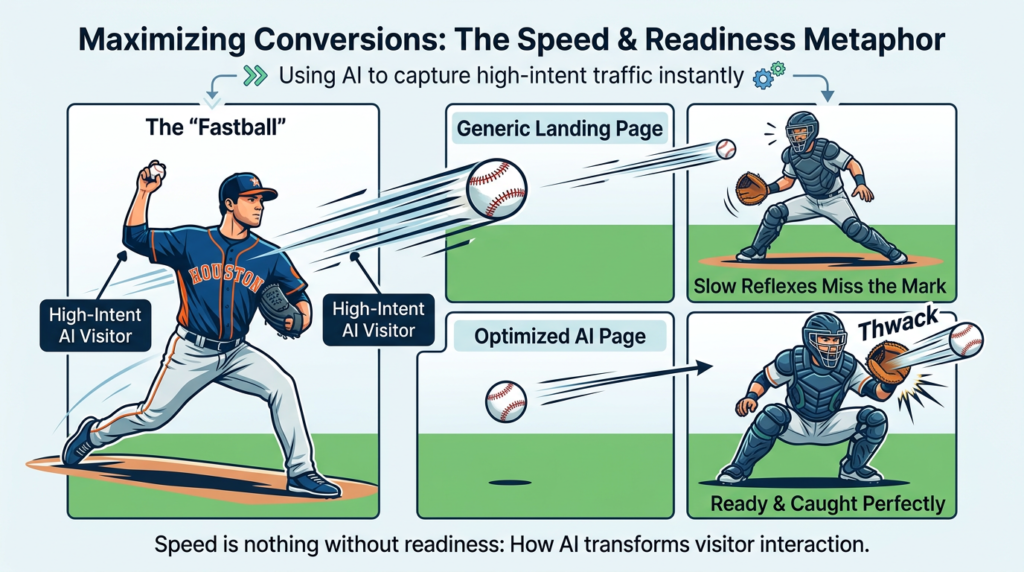
Optimizing conversion rates for AI-generated traffic requires treating visitors like high-speed fastballs rather than slow-pitch organic browsers. High-intent visitors arriving from large language models have already completed their research phase. Winning this traffic means delivering immediate, direct answers and frictionless transactional pathways instead of top-of-funnel educational content.
Imagine you run a B2B industrial supply firm in Houston. For years, your marketing team has optimized for the slow pitch. A prospect searches Google for "types of industrial valves," lands on your educational blog post, clicks around, downloads a whitepaper, and maybe calls your sales team three weeks later. That is the traditional organic search model. It is a slow, methodical nurturing process that requires extensive top-of-funnel content to build trust.
AI referral traffic is the exact opposite. It is a 100-mile-per-hour fastball right over home plate. When a prospect uses an AI platform to find a vendor, they are not casually browsing. They have already asked the large language model to compare your industrial valves against your top three competitors, analyze your technical specifications, and summarize your warranty terms. By the time that prospect clicks the citation link to visit your website, they do not want to read a blog post. They want to buy.
Many organizations are entirely unprepared for this shift in discovery behavior. They continue to route AI-referred visitors through the same bloated, multi-step funnels designed for low-intent organic traffic. This mismatch between user intent and website experience is the primary reason companies fail to capitalize on the AI search revolution. To win in 2026, you must completely restructure your conversion pathways to accommodate prospects who have already made their purchasing decision before a single pixel of your website loads.
📈 16% ChatGPT Conversion Rates Prove Traditional Organic Benchmarks Are Now Obsolete
Seer Interactive data reveals ChatGPT referral traffic converts at nearly sixteen percent compared to traditional organic search converting under two percent. Conversion rate benchmarks must be entirely recalibrated for AI platforms. Marketers applying legacy organic expectations to artificial intelligence referrals severely underestimate the commercial value of these high-intent visitors.
For over a decade, digital marketers have accepted a standard truth: a good organic conversion rate hovers around one to two percent. If you optimized your site brilliantly, you might push that to three percent. Those numbers were dictated by the nature of search engines, which deliver a mix of informational, navigational, and transactional intents in a single stream of traffic.
The emergence of AI search engines has shattered those benchmarks. Because AI platforms handle the informational and comparative heavy lifting internally, the traffic they send outward is almost exclusively transactional. A recent B2B software case study demonstrated this phenomenon perfectly, showing ChatGPT referral traffic converting at 15.9% while traditional Google Organic traffic languished at 1.76 percent.
This massive performance differential is not an isolated anomaly. Independent studies confirm that AI-referred traffic converts anywhere from four to twenty-three times higher than organic search, depending on the industry and measurement period. In fact, a comprehensive multi-industry analysis found a 5.1x higher conversion rate on average for ChatGPT visits compared to standard organic traffic. These numbers prove that evaluating AI traffic using legacy organic metrics is a fundamental strategic error.
When you understand these Conversion Rate Benchmarks, your entire approach to CRO changes. You stop trying to trick visitors into joining an email newsletter and start building frictionless pathways directly to your sales engineers. The goal is no longer to educate the prospect, but to validate the recommendation the AI has already made and facilitate the transaction as quickly as possible.
🧠 How Intent Compression Delivers 31% Higher Conversion Rates From AI Traffic
Intent compression explains why AI-sourced visitors convert at significantly higher rates than traditional searchers. Users complete comprehensive research and comparative analysis entirely within the LLM research phase. Arriving at your website with fully formed purchase intent means these prospects bypass typical mid-funnel nurturing and demand immediate transactional opportunities.
To understand how do you optimize conversion rates for AI-generated traffic, you must first understand the psychological mechanism driving these users. Visibility Labs formally identified this mechanism as "Intent Compression." In the traditional buyer journey, intent is built slowly over weeks or months. A buyer searches for a problem, reads five articles, downloads a guide, compares three software vendors, and finally requests a demo.
AI platforms compress that entire timeline into a ten-minute conversational session. The user asks the AI to act as an expert consultant, feeding it their specific constraints, budget, and requirements. The AI synthesizes dozens of sources, eliminates poor fits, and presents a highly curated recommendation. By the time the user clicks the citation link, they possess all the key information they need. The intent has been compressed from a sprawling, multi-touchpoint journey into a single, high-velocity interaction.
This compression mechanism is validated by hard data. A massive twelve-month study analyzing over nine million sessions across ninety-four ecommerce brands found that ChatGPT referral traffic converts at 31% higher rates than non-branded organic search. The intent is so strong that these visitors view an average of 2.3 pages per session versus just 1.2 for organic visitors, demonstrating nearly double the on-site engagement.
This engagement is not casual browsing. It is targeted validation. They are checking your pricing page to confirm the AI was accurate. They are checking your "About Us" page to ensure you are a legitimate entity. They are checking your technical documentation to verify integration capabilities. If your website is designed to support this rapid validation rather than forcing them back into an educational loop, your conversion rates will skyrocket.
📊 What GA4 Segmentation Reveals About Platform-Specific AI Conversion Differences
Platform-specific optimization requires isolating different AI traffic sources because user intent varies drastically across engines. Seer Interactive analysis shows ChatGPT delivering massive conversions while Gemini drives minimal results. GA4 segmentation allows B2B marketing teams to allocate resources efficiently based on actual platform performance rather than aggregate assumptions.
🛠️ Tracking AI Referrers
You cannot optimize what you do not measure. The first step in capturing this high-intent traffic is proper GA4 Segmentation. Lumping all AI traffic into a generic "referral" bucket destroys your ability to understand platform-specific behaviors. You must configure your analytics to identify the exact source of the traffic. This involves setting up custom channel groupings that isolate referrers like chatgpt.com, perplexity.ai, claude.ai, and gemini.google.com.
📱 Platform Performance Breakdown
Not all AI platforms generate the same type of traffic. Different underlying models, user interfaces, and citation formats attract different demographics with varying levels of commercial intent. Treating them as a monolith is a critical error. You must analyze each platform independently to understand where your specific buyers are conducting their research.
| Traffic Source | Platform Type | Average Conversion Rate | Primary User Intent |
|---|---|---|---|
| ChatGPT | Conversational LLM | 15.9% | Deep Analysis & Comparison |
| Perplexity | AI Search Engine | 10.5% | Factual Research & Sourcing |
| Claude | Conversational LLM | 5.0% | Technical Coding & Writing |
| Gemini | Ecosystem LLM | 3.0% | General Queries |
| Google Organic | Traditional Search | 1.76% | Mixed Discovery |
👥 Cohort Analysis Techniques
Once you have segmented the traffic, you must perform cohort analysis to track the long-term value of these AI-referred visitors. Because these users have higher initial intent, they often exhibit higher lifetime value (LTV) and lower churn rates. Tracking these cohorts over a six to twelve-month period will provide the financial justification needed to invest in dedicated Platform-Specific Optimization strategies.
🔄 Attribution Model Adjustments
AI Referral Attribution requires moving away from strict first-click models. Often, the AI platform acts as the final validation step before a direct visit. If your attribution model credits the original organic search from three months ago and ignores the ChatGPT session that occurred five minutes before the enterprise software purchase, you will misallocate your marketing budget entirely.
⚠️ Why Treating AI Traffic Like Regular Organic Still Destroys Your Conversion Potential
Applying traditional SEO conversion strategies to AI referral attribution actively damages your sales pipeline. High-intent visitors expect immediate access to pricing, technical specifications, and booking calendars. Forcing these ready-to-buy prospects through slow-pitch educational funnels creates friction that drives them back to the AI platform to find a faster competitor.
The most dangerous phase of any technological shift is the transition period where old tactics are forcefully applied to new paradigms. We saw this when mobile browsing first emerged, and companies simply shrank their desktop sites down to tiny, unreadable screens. We are seeing the exact same conversational failure mode today with ChatGPT Referral Traffic.
A B2B buyer uses Perplexity Traffic to narrow down a list of cybersecurity vendors. The AI recommends your firm because of your specific SOC 2 compliance features. The buyer clicks the citation link, expecting to see a direct confirmation of those features and a "Speak to Sales" button. Instead, they are hit with a generic pop-up asking them to subscribe to a newsletter, followed by a hero section vaguely promising to "synergize digital transformations." Frustrated by the friction, they hit the back button and click the next citation on the AI's list.
The urgency to correct this mismatch is accelerating. The ratio of traditional organic traffic to AI traffic is narrowing rapidly. Over a single year, the gap narrowed from 70-to-1 down to 47-to-1 in 2025. This means the volume of high-intent, fast-moving traffic is growing exponentially. If your site architecture remains stubbornly optimized for slow-pitch organic browsers, your conversion rates will steadily decline as the funnel topology structurally shifts.
Here is a factual list of common mistakes companies make when handling AI traffic:
- Forcing AI visitors to consume top-of-funnel educational content they have already bypassed.
- Hiding critical decision-making criteria (pricing, SLAs, technical specs) behind lead capture forms.
- Failing to isolate Claude Conversions from general referral traffic in analytics platforms.
- Using generic "Contact Us" forms instead of direct calendar booking links for high-intent prospects.
- Ignoring the platform-specific nuances between conversational LLMs and dedicated AI search engines.
📄 2.3 Pages Per Session Data Changes How You Should Build AI-Optimized Landing Pages
Engagement metrics show AI referrals view nearly double the pages of traditional organic visitors. This intense engagement requires site architectures built for deep technical validation rather than basic discovery. Post-AI decision needs dictate that landing pages must offer immediate proof, detailed specifications, and seamless transaction paths to capture conversions.
When the data showed that AI visitors consume 2.3 pages per session compared to the organic average of 1.2, many marketers misinterpreted the signal. They assumed these visitors were lost and clicking around in confusion. In reality, this behavior represents deep, targeted validation. High-Intent Visitors do not bounce immediately; they hunt for specific proof points to validate the AI's recommendation.
This reality fundamentally changes how you should design your site architecture. Traditional SEO landing pages are built to satisfy the algorithm first and the user second. They feature thousands of words of repetitive text, optimized headers, and internal links designed to pass PageRank. AI-optimized pages must be built entirely for the human who has already bypassed the Zero-Click Results phase.
To optimize for this 2.3-page journey, you must anticipate the post-AI decision needs. If the visitor lands on a product page, what is their logical next step? They will want to see pricing. If pricing is acceptable, what is the next step? They will want to see case studies or trust badges. You must build a tight, interconnected loop of validation pages that allow the user to rapidly confirm their intent without ever having to use your site's main navigation menu.
This approach directly addresses the B2B SaaS Optimization challenge. Software buyers are notoriously resistant to lengthy sales funnels. By acknowledging that the LLM has already done the heavy lifting, you show respect for the buyer's time. You transition from convincing them that they have a problem to proving that your specific solution executes flawlessly.
🎯 How to Optimize Conversion Rates for AI Traffic Without Wasting Resources on Low-Volume Channels
Resource allocation for AI traffic optimization demands strict volume thresholds before triggering major website overhauls. Wait until AI sessions reach five percent of total organic volume before launching dedicated conversational landing pages. Early movers who integrate AI tracking into existing CRO workflows capture high-margin wins without abandoning primary revenue engines.
A common pitfall in digital marketing is the "shiny object syndrome." Marketing directors read about the incredible conversion rates of AI traffic and immediately demand a complete website redesign, pulling resources away from the organic channels that still drive ninety-nine percent of their volume. This premature over-investment is a massive strategic error.
You must balance the incredible conversion efficiency of AI traffic against its currently low absolute volume. While AI traffic is growing rapidly, it still represents a fraction of total web traffic. The correct approach is to integrate AI optimization into your existing Ecommerce CRO and B2B workflows using strict data thresholds. You optimize for conversion now, while building the foundation for volume later.
Here is a systematic, factual list of steps to optimize AI conversion rates without wasting resources:
- Establish Tracking First: Configure GA4 to segment ChatGPT, Perplexity, Claude, and Gemini before making any site changes.
- Set Action Thresholds: Agree that no dedicated landing pages will be built until AI traffic consistently hits a specific threshold (e.g., 5% of total organic traffic).
- Optimize Existing High-Value Pages: Focus your initial efforts strictly on the bottom-of-funnel pages (Pricing, Demo, Contact) that AI visitors frequent most.
- Implement Bidirectional Learnings: Use the high-converting elements from your AI traffic experiments to improve your traditional organic landing pages.
- Monitor the Cohort Shift: Track the ratio of organic-to-AI traffic monthly to anticipate when structural funnel changes require larger structural website redesigns.
By following this systematic approach, you protect your core revenue streams while aggressively capturing the high-margin wins that AI traffic provides. One Seer Interactive client used this exact methodology to double their attributed conversions from AI year-over-year, securing 1,370 highly qualified conversions without disrupting their primary SEO strategy.
🏢 Which Industries Gain the Most From AI Traffic Optimization and Why Complex Purchases Win Biggest
Industries with high purchase complexity like hotels, legal services, healthcare, and higher education capture the largest advantage from AI search. Intent compression solves the comparison paralysis and trust evaluation hurdles that traditionally required weeks of independent research. Complex B2B decisions naturally align with the deep synthesis capabilities of modern LLMs.
The conversion advantages of AI traffic are not distributed equally across the economy. If you are selling five-dollar novelty socks, the difference between an organic searcher and an AI searcher is negligible. The purchase decision is instantaneous either way. However, if you are selling enterprise resource planning software, commercial real estate, or specialized medical equipment, the AI conversion advantage is monumental.
Purchase Complexity Industries benefit the most because they suffer the most from traditional search friction. Consider a business owner evaluating corporate legal services for a merger. In the traditional organic model, they must visit ten different law firm websites, try to decipher complex legal jargon, compare vague "About Us" pages, and attempt to determine which firm has specific experience in their niche. It is an exhausting process that leads to severe comparison paralysis.
When that same business owner uses an AI platform, they can explicitly prompt: "Compare these three corporate law firms based on their recent M&A experience in the Texas oil and gas sector, and summarize their fee structures." The AI synthesizes hours of research into a single, comprehensive answer. It eliminates the friction, builds trust through objective comparison, and delivers a highly confident buyer directly to the winning firm's website.
This dynamic explains why healthcare providers, higher education institutions, and complex B2B services are seeing the most dramatic ROI from AI optimization. A patient researching a specialized surgeon benefits enormously from asking follow-up questions inside an LLM before committing to a consultation. By the time they click through to the hospital's website, they are not looking for general health information; they are looking for the booking calendar.
🔮 The Future of B2B Pipeline Velocity Through AI Traffic
Pipeline velocity accelerates dramatically when sales teams align their conversion architecture with AI-driven intent compression. B2B organizations must stop treating artificial intelligence as a futuristic experiment and start treating it as their highest-converting referral channel. Adapting your digital footprint to catch these fastballs will define market leadership for decades.
The transition from traditional search to conversational AI discovery is not a passing trend; it is a fundamental restructuring of how human beings seek and validate information. We are moving rapidly toward a future where traditional organic search becomes a mid-funnel activity, while AI platforms absorb the entirety of the top-of-funnel research phase. Companies that insist on forcing high-intent AI visitors through outdated, slow-pitch educational funnels will watch their conversion rates plummet and their competitors thrive.
You now possess the blueprint to capitalize on this shift. You understand the mechanics of intent compression, the necessity of GA4 segmentation, and the critical importance of building frictionless, validation-focused landing pages. You know that while the traffic volume may be low today, the conversion efficiency is unmatched, offering early movers a distinct competitive advantage in complex purchase industries.
The question is no longer whether AI traffic will impact your business, but whether your website is architected to catch the fastball. Are you still trying to educate prospects who have already made their decision, or are you ready to remove the friction and close the deal?
❓ Common Questions About How Do You Optimize Conversion Rates for AI-Generated Traffic?
What makes AI traffic convert higher?
AI traffic converts higher due to intent compression. Users complete their comparative research inside the LLM and arrive at your site ready to transact, bypassing the traditional educational funnel entirely.
How do I track AI traffic in GA4?
You must set up custom channel groupings in GA4 to isolate specific referrers like chatgpt.com, perplexity.ai, and claude.ai rather than lumping them into a generic referral traffic bucket.
Should I build new pages for AI visitors?
Only if AI traffic exceeds five percent of your total organic volume. Until then, optimize your existing bottom-of-funnel pages with clear pricing, technical specs, and direct contact options.
Which AI platform drives the most sales?
Current B2B data shows ChatGPT leading with conversion rates around 16 percent, followed by Perplexity at 10.5 percent. Gemini and Claude typically drive lower transactional volume.
Why is my AI traffic bouncing?
High-intent visitors bounce when they cannot immediately verify the information the AI provided. Never hide pricing, technical documentation, or contact forms behind long-winded educational content.
What industries benefit most from AI traffic?
Complex purchase industries like B2B SaaS, healthcare, legal services, and enterprise manufacturing benefit most because AI eliminates the heavy friction of multi-variable comparative research.
 SEO SOLUTIONS TEXAS BLOG
 SEO SOLUTIONS TEXAS BLOG
We are a results-driven digital marketing and AI SEO agency focused on increasing website traffic, improving online visibility, and generating high-quality leads for our clients.
🏆 Our Services:
Get Access To Our Texan Newsletter
Outrank. Outplay. Outperform.
We deliver elite Texas AI SEO and digital marketing strategies that amplify your presence across search engines, social media, and the platforms that matter most—so you get cited, attract ready-to-buy customers, and turn visibility into unstoppable brand growth.