Answer Engine Optimization: 🚀 The 2026 Guide for Texas Businesses
What Is Answer Engine Optimization and How Does It Differ From SEO?
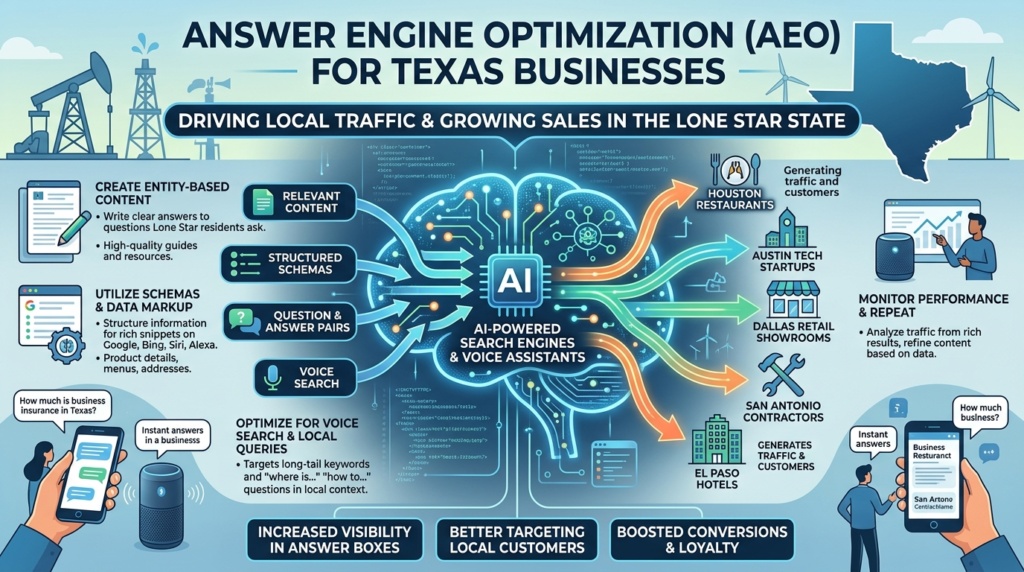
Answer Engine Optimization focuses on structuring content to be directly cited by artificial intelligence systems and conversational search interfaces. While traditional SEO targets blue link rankings, AEO prioritizes passage clarity and entity salience to secure visibility within Google AI Overviews. Generative Engine Optimization expands this to all LLM citations.
Jump to Passage. . .
📈 The Stat That Rewrites Everything You Know About Google AI Overviews
Texas businesses face a critical inflection point in 2026. The traditional search engine results page has transformed into a conversational interface. Google AI Overviews now appear in 60% of searches across the United States. Initial reactions from marketing departments predicted massive traffic losses across the board. Many feared a 34.5% drop in click-through rates for top-ranking pages. However, the reality looks entirely different for companies that chose to adapt rather than panic. Current data reveals that 63% of brands report Google AI Overviews actually created a positive impact on their organic traffic and overall digital visibility.
The secret lies in understanding Answer Engine Optimization. When a Texas enterprise optimizes for direct answers rather than just keyword rankings, the quality of incoming visitors changes dramatically. The Conductor Research Team discovered a massive shift in how these visitors behave. A staggering 97% of Chief Marketing Officers report that integrating AEO and GEO positively impacted their entire marketing funnel. This is not just a top-of-funnel brand awareness play. Traffic from AI systems tends to have exceptionally high intent. These visitors are converting at twice the rate of traditional organic traffic. Furthermore, they achieve these conversions in one-third the number of sessions.
The transition requires a fundamental shift in content production. You must move away from long, rambling introductions that frustrate users. Instead, focus on citation-dense content that provides immediate, undeniable value. Answer engines do not read like humans. They parse data looking for structured, factual density. If your website provides the clearest, most authoritative answer, the AI will pull your data and cite your brand as the source.
🤖 Why Does Traditional SEO Still Fail Even When You Follow Every Ranking Rule?
Many Texas companies invest heavily in traditional search rather than the new search optimization. They build backlinks, optimize meta tags, and ensure lightning-fast load times. Yet, their traffic stagnates. The global SEO services market is valued at $108.28 billion in 2026. North America dominates this space, holding 33.9% of the market share. Despite this massive financial investment, legacy playbooks are failing because user behavior has fundamentally changed.
The disruption began between 2024 and 2025. Generative AI platforms like ChatGPT reached 2.5 billion daily queries. Users realized they no longer needed to click through ten different websites to find an answer. They could simply ask an AI and receive a synthesized, highly accurate response. Traditional SEO focuses on getting a user to click a blue link. Answer Engine Optimization focuses on being the foundational source material the AI uses to generate its response.
When you ignore AEO and Generative Engine Optimization, you miss out on crucial LLM citations. AI models look for specific signals that traditional SEO often overlooks entirely. They need clear entity relationships and structured data. If your content lacks these elements, the AI will bypass your site. This results in severe zero-click losses. Your website might rank number one in the traditional blue links, but if an AI Overview pushes those links far below the fold, your visibility vanishes.
Texas businesses must realize that ranking is no longer enough. You must be cited. The Xamsor Analytics Team notes that AI-powered search is dramatically changing the overall search experience. You are no longer competing just with other local businesses. You are competing with the AI's ability to answer the question without ever sending the user to your website.
🎯 How to Double Conversion Rates by Capturing Higher-Intent AI Traffic
Capturing AI traffic requires a strategic layering approach. You do not abandon your foundational search strategies. Instead, you build upon them. Traditional SEO provides the structural integrity of your website. Answer Engine Optimization acts as the translation layer that makes your expertise digestible for machines.
When users interact with AI search features, they usually ask highly specific, long-tail questions. They are further down the purchasing funnel. A user searching for a broad term is simply browsing. A user asking an AI a complex, multi-part question is preparing to make a financial decision. This explains why AI traffic converts at twice the rate compared to standard organic visitors. They get their preliminary research done instantly via the AI summary. By the time they actually click your cited link, they are ready to engage.
| Metric | Traditional Organic Traffic | AI-Sourced Traffic (AEO/GEO) |
|---|---|---|
| User Intent Level | Broad to Moderate | Highly Specific |
| Conversion Rate | Baseline standard | 2x higher than baseline |
| Sessions to Convert | Multiple touchpoints | 1/3 the standard sessions |
| Content Requirement | Keyword density and backlinks | Passage clarity and entity salience |
To capture this high-intent traffic, Texas enterprises are aggressively shifting resources. Current enterprise data shows companies allocating 12% of their total digital budgets specifically to AEO and GEO initiatives. They recognize that capturing a smaller volume of highly qualified AI traffic is significantly more profitable than capturing a large volume of low-intent traditional traffic.
This budget reallocation directly supports the creation of Q&A structures within existing content. It funds the technical implementation of advanced Schema Markup. Most importantly, it allows brands to develop topical authority that AI systems inherently trust.
🚀 What Is the Explosive 34% CAGR of GEO and Why It Outpaces SEO?
Generative Engine Optimization represents the next massive frontier beyond Google. While AEO focuses heavily on Google AI Overviews and traditional voice assistants, GEO targets the broader ecosystem of large language models. This includes platforms like ChatGPT, Claude, and specialized industry AI tools utilized by B2B buyers.
The financial trajectory of this sector is staggering. The GEO services market was valued at a modest 886 million dollars in 2024. However, it is projected to reach 7.32 billion dollars by 2031. This represents a massive 34% compound annual growth rate. In contrast, the traditional SEO market is growing at a respectable, but much slower, 17.1% CAGR. This explosive growth indicates a fundamental shift in how information is retrieved online.
Why is GEO outpacing traditional search optimization? The answer lies in visibility mechanics. Traditional optimization drives rankings on a specific page. Answer Engine Optimization improves visibility within specific search engine features. Generative Engine Optimization ensures your content is actively referenced and cited by independent AI systems. The Sprintofy Strategy Team emphasizes that these three disciplines serve distinct but highly complementary purposes.
Texas businesses that operate in B2B sectors or highly technical fields benefit immensely from GEO. When a procurement officer asks an enterprise AI tool to compare vendors, that AI does not look at traditional search rankings. It looks for citation-dense content, original research, and clear entity relationships. If your company has optimized for GEO, your brand becomes the recommended solution directly within the chat interface.
💰 Why Are 97% of CMOs Shifting Budgets to Answer Engine Optimization?
The CMO Investment Report highlights a massive reallocation of corporate resources. The decision to move digital budgets into Answer Engine Optimization is not experimental. It is a calculated response to the absolute dominance of zero-click searches. When a user gets their answer directly from the search results page, traditional metric tracking breaks down. Clicks decrease, but brand influence actually increases if you are the cited source.
Chief Marketing Officers recognize that building topical authority is the only defense against AI disruption. You cannot trick a large language model with keyword stuffing. You must provide genuine, structured value. This requires a unified strategy that bridges technical infrastructure with high-level content creation.
The strategic budget shift primarily funds three core operational changes within marketing departments:
- Advanced Structured Data Implementation: Moving beyond basic organizational schema to complex, nested entity markup that explicitly defines relationships for AI parsers.
- Original Data Acquisition: Funding primary research, surveys, and proprietary data collection. AI models prioritize and cite unique, verifiable statistics over regurgitated content.
- Content Restructuring: Retrofitting existing high-value pages with clear, concise passage clarity to serve as direct answers for LLM extraction.
This investment creates a digital moat around the business. Competitors who rely solely on legacy tactics will find their traffic slowly eroding as AI Overviews consume more screen real estate. The brands that invest in AEO become the authoritative sources that power those very overviews.
⚠️ Which Mistakes Are Costing Brands Visibility in 60% of AI-Powered Searches?
Despite the clear financial benefits, many Texas companies struggle to adapt. They make critical errors that render their content completely invisible to AI systems. Understanding these common pitfalls is essential for maintaining digital relevance.
The most frequent mistake is siloing SEO from AEO and GEO. Marketing teams often treat these as entirely separate disciplines with different managers and budgets. This fragmentation leads to inefficient spending and conflicting strategies. A unified approach recognizes that the keyword foundations of traditional search directly support the Q&A structures needed for answer engines.
Another massive failure point is ignoring data quality and crawlability. Teams severely undervalue Schema Markup. They assume that if a human can read the page, an AI can understand it. This is entirely false. AI requires structured data to confidently parse and categorize information. Without it, your content is skipped over in favor of a competitor who provided clear machine-readable context.
Furthermore, companies fail when they attempt scalable content creation without proper AI workflows. Manual processes simply cannot match the speed required to maintain relevance in a GEO environment. However, fully automated content without human oversight lacks the unique perspective and authority that LLM citations require. The solution is adopting AI-optimized workflows where machines handle the structuring and formatting, while human experts provide the original insights and verify accuracy.
Finally, creating content that is not citation-dense is a critical error. Fluff, filler, and lengthy personal anecdotes dilute the factual density of a page. Answer engines look for high concentrations of facts, statistics, and definitive statements. If your content takes four paragraphs to answer a simple question, the AI will find another source.
🏆 How Winning Brands Optimize for Search Engines, Answer Engines, and AI Systems Together in 2026
The future of digital visibility is not about choosing between these three disciplines. It is about total integration. The Conductor Research Team and the Xamsor Analytics Team both point to a hybrid model as the absolute standard. You must build a technical foundation that satisfies traditional crawlers, structure your content to feed answer engines, and establish the broad authority required by generative AI.
In 2026, winning brands understand that each system feeds the others. High traditional rankings often provide the initial trust signals that allow an AI to evaluate a site. Strong AEO performance drives the high-intent traffic that boosts overall domain authority. Deep GEO integration ensures long-term brand survival as conversational interfaces become the primary way humans interact with the internet.
To achieve this total integration, Texas businesses should implement the following unified workflow:
- Identify the Entity Core: Determine the specific concepts, products, and services your brand must absolutely own in the digital space.
- Map the Question Landscape: Use traditional keyword research tools to find the exact phrasing users employ when asking about your core entities.
- Develop Citation-Dense Answers: Write definitive, 40-word responses to these questions, placing them strategically at the top of relevant pages.
- Apply Technical Schema: Wrap these answers and your broader content in advanced structured data to guarantee machine readability.
- Expand with Human Expertise: Follow the direct answers with deep, original insights that AI cannot generate on its own, securing your position as a primary source.
By adopting this integrated approach, you stop fighting against the rise of zero-click searches. Instead, you position your business to be the definitive answer that every engine, algorithm, and language model relies upon.
❓ Common Questions About Answer Engine Optimization
What is Answer Engine Optimization?
AEO is the process of structuring digital content so it can be easily understood, extracted, and cited by AI-powered search features and voice assistants.
How does AEO differ from traditional SEO?
While SEO focuses on ranking web pages in traditional search results, AEO focuses on providing direct, structured answers for AI overviews and zero-click searches.
Why is Schema Markup important for AEO?
Schema Markup provides machine-readable context. It tells AI engines exactly what your content means, drastically improving your chances of being cited as a source.
What is Generative Engine Optimization?
GEO targets visibility within large language models like ChatGPT. It ensures your brand and data are referenced when users ask conversational AI for recommendations.
How do I write citation-dense content?
Focus on clear entity relationships, remove filler words, and state facts directly. Answer the target question in the first sentence using precise, unambiguous language.
Will AI Overviews destroy my website traffic?
Not if you adapt. While low-intent browsing traffic may decrease, brands optimized for AEO report higher conversion rates from the AI traffic they do receive.
 SEO SOLUTIONS TEXAS BLOG
 SEO SOLUTIONS TEXAS BLOG
We are a results-driven digital marketing and AI SEO agency focused on increasing website traffic, improving online visibility, and generating high-quality leads for our clients.
🏆 Our Services:
Get Access To Our Texan Newsletter
Outrank. Outplay. Outperform.
We deliver elite Texas AI SEO and digital marketing strategies that amplify your presence across search engines, social media, and the platforms that matter most—so you get cited, attract ready-to-buy customers, and turn visibility into unstoppable brand growth.