Zero-Click Search Strategy: How to Win Visibility in 2026
What Is Zero-Click Search?
Zero-Click Search refers to search engine results pages (SERPs) where the user's query is answered directly on the page by features like Google AI Overviews, Featured Snippets, or Knowledge Panels, requiring no further action. In 2026, this phenomenon dominates 58.5% of queries, forcing brands to optimize for entity visibility and semantic completeness rather than just traditional website traffic.
Jump to Passage. . .
Why Zero-Click Search is Redefining SEO
Listen closely, because the way we used to do business on Google is changing faster than a tumbleweed in a tornado. For years, the deal was simple. You put up a digital billboard—your website—and Google drove traffic to your door. But in 2026, that highway has changed. Google isn't just the road anymore; it's becoming the destination. The search engine is answering your customers' questions right there on the spot, meaning they don't need to visit your shop to get what they need.
This shift to Zero-Click Search is the biggest disruption I have seen in decades. It is not just about losing clicks; it is about losing the opportunity to shake hands with your customer. When a potential client asks their phone a question and gets the answer without ever seeing your logo, you are invisible. We are moving from a game of traffic to a game of visibility. If you are still chasing blue links like it is 2020, you are fishing in a dry creek bed. We need to focus on structuring our content so these AI engines cannot help but cite us as the authority.
Dissecting the Rise of Zero-Click Searches
You cannot fix what you do not measure, and the numbers we are seeing this year are enough to make any marketer sweat. Recent data confirms that Zero-click searches have surged to 58.5%-69% of U.S. Google searches. That means nearly six out of ten people who search for something never leave the search results page. They get their answer and move on with their day.
The primary driver here is the aggressive rollout of AI tools. We are talking about Google AI Overviews and chatbots like ChatGPT that have fundamentally retrained users. Why dig through three different websites when a smart machine can summarize the facts in three seconds? This convenience is addictive. Generative AI is not just a feature anymore; it is the standard operating procedure for information retrieval.
We are seeing AI Overviews trigger on anywhere from 18% to 60% of queries, depending on the industry. For long-tail questions—the specific, detailed ones that used to be gold mines for niche businesses—the impact is even higher. According to the AI SEO Statistics report, traffic patterns are being rewritten as users get comfortable letting algorithms do the heavy lifting. If your content is not formatted to feed these bots, you are effectively invisible to the majority of your market.
The Role of Chatbots and LLMs
It is not just Google we have to worry about. Tools like Perplexity and ChatGPT are processing billions of queries that never even touch a traditional search engine. These platforms act like personal research assistants. They read the web, digest the information, and serve it up on a silver platter. If your brand isn't part of that synthesized answer, you don't exist in the conversation.
Impact of Zero-Click on Online Visibility
Let's talk brass tacks about what this does to your bottom line. The convenience for the user comes at a steep cost for website owners. We are witnessing a massive reduction in traditional search volume, with some sectors seeing a drop of 25% as users shift to AI alternatives. That is a quarter of your potential audience vanishing before they even get a chance to see your headline.
The click-through rates (CTR) paint an even starker picture. Organic CTR has dropped by 61% with AI Overviews active. Think about that. Even if you rank number one, you are getting less than half the visitors you used to. The paid side isn't safe either, with paid CTR down nearly 68% in some cases. The real estate on the screen is shrinking, and the AI summary is hogging the spotlight.
This is a structural change in the economy of the internet. Informational sites and news publishers are taking the hardest hits, but e-commerce isn't immune. When a user asks for the "best heavy-duty work boots," and the AI lists the top three brands with pros and cons right there, the user might just head directly to Amazon or a local retailer, bypassing your review site entirely. The State of AI Search Guide highlights how this shift forces us to rethink our entire approach to acquisition. We have to stop counting door swings and start counting how many people know our name.
Tactical Shifts for SEO in a Zero-Click World
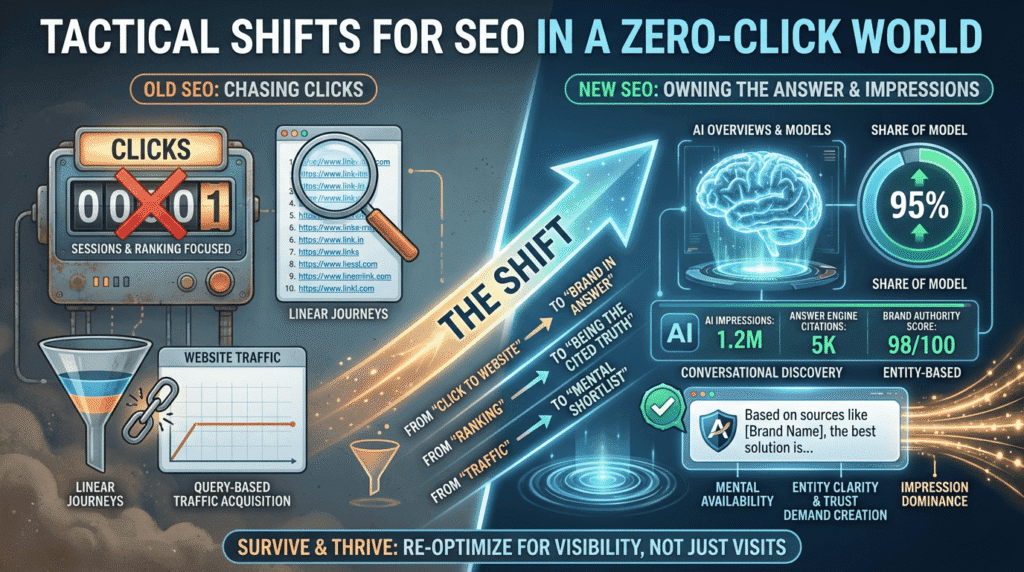
So, how do we survive when the clicks dry up? We have to change our metrics. We need to start valuing impressions and SERP features as much as we used to value sessions. It is about "Share of Model"—how often your brand is cited by the AI as the source of truth.
Focus on Visibility Metrics
In this new world, visibility is the new currency. You need to track how often your brand appears in AI summaries, Knowledge Panels, and Featured Snippets. If a user sees your company name associated with the answer to their problem, that is a branding win. It builds trust. When they are finally ready to buy, they will remember the expert who gave them the answer, not the one who tried to force a click.
Building Reference-Quality Pages
To get cited, you need to be the encyclopedia, not the brochure. We call these "Reference Quality Pages." These are deep, authoritative resources that cover a topic so thoroughly that the AI has no choice but to use you as a source. This is where E-E-A-T (Experience, Expertise, Authoritativeness, and Trustworthiness) becomes your best friend. You need to provide unique data, original research, and contrarian viewpoints that the AI cannot find anywhere else.
Your content must pass the "Island Test." If your page was the only resource available on a desert island, would it completely answer the user's question? If not, the AI will look elsewhere. Implementing structured data and schema markup is like handing the AI a business card that tells it exactly who you are and what you do. The AI Overviews Strategy emphasizes that semantic clarity is non-negotiable. If the bot can't parse your data, it won't use it.
| Feature | Traditional SEO | Zero-Click (GEO) |
|---|---|---|
| Primary Goal | Drive Traffic to Site | Earn Citations & Brand Mention |
| Content Style | Long-form, keyword-heavy | Concise, fact-dense, structured |
| Success Metric | Clicks & Conversions | Share of Voice & Impressions |
Adapting to AI Overviews and LLMs
The rise of Large Language Models (LLMs) requires us to rethink how we write. We are no longer writing just for humans; we are writing for the machines that serve humans. This means we need to focus on "Information Gain." You cannot just regurgitate what everyone else is saying. You need to bring something new to the potluck—a fresh statistic, a unique expert quote, or a proprietary process.
AI Overviews thrive on consensus but crave novelty. If you can provide the novelty that validates the consensus, you win. This is where Generative Engine Optimization (GEO) comes into play. It is the art of optimizing your content to be the preferred source for generative AI responses. This involves using clear headings, concise answer paragraphs (like the one at the top of this article), and logical structuring that makes extraction easy.
We must also consider the platform. Optimizing for Google's Gemini might look different than optimizing for ChatGPT or Claude. However, the common denominator is authority and clarity. According to SEO Trends, the brands that adapt to these AI-driven environments by providing structured, high-confidence data are seeing a stabilization in their visibility, even as raw click counts fluctuate.
Future-Proofing Your Brand: Beyond Traditional SEO
Looking ahead, the landscape is only going to get more complex. By the end of 2026, we expect AI agents and multimodal search to dominate. People won't just type; they will talk to their glasses, show their phone camera a broken part, or ask their car for advice. Gartner predicts a 25% drop in search engine traffic to websites by 2026, and that is just the beginning.
To future-proof your business, you need to be everywhere. You need to be optimizing for Perplexity, Claude, and Gemini alongside Google. This means your digital footprint needs to be diverse. Video content, podcasts, and high-quality images are essential because multimodal AI looks at everything, not just text. If a user asks for a video on how to fix a leaking pipe, and you only have a blog post, you lose.
The Rise of AI Agents
Soon, users will have personal AI agents that perform tasks for them. "Book me a hotel in Austin" won't result in a list of links; it will result in a booked room. If your hotel isn't in the AI's trusted database, you are not getting that booking. This requires technical SEO on steroids—APIs, schema, and real-time inventory data must be accessible to these agents.
Leveraging Strategic Links and Insights
Strategy without data is just guessing. You need to keep your finger on the pulse of these changes. We know that reference-quality pages with high E-E-A-T scores are winning citations. We know that zero-click doesn't mean zero value if you adjust your attribution models.
Marketers need to adopt multi-touch attribution that credits zero-click impressions. If someone sees your brand in an AI summary and searches for you directly three days later, that original impression did the heavy lifting. The Zero-Click Redefines Marketing report suggests that brand recall is becoming a critical metric. You want to be the brand that people ask for by name, bypassing the generic search entirely.
- Invest in Original Research: Be the primary source of data that others cite.
- Optimize for Entities: Ensure Google's Knowledge Graph understands who you are and what you offer.
- Diversify Platforms: Don't rely solely on Google; ensure visibility on vertical search engines and social platforms.
- Focus on User Intent: Solve the problem faster and better than the AI summary can.
The New Rules of Engagement for 2026
We are standing on the edge of a new frontier. The days of easy traffic from blue links are behind us, but the opportunity to build genuine authority has never been greater. Zero-Click Search is not a death knell; it is a filter. It filters out the noise and the middlemen, leaving only the true experts standing.
Your job now is to be that expert. Build content that is so good, so dense with value, and so clearly structured that the smartest machines on the planet have no choice but to quote you. It is about respect—respecting the user's time and respecting the intelligence of the new search engines. If you can do that, you won't just survive the zero-click era; you will own it.
Common Questions About Zero-Click Search
What is the main cause of zero-click searches?
The primary driver is AI-generated answers and SERP features like Knowledge Panels that provide immediate information, removing the need for users to visit a website.
Does zero-click search hurt my SEO?
It reduces traditional traffic but offers high-value brand visibility. Optimizing for it ensures you are cited as an authority, which builds trust and long-term brand recognition.
How do I track zero-click performance?
Focus on impressions, SERP feature appearances, and brand search volume in Google Search Console rather than just clicks and sessions.
Can I optimize for Google AI Overviews?
Yes. Use structured data, answer questions directly in the first paragraph, and ensure your content has high E-E-A-T signals to be selected as a source.
Will traditional SEO die completely?
No, but it is evolving. Transactional and deep-research queries still drive clicks, while simple informational queries are increasingly satisfied directly on the results page.
 SEO SOLUTIONS TEXAS BLOG
 SEO SOLUTIONS TEXAS BLOG
We are a results-driven digital marketing and AI SEO agency focused on increasing website traffic, improving online visibility, and generating high-quality leads for our clients.
🏆 Our Services:
Get Access To Our Texan Newsletter
Outrank. Outplay. Outperform.
We deliver elite Texas AI SEO and digital marketing strategies that amplify your presence across search engines, social media, and the platforms that matter most—so you get cited, attract ready-to-buy customers, and turn visibility into unstoppable brand growth.