E-E-A-T Signals for Entity Authority: The 2026 Guide for Texas Businesses
What Are E-E-A-T Signals for Entity Authority?
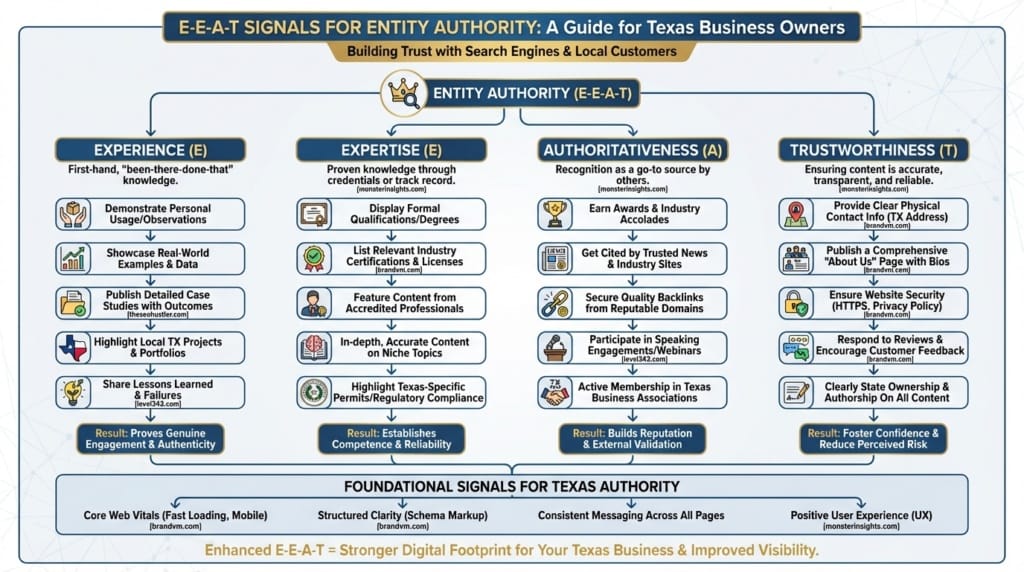
E-E-A-T Signals for Entity Authority represent verified digital trust markers that Large Language Models use to select credible sources. By demonstrating Experience, Expertise, Authoritativeness, and Trustworthiness through the Entity-Identity Protocol, businesses establish verifiable credentials within Knowledge Graphs, directly influencing their visibility in Generative Engine Optimization.
Jump to Passage. . .
Why Texas Businesses Must Shift from Keywords to Verified Digital Trust
Texas business owners know that a firm handshake and a solid reputation drive more revenue than a flashy billboard. The digital equivalent of that handshake is changing rapidly. For years, local companies in Dallas, Houston, and Austin relied on traditional keyword stuffing and backlink counting to dominate local search results. That era is officially over. A massive paradigm shift is occurring as artificial intelligence reshapes how consumers find products, services, and B2B partners.
Search engines are no longer simple directories that match keywords to web pages. They have evolved into sophisticated recommendation engines that prioritize verifiable facts and established reputations. If your company lacks a verified digital footprint, artificial intelligence will simply ignore you. Building E-E-A-T Signals for Entity Authority is no longer an optional marketing tactic. It is a fundamental operational requirement for surviving the transition to AI-mediated discovery.
This comprehensive guide details the exact strategies Texas businesses must implement to survive and thrive. By mastering the Entity-Identity Protocol and leveraging Global Trust Graphs, your business can secure its position as the definitive authority in its industry. We will explore how to build these essential trust signals, optimize user engagement, and unlock unprecedented conversion rates through targeted AI traffic.
Achieve Unmatched AI Visibility with E-E-A-T
The transition toward Generative Engine Optimization (GEO) represents the most significant shift in digital marketing since the invention of the search engine itself. Traditional search volume is predicted to drop by 25% by 2026 due to migration to AI-powered answer engines. This staggering statistic underscores the urgency of adapting your strategy immediately. As users increasingly rely on Large Language Models (LLMs) like ChatGPT, Perplexity, and Google's AI Overviews for direct answers, the old rules of search visibility no longer apply.
In the past, a well-optimized page with a high keyword density could secure a top spot in search results. Today, LLMs do not read web pages like humans do. They fragment text into small passages, verify the identity and credentials of the author against external sources, and then decide whether to cite you or a competitor. This process relies heavily on E-E-A-T Signals for Entity Authority. AI systems prioritize trustworthy sources that demonstrate true expertise and lived experience.
To succeed in this new environment, your content must become a trusted source that AI systems actively choose to cite. This requires a fundamental shift from keyword-based optimization to intent-driven, verifiable authority building. You must prove to the algorithms that your business is a legitimate, recognized entity within its specific field. This is where E-E-A-T as the #1 GEO Ranking Factor in 2026 becomes critical for maintaining visibility.
Building this visibility requires consistent, high-quality signals across the entire web. A single optimized blog post is insufficient if the author lacks verifiable credentials or if the business has no presence on reputable industry platforms. The algorithms synthesize consensus from high-authority sources to determine the "Ground Truth" for any given topic. Your goal is to become that Ground Truth for your specific niche in Texas.
The Entity-Identity Protocol: Your Secret Weapon
The Entity-Identity Protocol is the systematic process of connecting your brand, your key personnel, and your content to verifiable external databases. It is the mechanism by which you prove your existence and expertise to AI systems. This protocol emerges as the 2026 core for GEO, with AI cross-referencing credentials to establish verifiable E-E-A-T Signals for Entity Authority. Without a robust Entity-Identity Protocol, your business remains an undefined entity, losing visibility in AI-mediated search.
Implementing this protocol involves establishing clear connections between your website and authoritative external platforms. For individual experts within your company, this means maintaining active, detailed profiles on platforms like LinkedIn and academic registries like ORCID. For the business itself, it involves securing patents, publishing original research, and earning mentions in reputable news outlets and industry publications. These connections build a comprehensive Global Trust Graph that AI models use to verify your legitimacy.
The impact of this strategy is profound and measurable. Data shows that strategies leveraging external authority like citations and quotations boost AI response visibility by up to 40%. This proves that verifiable entity identity drives LLM preference far more effectively than traditional on-page optimization techniques. When an AI engine names your brand in its answer, it delivers an implicit endorsement that no organic listing could ever match.
| Metric | Traditional SEO Focus | Entity-Identity Protocol Focus |
|---|---|---|
| Authority Signal | Backlink Volume | Brand Web Mentions & Citations |
| Content Strategy | Keyword Density | Original Data & Expert Synthesis |
| Author Verification | Simple Byline | ORCID, LinkedIn, Patent Linkage |
| Evaluation Scope | Domain-Level Metrics | Web-Wide Reputation (Global Trust Graphs) |
To leverage the Entity-Identity Protocol effectively, Texas businesses must audit their current digital footprint. Identify where your key personnel are mentioned online and ensure those mentions link back to verified profiles. If your CEO is quoted in a local Dallas business journal, ensure their name is associated with their LinkedIn profile and your company's official website. This interconnected web of data points is what builds true entity authority.
Optimize User Engagement with E-E-A-T
While external verification is crucial, on-site user behavior remains a powerful indicator of E-E-A-T Signals for Entity Authority. When users land on your website and immediately leave, it signals to search engines that your content did not meet their needs or expectations. Conversely, high engagement metrics demonstrate that real humans find your content valuable, authoritative, and trustworthy. This behavioral data directly influences your Page Quality (PQ) rating.
One of the most critical metrics to monitor is your bounce rate. An ideal bounce rate below 40% signals strong E-E-A-T via user engagement, providing a clear benchmark for measuring trust improvements. When users stay on your site, read multiple pages, and interact with your content, they validate your expertise. You can learn more about optimizing these behavioral metrics by reviewing EEAT for Business: The Real Trust Signals AI Search Engines Want to ensure your site architecture supports deep engagement.
To achieve this optimal bounce rate, your content must be structured for immediate clarity and comprehensive depth. AI Overviews and human readers alike prefer an "answer-first" architecture. The first sentence of each section should directly answer the question posed in the heading. Do not bury the lead under paragraphs of generic introduction. Provide the value immediately, and then use the subsequent text to elaborate, provide context, and demonstrate your unique experience.
Monitoring user engagement requires the right tools and a systematic approach. Texas businesses should regularly analyze their performance data to identify areas for improvement.
- Use Google Search Console to identify pages with high impressions but low click-through rates, indicating a mismatch between user intent and search appearance.
- Analyze dwell time metrics to determine if users are actually reading your long-form content or simply skimming and leaving.
- Implement interactive elements like original data tables, infographics, or comparison charts to increase time-on-page and provide verifiable value.
- Ensure your content is refreshed regularly, ideally within the last quarter, with a visible "Last Updated" date to signal freshness to both users and AI systems.
Furthermore, the technical performance of your website plays a significant role in user engagement. A slow-loading site or a poor mobile experience will artificially inflate your bounce rate, regardless of how authoritative your content might be. Ensure your technical infrastructure supports the high-quality E-E-A-T signals you are working so hard to build.
Unlocking Conversion Potential with AI Traffic
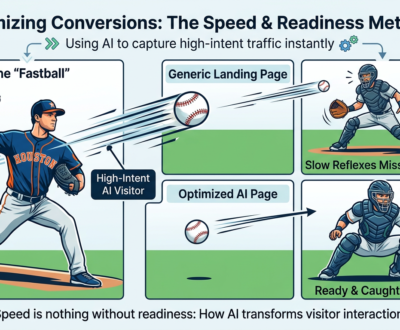
The ultimate goal of building E-E-A-T Signals for Entity Authority is not just visibility, but revenue generation. As search behavior shifts toward AI-powered answer engines, the quality of the traffic you receive will change dramatically. Users who engage with AI assistants are often further along in the buying cycle. They are seeking specific, nuanced answers to complex problems, not just browsing generic keywords.
This shift presents a massive opportunity for businesses that have established strong entity authority. Recent data reveals that AI visitors convert 4.4x better than traditional organic traffic. This extraordinary conversion rate highlights the revenue stakes of E-E-A-T-optimized entity strategies in 2026 SEO pivots. When an AI system recommends your Houston-based logistics firm as the definitive expert in supply chain management, the resulting leads are highly qualified and primed for conversion. You can explore the full implications of this shift in the report Critical Stats Proving Your 2026 SEO Strategy Must Change Now to understand the financial impact.
To capture and convert this high-value traffic, your website must be designed to synthesize complex information quickly. AI systems prefer content that is structured for easy extraction. Using tools like the Semrush Authority Score or Ahrefs can help you benchmark your progress against competitors, but the true test is how well your content answers specific user queries. You must move beyond generic service pages and create deep, authoritative resources that address the specific pain points of your target audience.
Capturing this high-converting AI traffic requires a deliberate, multi-step strategy. Texas business owners must implement a systematic approach to ensure their entity authority translates into tangible business results.
- Audit your current brand mentions using enterprise monitoring platforms like NetRanks to identify gaps in LLM perceptions of your business.
- Develop an aggressive digital PR strategy focused on securing citations and mentions in authoritative industry publications, not just acquiring low-quality backlinks.
- Structure your website content using FAQ and HowTo schema markup to make it easily interpretable by AI extraction systems.
- Create comprehensive, data-driven resources that serve as the definitive "Ground Truth" for specific topics within your industry.
- Continuously monitor AI-generated mentions and adjust your Entity-Identity Protocol based on how LLMs are currently categorizing your brand.
By focusing on these strategic steps, you position your business to capture the most valuable segment of the digital market. AI traffic is not just about volume, it is about intent and trust. When you become the recommended entity, conversion naturally follows.
Navigating the Future with Trust and Verification
As we look toward the future of digital marketing in 2026 and beyond, it is clear that the landscape will be dominated by those who can prove their legitimacy. The era of synthetic authority, built on manipulated link metrics and keyword stuffing, is over. The integration of helpful content systems into core algorithms has permanently shifted the focus from manipulation to verification. E-E-A-T Signals for Entity Authority are now the foundational requirement for digital survival.
Knowledge Graphs will continue to evolve, becoming increasingly sophisticated in their ability to map relationships between entities, authors, and concepts. Businesses that actively manage their presence within these graphs will thrive, while those that remain undefined will lose visibility entirely. The Entity-Identity Protocol is not a one-time project, it is an ongoing operational discipline that requires constant attention and refinement.
Texas business leaders must shift their marketing budgets from high-volume, low-quality content production to high-authority entity verification. It is no longer about publishing ten mediocre blog posts a month. It is about publishing one definitive, expert-level resource and ensuring that resource is cited, referenced, and recognized by the broader industry. Quality, accuracy, and verifiable trust are the new currencies of the digital economy.
The businesses that succeed will be those that embrace transparency and actively work to verify their expertise. Encourage your team members to publish original research, speak at industry conferences, and maintain robust professional profiles. Every verified external connection strengthens your Global Trust Graph and solidifies your position as a recognized authority.
Securing Your Brand's Legacy in the AI Answer Era
The transition to AI-mediated search represents a fundamental restructuring of how information is discovered and trusted online. For Texas business owners, adapting to this new reality is critical for long-term growth and sustainability. By prioritizing E-E-A-T Signals for Entity Authority, you move beyond the mechanical tactics of traditional SEO and build a resilient, verifiable digital reputation.
We have explored the critical importance of the Entity-Identity Protocol, the necessity of maintaining high user engagement metrics, and the massive conversion potential of AI-driven traffic. The data is clear: search volume is shifting, AI visitors convert at significantly higher rates, and external authority citations are the key to unlocking visibility. The strategies outlined in this guide provide the blueprint for establishing your business as the definitive "Ground Truth" in your industry.
Are you prepared to audit your current digital footprint and begin the meticulous work of building your Global Trust Graph? The algorithms are already evaluating your brand's legitimacy. The time to establish your verified entity authority is now, before the competition secures the AI recommendations that will define the next decade of digital commerce.
Common Questions About E-E-A-T Signals for Entity Authority
What exactly is an entity in SEO?
An entity is a distinct, recognizable concept, person, or business that AI systems can uniquely identify and map within a Knowledge Graph using verified data points.
How do I start building entity authority?
Begin by claiming and optimizing your business profiles, linking key personnel to ORCID and LinkedIn, and securing mentions in authoritative industry publications to build trust.
Does E-E-A-T replace traditional SEO?
It does not replace technical SEO, but it shifts the focus from keyword density and link volume to verifiable expertise, external citations, and user engagement metrics.
How long does it take to establish E-E-A-T?
Building genuine E-E-A-T Signals for Entity Authority is a long-term process that compounds over months and years through consistent accuracy, citations, and off-site recognition.
Why is my bounce rate important for E-E-A-T?
A bounce rate below 40% signals to search engines that real users find your content valuable and trustworthy, which directly improves your overall Page Quality rating.
Can small local businesses compete in GEO?
Yes. Small businesses can dominate local GEO by establishing deep, niche-specific expertise and securing hyper-relevant local citations that larger, generic brands cannot easily replicate.
 SEO SOLUTIONS TEXAS BLOG
 SEO SOLUTIONS TEXAS BLOG
We are a results-driven digital marketing and AI SEO agency focused on increasing website traffic, improving online visibility, and generating high-quality leads for our clients.
🏆 Our Services:
Get Access To Our Texan Newsletter
Outrank. Outplay. Outperform.
We deliver elite Texas AI SEO and digital marketing strategies that amplify your presence across search engines, social media, and the platforms that matter most—so you get cited, attract ready-to-buy customers, and turn visibility into unstoppable brand growth.