Unleashing AI Search Visibility with SameAs Identity Mapping
What Is SameAs Identity Mapping in SEO?
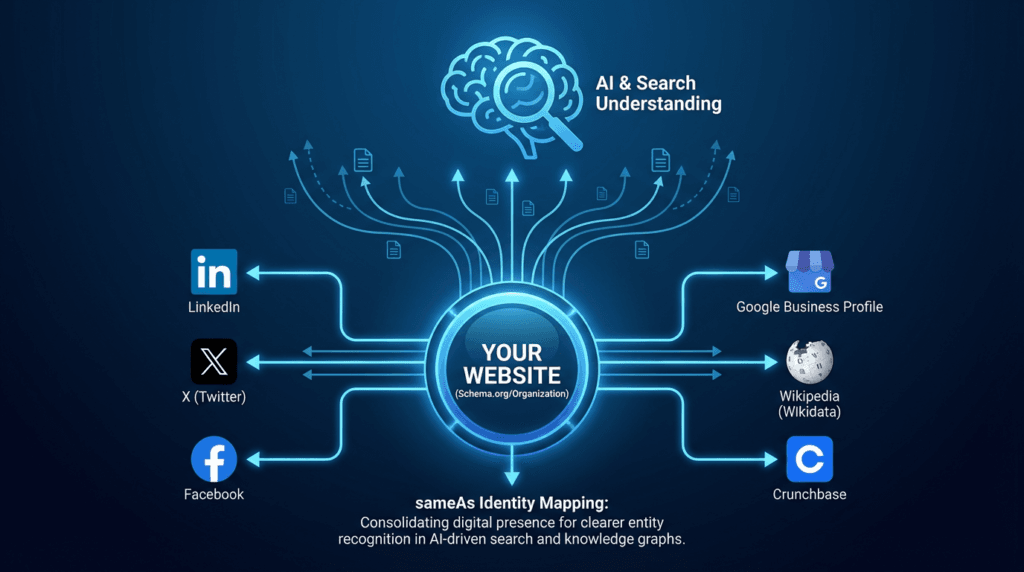
SameAs identity mapping is a schema.org property that connects your digital content to authoritative external sources like Wikidata and Wikipedia. By establishing these explicit relationships, you help AI search engines like Google and ChatGPT disambiguate your brand, validate your entity's existence, and confidently cite your content in generated answers.
Jump to Passage. . .
🤷♂️ How SameAs Enhances Your Brand's Digital Footprint
Search engines have evolved from matching keywords to understanding real-world concepts. The schema.org property known as sameAs acts as the digital bridge between your website and the rest of the structured web. It tells search algorithms exactly who you are by pointing to trusted third-party verification.
When you implement sameAs correctly, you are essentially claiming your territory in the Knowledge Graph. Without this mapping, AI systems must guess if your "Acme Corp" is the roadrunner-catching company or the Texas-based logistics firm. By linking your Organization schema to a specific Wikidata entry or Crunchbase profile, you remove that guesswork entirely.
According to Sympler, traditional SEO assumed rankings were just blue links, but AI systems now rank entities and sources. If these systems cannot reliably resolve queries to your brand, your content quietly disappears from answer boxes and conversational results. This makes sameAs not just a technical detail, but a fundamental requirement for modern visibility.
🔗 Boosting AI Search Visibility with Seamless Entity Disambiguation
Entity disambiguation is the process of clarifying the meaning of a specific term or concept. In the context of AI SEO, it is the difference between being cited as an authority or being ignored completely. When multiple pages or domains reference similar names, AI models face confusion and may exclude both from their reasoning chains to avoid hallucinations.
Research indicates that AI-driven discovery has changed what visibility means. With platforms like ChatGPT handling billions of prompts, brands must be understood as authoritative entities to appear in summaries. SameAs mappings eliminate ambiguity by pointing to a single authoritative source, ensuring that when an AI processes your content, it attributes it to the correct entity node.
Consider the impact on local search. If you operate a business in Dallas, linking your LocalBusiness schema to your specific Google Maps CID and local directory profiles via sameAs helps search engines distinguish you from similarly named businesses in Houston or Austin. This precision is what allows AI Overviews to confidently recommend your services for location-specific queries.
🛠️ Implementing SameAs: From Concept to Practice
Technical implementation of sameAs requires precision within your JSON-LD structured data. This property should be added to core entity schemas such as Organization, Person, Product, and LocalBusiness. The goal is to provide stable, canonical URLs that point to verified external profiles.
To maximize credibility, you must choose your targets carefully. Linking to a low-authority social profile is less effective than linking to a structured knowledge base. Below is a breakdown of high-impact targets for different entity types.
| Entity Type | Primary Targets | Strategic Value |
|---|---|---|
| Organization | Wikidata, Crunchbase, LinkedIn | Establishes corporate identity and Knowledge Graph connection |
| Person | ORCID, LinkedIn, Personal Website | Validates author expertise and E-E-A-T signals |
| Product | Manufacturer URL, GTIN/UPC Database | Distinguishes specific models and versions |
Effective implementation goes beyond just adding links. You must ensure that every URL you include resolves correctly and contains consistent information about your entity. Entity-linking is becoming less optional by the day, as it bridges your content to how search engines organize information. A broken sameAs link can signal to search engines that your entity data is unreliable or outdated.
🏗️ Building Your Entity Model with a Pillar and Spoke Strategy
Simply tagging your homepage is not enough. To truly dominate AI search, you need to structure your content to reinforce your entity's authority. This involves designating one canonical pillar page per entity and supporting it with a network of related content.
The hub-and-spoke model works by creating a central source of truth on your website. This hub page should define the entity clearly and include the primary sameAs markup. Surrounding this hub, you create "spoke" content—articles, case studies, and guides—that link back to the hub using consistent anchor text.
- Create a Pillar Page: Develop a comprehensive page that serves as the definitive guide for your entity or core topic.
- Link Intentionally: Ensure all supporting articles link back to this pillar to signal its importance to search crawlers.
- Avoid Cannibalization: Merge competing pages that target the same intent to prevent diluting your entity's signal.
- Standardize Terminology: Use consistent naming conventions across all pages to reinforce the entity's identity.
For example, a Texas SaaS company specializing in logistics might have a pillar page for "Last-Mile Delivery Software" linked to the Wikidata concept for logistics. Blog posts about "Delivery Route Optimization" and "Fleet Tracking" would serve as spokes, linking back to the main software page to strengthen its topical authority.
🧠 Mastering Semantic Coverage and Strengthening Entity Relationships
Semantic coverage refers to how well your content addresses the related concepts and entities connected to your primary topic. AI systems use these relationships to determine if a piece of content is comprehensive and trustworthy. If you are writing about "SEO," an AI expects to see related entities like "backlinks," "keywords," and "content marketing."
To achieve this, you need to identify the entities that naturally co-occur with your main topic. Tools like MarketMuse or InLinks can help surface these connections. Once identified, you should weave these related entities into your content and connect them using internal links and schema markup.
Using semantic HTML tags like <article> and <section> further helps search engines understand the hierarchy and relationship of concepts within your page. By explicitly defining these relationships, you make it easier for AI models to parse your content and extract the specific answers they need to fulfill user queries.
🌐 Aligning External Knowledge Graphs for Unmatched Entity Consistency
Your website does not exist in a vacuum. AI search engines constantly cross-reference your site's data against public knowledge repositories. Consistency between your site and these external sources is non-negotiable for entity resolution.
Public knowledge graphs like Wikidata contain hundreds of billions of facts. If your schema markup claims one thing, but your Crunchbase profile says another, you create data conflict. This conflict reduces the confidence score AI systems assign to your entity, making them less likely to cite you.
To ensure alignment, follow this maintenance routine:
- Sync Attributes: Ensure your description, founding date, and contact info match across your site, Google Business Profile, and Wikidata.
- Verify Links: Regularly check that all sameAs URLs resolve to active, correct profiles.
- Monitor Knowledge Panels: Watch for changes in your Google Knowledge Panel, as these often reflect shifts in how Google understands your entity.
- Audit Schema: Use automated tools to validate your markup against current schema.org standards.
According to Stellar SEO, the Google Knowledge Graph allows the search engine to connect people, brands, and concepts across queries. By aligning your internal data with this external graph, you make your content "groundable," giving AI systems the verification they need to trust your information.
🛡️ Enhancing E-E-A-T Signals for Higher AI Trust and Authority
Experience, Expertise, Authoritativeness, and Trustworthiness (E-E-A-T) are no longer just abstract concepts for human raters. They are tangible signals that can be reinforced through structured data. SameAs plays a pivotal role here by mathematically proving who is behind the content.
For individual authors, using sameAs to link a Person entity to a verified LinkedIn profile or university bio page provides concrete evidence of expertise. It transforms a byline from simple text into a verified entity with a history and reputation. This is particularly crucial for YMYL (Your Money or Your Life) topics where trust is paramount.
For organizations, linking to industry associations, Better Business Bureau profiles, or government registration pages helps establish legitimacy. These third-party validations act as digital endorsements that AI systems can verify independently, significantly boosting your entity's authority score.
📊 Evaluating Success: Measuring the Entity SEO Impact
Measuring the impact of sameAs identity mapping requires looking beyond traditional keyword rankings. You must track how well your entity is understood and cited by AI systems. This involves monitoring schema validity, knowledge graph presence, and AI answer frequency.
Start by auditing your schema implementation. Tools like the Schema.org Entity Auditor can help you identify missing fields or broken sameAs links. Your goal should be 95%+ validity for critical entity types. A technically flawless implementation ensures that search engines encounter zero friction when parsing your identity.
Next, monitor your presence in AI-generated answers. Perform searches for your brand and key products on platforms like ChatGPT, Perplexity, and Google AI Overviews. Are you mentioned? Is the information accurate? Are the citations pointing to your preferred pages? These qualitative checks provide insight into how well your entity strategy is translating into visibility.
🔮 Future Trends in Entity-First SEO and AI Search Evolution
The trajectory of search is clear: we are moving from strings to things. Keywords are becoming secondary to entities and relationships. As AI models become more sophisticated, their reliance on structured knowledge graphs will only increase.
We are witnessing the convergence of SEO, Generative Engine Optimization (GEO), and Answer Engine Optimization (AEO). In this new hierarchy, entity clarity is the unifying principle. Brands that invest in building robust entity models today will be the ones that dominate the AI-mediated web of tomorrow.
Forward-thinking teams are already automating this process, generating JSON-LD entity markup at build time to ensure consistency across thousands of pages. They are proactively building Wikipedia and Wikidata entries to establish authoritative external anchors. By treating your brand as a data entity, you future-proof your visibility against the volatility of algorithm updates.
❓ Common Questions About sameAs Identity Mapping
What is the main benefit of sameAs?
The primary benefit is disambiguation. It tells search engines exactly which real-world entity your content refers to, preventing confusion with similarly named brands or people and ensuring accurate Knowledge Graph placement.
Can I use social media profiles for sameAs?
Yes, you can and should. verified profiles on LinkedIn, Twitter (X), Facebook, and YouTube are excellent targets. They help establish your digital footprint and confirm your brand's active presence across the web.
How does sameAs affect AI Overviews?
AI Overviews rely on trusted entities to generate answers. By using sameAs to validate your identity and authority, you increase the likelihood of your content being selected as a source for these AI-generated summaries.
Is Wikidata better than Wikipedia for sameAs?
Wikidata is often better for technical SEO because it provides machine-readable unique identifiers (Q-numbers). While Wikipedia is excellent for authority, Wikidata is the native language of the Knowledge Graph.
Do I need sameAs for Local SEO?
Absolutely. Linking your LocalBusiness schema to your Google Maps CID and local directory listings helps search engines understand your specific location and service area, boosting visibility in local pack results.
How often should I update sameAs links?
Review them quarterly or whenever your external profiles change. Broken links degrade trust, so ensuring they always point to active, accurate pages is critical for maintaining your entity's credibility.
 SEO SOLUTIONS TEXAS BLOG
 SEO SOLUTIONS TEXAS BLOG
We are a results-driven digital marketing and AI SEO agency focused on increasing website traffic, improving online visibility, and generating high-quality leads for our clients.
🏆 Our Services:
Get Access To Our Texan Newsletter
Outrank. Outplay. Outperform.
We deliver elite Texas AI SEO and digital marketing strategies that amplify your presence across search engines, social media, and the platforms that matter most—so you get cited, attract ready-to-buy customers, and turn visibility into unstoppable brand growth.