Topical Authority: The 2026 Playbook for Dominating AI Search & Business Visibility
What Is Topical Authority?
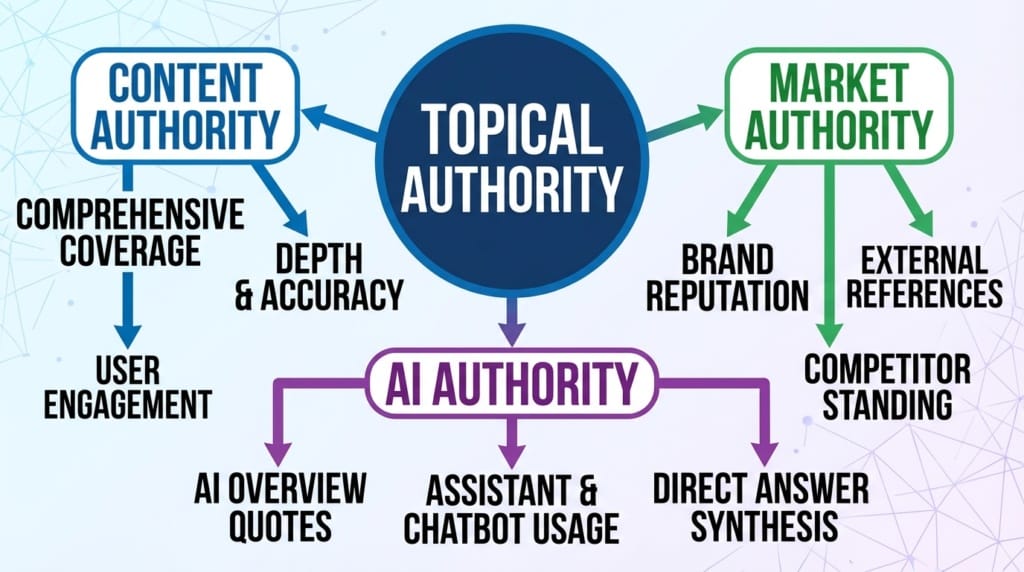
Topical authority is a search engine ranking signal that measures a website's depth of expertise and credibility within a specific subject area. Unlike individual keyword targeting, it evaluates whether a domain covers a topic comprehensively enough to be considered a trusted resource by algorithms like Google and AI engines such as ChatGPT and Perplexity.
Jump to Passage. . .
🤠 Staking Your Claim: Why Topical Authority Is the New Digital Real Estate
In the vast expanse of the Texas business landscape, reputation has always been currency. If you needed a commercial roofer in Dallas or a logistics partner in Houston, you didn't just pick the loudest voice; you picked the one everyone knew was the expert. In 2026, the digital world operates on the exact same principle, but the town square has been replaced by Large Language Models (LLMs) and the word-of-mouth gossip is now algorithmic data processing.
For years, businesses chased keywords like wildcatters chasing oil, drilling shallow wells hoping for a quick gusher. That strategy is dry. Today, Topical Authority is about owning the mineral rights to the entire field. It is not enough to rank for a single term; you must prove to the search engines—and the new wave of AI agents—that you are the definitive source of truth for your entire industry vertical.
This guide is your blueprint for building that authority. We are moving beyond simple search rankings into an era where your business must be "understood" by machines to be recommended to humans. Whether you are running a supply chain in the Panhandle or a tech startup in Austin, the rules of engagement have shifted from being found to being cited.
🚀 Elevate Visibility with AI-Driven Strategies
The transition from traditional SEO to Generative Engine Optimization (GEO) is as significant as the shift from steam to diesel. Traditional SEO was about convincing a search engine to list you on a page. GEO is about convincing an AI model that your brand is a fundamental entity related to a user's problem. If an AI agent like Claude or Gemini doesn't recognize your brand as an authority, you don't just lose a ranking position; you become invisible.
In this new environment, we stop obsessing over keyword density and start focusing on entity management. This means teaching the AI who you are, what you do, and why you are the expert. According to Decodes Future, agencies are pivoting to measure success through mention rates and sentiment analysis rather than vertical rankings. This shift is driven by the migration to zero-click searches, where the answer is provided directly on the screen, and the user never visits a website unless the source is compelling enough to warrant a deep dive.
For a Texas business owner, this means your digital footprint must be impeccable. You are not just optimizing for Google's crawler; you are optimizing for an inference engine that reads, understands, and synthesizes information. You want to be the brand that ChatGPT mentions when a user asks, "Who is the most reliable HVAC contractor in San Antonio?" achieving that requires a deliberate strategy of citation building and semantic relevance.
🧠 Master the Algorithmic Trinity: LLMs, Knowledge Graphs & Search
To dominate your market, you must understand the machinery running it. We call this the Algorithmic Trinity: Large Language Models (LLMs), Knowledge Graphs, and traditional Search Results. These three pillars work together to determine who gets seen. Think of the Knowledge Graph as the state's official registry of businesses. If you aren't in the registry with accurate details, the state doesn't know you exist. Similarly, if you aren't firmly established in Google's Knowledge Graph, the AI has no "anchor" for your brand.
The Kalicube Process™ emphasizes educating these algorithms rather than trying to trick them. It replaces outdated tactics like the skyscraper technique with a focus on ensuring your brand is understood, trusted, and delivered. In 2026, search engines have moved from heuristic (rule-based) systems to probabilistic AI systems. They calculate the probability that your content is the best answer based on your established authority.
For business visibility, this requires a three-step approach:
- Identification: Ensure the Knowledge Graph clearly identifies your business entity (Name, Address, Phone, CEO, Services).
- Corroboration: Use third-party sources (news, industry directories, partners) to confirm your details.
- Expertise: Publish content that demonstrates deep knowledge, connecting your entity to specific industry topics.
When you successfully educate the algorithm, you secure your place in the "consideration set" of AI agents. You become the trusted advisor that the AI recommends to its users.
📊 Harness AI Citation Rates for Maximum Impact
If content is king, then data is the emperor. In the world of AI search, not all content is created equal. Text-heavy opinion pieces are losing ground to structured, data-rich formats that machines can easily parse and cite. If you want your business to be the source referenced in an AI Overview, you need to speak the language of data.
Recent analysis reveals a stark difference in what gets picked up by these engines. Research into AI citation rates shows that comprehensive guides achieve a staggering 67% citation rate, while opinion pieces lag behind at just 18%. The message is clear: stop writing fluff and start publishing hard data, comparison tables, and definitive guides.
| Content Type | Citation Rate | Why It Wins |
|---|---|---|
| Comprehensive Guides | 67% | High depth, covers full topic scope |
| Comparison Matrices | 61% | Structured data is easy for AI to extract |
| FAQ with Schema | 58% | Direct answers to specific user queries |
| Opinion / Thought Leadership | 18% | Subjective, harder to verify as fact |
For a business in the SaaS or Technology sector, the stakes are even higher, with data-driven content seeing up to 5x higher citations. But this applies to traditional industries too. A Texas plumbing company that publishes a "2026 Price Guide for Pipe Replacement in Dallas" with a clear data table is far more likely to be cited by an AI than a competitor writing a generic blog post about "Why Pipes Burst."
🛡️ Build Authority with E-E-A-T Principles
Trust is the bedrock of business, and in the digital age, that trust is measured by E-E-A-T: Experience, Expertise, Authoritativeness, and Trustworthiness. With more than 65% of complex Google searches now triggering AI Overviews, potential customers are forming impressions of your brand long before they ever click through to your website. If the AI summary doesn't reflect high E-E-A-T, you lose the customer at the preview stage.
Building E-E-A-T requires a holistic approach. It is not just about what you say, but who is saying it and who vouches for it. For "Your Money or Your Life" (YMYL) niches—like finance, health, and law—this is non-negotiable. Google and AI models are programmed to be skeptical. They need proof.
To build this authority, focus on:
- Author Credentials: Ensure every piece of content is attributed to a real expert with a verifiable biography.
- First-Hand Experience: Use phrases like "In our experience managing 500+ commercial roofs..." to demonstrate genuine "Experience" (the new 'E' in E-E-A-T).
- Digital Reputation: Actively manage reviews and mentions across the web. A high volume of positive sentiment off-site reinforces on-site authority.
Authoritative domains predict visibility. While there is no single "authority score" that Google reveals, the correlation between comprehensive, expert-led coverage and visibility is undeniable. By consistently demonstrating E-E-A-T, you signal to the AI that your business is a safe, reliable recommendation.
🤖 Prepare for the Rise of Agentic Commerce
We are entering the age of Agentic Commerce (A-Commerce), where autonomous AI agents handle transactions on behalf of users. Imagine a procurement manager for a large Texas construction firm telling their AI agent, "Find me the best supplier for steel beams in North Texas with delivery under 48 hours and place an order for 50 units." If your business doesn't have the topical authority to be trusted by that agent, you aren't just missing a click; you're missing a sale.
This shift is happening faster than many realize. It is projected that 78% of global companies will be using AI by 2025, fundamentally reshaping value chains. The C-suite must prioritize adapting to this reality. Your website and digital presence must be structured not just for human browsing, but for machine processing. This means clear pricing, transparent inventory data (where applicable), and robust technical foundations that allow agents to verify your capabilities in real-time.
🏗️ Design Winning Content: Clusters, Schema, and UGC
So, how do you actually build this authority? You can't just throw content at the wall. You need to build a library of expertise, structured like a well-organized warehouse. The most effective strategy is the use of Topic Clusters. This involves creating a "pillar page" that covers a broad topic in depth, surrounded by a cluster of supporting articles that answer specific questions. This internal linking structure signals to search engines that you cover the topic comprehensively.
For example, a pest control company might have a pillar page on "Termite Control in Texas" linked to supporting articles like "Signs of Termite Damage," "Termite Seasonality," and "Eco-Friendly Treatments." This creates a dense web of semantic relevance that boosts your Topical Authority Ratio—a metric calculated by dividing your topic-associated pages by your total domain pages. A high ratio (e.g., 0.96) tells the algorithm you are a specialist, not a generalist.
Essential Tactics for Content Dominance:
- Implement Structured Data: Use Schema.org markup for FAQs, How-Tos, and Local Business details. This is the code that helps AI parse your content.
- Leverage User-Generated Content (UGC): Encourage reviews and video testimonials. Real human voices validate your expertise and provide fresh content updates.
- Update Frequency: Freshness is a trust signal. Regularly update your data tables and guides to keep them current (e.g., "2026 Industry Report").
By combining technical precision with genuine human expertise, you position your business as the Information Architect of your niche. You aren't just participating in the market; you are defining it for the AI agents that now act as its gatekeepers.
🔮 The Future Is Authority-First
The days of gaming the system with cheap tricks are over. In 2026, the businesses that win are the ones that have built a fortress of facts, data, and genuine expertise. Topical Authority is not a vanity metric; it is the fundamental requirement for visibility in an AI-first world. It is the difference between being the recommended solution and being digital noise.
For the Texas business owner, the path forward is clear: dig deep, build strong foundations, and ensure your expertise is documented in a way that both humans and machines can respect. The landscape has changed, but the goal remains the same—to be the one they call when the job needs to be done right.
Frequently Asked Questions About Topical Authority
What is topical authority in simple terms?
Topical authority is a measure of how much expertise and credibility a website has on a specific subject. It helps search engines and AI determine if your site is a trusted source to recommend to users.
How do I calculate my Topical Authority Ratio?
You can estimate this by dividing the number of pages on your site covering a specific topic by the total number of pages on your domain. A higher ratio indicates focused expertise rather than generalist content.
Does topical authority replace keywords?
Not entirely, but it evolves them. Instead of targeting single keywords, you target entire topics and entities. You still use keywords, but they serve to build a broader web of semantic relevance rather than just individual page rankings.
How does AI affect topical authority?
AI engines like ChatGPT prioritize trusted, authoritative sources. Strong topical authority increases your "mention rate" in AI answers, making it crucial for visibility in zero-click searches and conversational queries.
What content builds authority fastest?
Data-driven content works best. Research shows comprehensive guides, comparison tables, and original statistics achieve the highest citation rates (up to 67%) from AI platforms compared to opinion-based articles.
Why is E-E-A-T important for local business?
E-E-A-T (Experience, Expertise, Authoritativeness, Trustworthiness) verifies your legitimacy. For local businesses, it proves to AI agents that you are a real, reliable service provider, which is essential for local recommendations.
 SEO SOLUTIONS TEXAS BLOG
We are a results-driven digital marketing and AI SEO agency focused on increasing website traffic, improving online visibility, and generating high-quality leads for our clients.
🏆 Our Services:
Get Access To Our Texan Newsletter
Outrank. Outplay. Outperform.
We deliver elite Texas AI SEO and digital marketing strategies that amplify your presence across search engines, social media, and the platforms that matter most—so you get cited, attract ready-to-buy customers, and turn visibility into unstoppable brand growth.