Is SEO Still Worth It With AI? The 2026 Answers For Online Businesses
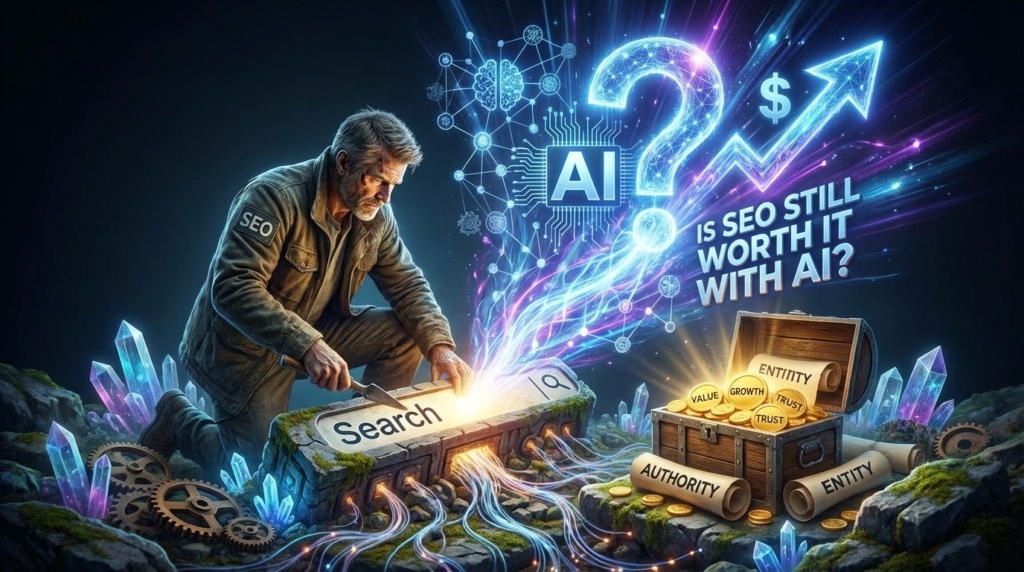
Is SEO Still Worth It With AI in 2026?
SEO remains worth it in 2026 because AI changes how content gets produced, not why people search. Buyers still use Google to compare options, validate trust, and find specific answers. AI increases content supply, which raises the bar on quality, evidence, and differentiation, but it does not remove the demand for discoverable information.
Jump to Passage. . .
SEO remains worth it in 2026 because AI changes how content gets produced, not why people search. Buyers still use Google to compare options, validate trust, and find specific answers. AI increases content supply, which raises the bar on quality, evidence, and differentiation, but it does not remove the demand for discoverable information.
AI SEO also changes where visibility comes from. Rankings still matter, but so do rich results, product snippets, and entity-based relevance across a SERP that blends classic links with AI summaries. Winning means building pages that are easy to parse, easy to trust, and clearly aligned to intent.
For WordPress sites, the practical shift is operational. Teams that treat SEO as a repeatable production system, with consistent on-page standards, schema, and internal linking, keep compounding traffic while competitors chase short-lived AI hacks.
🎯 Is SEO still worth it with AI if content is cheap now?
Yes, SEO is still worth it with AI because content volume is no longer the constraint, credibility and relevance are. When everyone can generate 50 articles a day, the differentiator becomes whether a page satisfies a specific query better than alternatives, earns engagement, and supports trust signals that search engines can interpret.
AI makes it easier to publish, which increases duplication. That pushes the SERP toward stronger filtering, more emphasis on intent match, and more reliance on structured signals like schema types, internal linking, and topical coverage. Online businesses that already have real products, customer data, and operational expertise have an advantage, they can publish content that AI cannot invent responsibly.
🧠 The mindset shift is this. Stop thinking of SEO as “writing posts.” Start thinking of SEO as building a searchable knowledge base that maps to revenue, with pages designed for humans and machines.
🧩 What AI changed in the SEO value equation
AI compresses time and cost for first drafts, outlines, FAQ extraction, and meta copy. That is useful, but it also means your competitors can match your “baseline” content quickly. The new value comes from what sits above baseline: original examples, product-led insights, comparison clarity, and technical cleanliness.
That matters for business owners because time saved is not “nice to have.” It is the difference between publishing one strong page per month and publishing a consistent set of pages that cover your category, support internal links, and build topical authority.
💰 When SEO is still the highest ROI channel
SEO is especially worth it when you sell something with repeatable demand and high intent queries, like local services, B2B software, WooCommerce products, or niche education. Paid ads rent attention. SEO builds an asset. AI does not change that economics, it changes the production workflow and the competitive bar.
To keep SEO profitable, connect pages to revenue paths. Category pages, product pages, comparison pages, and “best for” pages often outperform generic blog posts because they align to buying intent. Use informational content to feed internal links into these money pages, not as an isolated publishing hobby.
🧭 Is SEO still worth it with AI when Google answers directly?
Yes, SEO is still worth it with AI even when Google surfaces direct answers, because businesses can optimize for the parts of the SERP that still drive clicks and conversions. That includes high intent queries, rich results, local packs, product results, and pages that become the cited source behind summaries.
AI answers reduce clicks for some simple queries. That is not new, featured snippets and knowledge panels have done this for years. The opportunity is to target queries where users still need depth, comparison, pricing context, compatibility, and real-world constraints. Those are the queries that drive leads and sales.
📌 The practical adjustment is to design pages that are “answerable” and “actionable.” Answerable means clear headings, concise definitions, and structured data. Actionable means next steps, product fit guidance, and internal links that move a buyer forward.
🧱 Build pages that AI can quote without losing the sale
If an AI summary quotes you, you want the user to still need your page. That means publishing content that includes decision frameworks, calculators, checklists, and product-specific constraints that cannot fit in a short summary. For WooCommerce, that might be size charts, compatibility tables, shipping constraints, or return policy nuances that affect purchase confidence.
Also, structure matters. Use short definitional paragraphs under H2 and H3 headings, then expand with examples. This increases the chance your passage is selected for a snippet or AI citation while keeping deeper value on-page.
🧾 Use Google’s own guidelines as your guardrails
When teams overuse AI, they often create pages that read fine but fail on helpfulness, originality, and trust. Anchor your process to Google Search Central guidance on creating helpful content and avoiding scaled content abuse. Keep a direct link to the documentation in your internal SOP so writers and editors know the standard.
Reference: Google Search documentation.
🧪 Why “super fast” matters more than feature count
Many businesses avoid feature-rich plugins because they fear performance issues. The more realistic risk is operational inconsistency, teams using multiple tools and producing uneven outputs. A single SEO system, with role controls and repeatable templates, often leads to fewer mistakes and faster iteration.
That is the real advantage of a consolidated SEO suite. It reduces context switching, which is one of the biggest hidden costs in content operations.
🔑 Unlimited focus keywords and long-tail coverage that survives AI saturation
Unlimited focus keywords are valuable in 2026 because long-tail SEO is how smaller brands compete when AI floods the web with generic content. A single page often needs to satisfy multiple closely related intents, especially for product-led content, local services, and B2B feature pages.
🧩 The real win is not “ranking for more keywords.” It is building a page that matches how people search. Users do not search one exact phrase. They search variations, comparisons, and problem statements.
🕵️ How to pick keyword sets that convert
Instead of picking one head term, build a small set of related queries that share the same solution. For example, a WooCommerce store selling espresso grinders might target “best espresso grinder for home,” “espresso grinder for small kitchen,” and “quiet espresso grinder,” then structure the page with sections that address each constraint.
Use LSI keywords as supporting language, not as a checklist. LSI keywords help you cover subtopics and terminology that search engines expect to see on a thorough page. They also reduce the risk that your AI-written content sounds generic because it forces specificity.
🧠 A practical on-page map for multi-keyword pages
Use this structure to keep multi-keyword optimization clean and readable:
- 🧩 One primary keyword in the title and H1, aligned to the main intent.
- 🧱 3 to 6 secondary keywords mapped to H2 sections, each answering a constraint or question.
- 🔗 Internal links to supporting articles that go deeper on subtopics.
- 🏷️ Schema types that match the content format, like FAQ or HowTo.
- 🧪 A short “decision” section that recommends next steps or products.
This approach keeps your page eligible for multiple passages to rank, while still reading like one coherent piece.
🧾 Integrate Google Search Console insights into content updates
Google Search Console data is one of the most underused assets in small business SEO. Use it to find pages that already rank on page 2 and improve them, or to find queries where you rank but your snippet is weak. Then adjust headings, add missing sections, and improve internal links.
For deeper context on how Search Console works and what it measures, reference Search Console performance reports.
🏷️ Schema types, rich results, and why structured data is the anti-AI moat
Schema is worth more in 2026 because AI summaries and rich results depend on machine-readable structure. If your pages are unstructured, they are harder to interpret, harder to feature, and easier to replace with generic answers. Structured data is one of the cleanest ways to make your content legible to search systems.
Rank Math supports over 20 schema types, including FAQ, HowTo, and Rating, plus auto-detection for videos and instant Google indexing features. This breadth matters because schema is not one-size-fits-all. Your product page needs different markup than your tutorial, and your tutorial needs different markup than your review.
📌 The business takeaway is that schema is not “technical garnish.” It is a distribution lever. It can influence how you appear on the SERP, how much space you occupy, and how quickly Google understands new or updated content.
🧾 Which schema types matter most for online businesses
Most businesses do not need every schema type. They need the ones that match their content formats and revenue paths:
- 🛒 Product schema for WooCommerce product pages, including price and availability where appropriate.
- ❓ FAQ schema for pages that answer objections, shipping, returns, or implementation questions.
- 🧰 HowTo schema for setup guides, onboarding, and troubleshooting content.
- ⭐ Review or Rating schema where it is compliant and supported by visible on-page content.
- 🎥 Video schema for pages with embedded demos or tutorials.
🧪 Validate schema like a release engineer
Schema errors are silent killers. They do not always break your page, they just remove your eligibility for rich results. Use Google’s Rich Results Test and Search Console enhancements reports to validate. Keep schema consistent across templates so you do not create a different markup pattern for every author.
Reference: Rich Results Test.
🧑💻 AI as a personal assistant inside WordPress, not a separate tool
SEO is worth it with AI when AI becomes an assistant embedded in your workflow, not a separate destination. The moment AI lives outside WordPress, teams lose context, forget to implement on-page elements, and ship inconsistent content. Embedded AI keeps optimization close to publishing.
🧠 The key is to define what the assistant is allowed to do. AI should propose, draft, and summarize. Humans should verify, decide, and approve. That governance is what keeps your brand voice intact and your claims defensible.
🧭 A simple governance model for AI-assisted SEO
Use a two-layer review system:
- 🧪 Technical review, titles, meta, internal links, schema types, and formatting.
- 🧾 Editorial review, accuracy, originality, product truth, and brand tone.
This is how agencies scale without turning content into a liability. It also makes it easier to onboard new writers because the checklist is explicit.
🧠 Where AI helps most, and where it hurts most
AI helps with repetitive tasks and blank-page anxiety. It hurts when it becomes the source of truth. If you sell regulated products, financial advice, medical content, or anything where incorrect claims create legal risk, AI must be treated as a drafting tool only.
| ✅ Task Type | 🎯 Best Use | ⚠️ Main Risk |
|---|---|---|
| Meta titles and descriptions | Generate variants, then human selects | Overpromising or mismatching intent |
| Outlines and headings | SERP-driven structure and coverage | Generic structure that copies competitors |
| FAQs and summaries | Extract questions from support and sales | Invented answers without policy alignment |
| Claims and statistics | Only rewrite verified facts | Hallucinations and compliance issues |
🔌 Headless SEO, REST APIs, and automation that keeps rankings fresh
SEO is still worth it with AI because automation makes it possible to maintain large sites without drowning in manual updates. Headless SEO is the idea that optimization tasks can run through workflows and REST APIs, not just through a dashboard. This is especially relevant for WooCommerce catalogs and multi-site publishers.
In 2026, teams increasingly treat SEO like a pipeline. Content gets drafted, reviewed, published, monitored, and refreshed through repeatable steps. When rankings drop or new queries appear, the system triggers updates, not panic.
📌 The key is to automate the boring parts while keeping strategy human-led. Automation can update meta descriptions, add internal links, and generate schema templates. Humans should decide what to target and what to say.
🧩 What “SEO pipelines” look like in practice
A mature pipeline resembles CI/CD for content:
- 🗂️ Intake, collect queries from Google Search Console and customer questions.
- 🧠 Briefing, create outlines, LSI keywords, and internal link targets.
- ✍️ Drafting, write inside WordPress editors with Content AI assistance.
- 🧪 QA, validate schema types, titles, and on-page coverage.
- 📈 Monitoring, track impressions, CTR, and ranking movement.
- 🔁 Refresh, update top pages quarterly and prune low-value pages.
🧰 REST APIs and integrations for bulk SEO work
Bulk SEO tasks are where automation pays for itself. Updating hundreds of product metas, adding consistent Open Graph data, or syncing schema templates can be done via REST APIs and workflow tools. The n8n community has discussed full SEO automation in WordPress using Rank Math integrations and API-driven meta generation, reflecting the broader headless SEO trend in 2026.
Reference: n8n automation thread.
🧪 The plugin bloat myth vs real performance risk
Businesses often fear a “heavy” SEO plugin. The bigger risk is content bloat, publishing too many low-value pages that dilute crawl budget and topical focus. AI makes content bloat easier than ever. A disciplined plugin setup plus a ruthless content strategy is the safer path.
| ⚡ Scale With AI | 🧑🔬 Keep Human-Led |
|---|---|
| Outline generation and intent mapping | Claims, proof, and original expertise |
| Meta variants and snippet testing | Brand voice and positioning |
| FAQ drafting and schema formatting | Policy, pricing, and compliance language |
| Internal link suggestions | Final editorial approval and publishing decisions |
🧱 The 2026 strategy shift: fewer pages, stronger pages, better internal links
SEO is still worth it with AI when you focus on fewer, stronger pages that earn trust and consolidate authority. AI tempts teams to publish hundreds of thin pages. That usually backfires. Strong SEO in 2026 looks like a library of pages that each own a clear intent, supported by internal linking and schema.
For online businesses, the most reliable approach is to build topic clusters around revenue categories. Each cluster has a pillar page that targets the main query, plus supporting pages that answer sub-questions. Internal links connect them so Google can understand topical depth and users can navigate naturally.
🧭 A content plan that aligns to revenue, not vanity traffic
Build your plan around these page types:
- 🛒 Money pages, product, service, and category pages that convert.
- 🧩 Comparison pages, “X vs Y,” “best for,” “alternatives,” and “reviews.”
- 🧰 Support pages, setup, troubleshooting, and compatibility guides.
- 📚 Educational pages, definitions and explainers that build topical authority.
This mix captures both informational and commercial investigation intent. It also makes your site more useful, which is the real long-term moat.
🔗 Internal linking as the compounding engine
Internal links are one of the few SEO levers you fully control. They distribute authority, clarify topical relationships, and guide users toward conversion. In AI-heavy SERPs, internal linking also helps keep users on your site longer, which improves behavioral signals indirectly.
Make internal linking systematic. Create a rule that every new page must link to one pillar page and two supporting pages, and must receive at least three internal links from existing content within 30 days.
🏁 The decision framework: when SEO is worth it, and when it is not
SEO is worth it with AI when you have a real offer, clear differentiation, and the ability to publish and improve content consistently. It is not worth it when you want quick wins, cannot commit to maintenance, or operate in a niche where search demand is minimal. AI does not change those fundamentals, it just changes the speed of execution.
Most online businesses should treat SEO as a 6 to 12 month asset-building program. AI can shorten production cycles, but it cannot eliminate the time it takes for trust, links, and user engagement to accumulate.
📌 Use a simple test. If you can answer “yes” to the majority of the checklist below, SEO remains a strong bet.
✅ A practical “worth it” checklist
- 📦 You sell a product or service with recurring demand and clear search intent.
- 🧠 You can publish content that includes real expertise, not generic summaries.
- 🧾 You can support claims with proof, screenshots, policies, or customer data.
- 🧰 You can implement technical basics, titles, metas, schema types, and internal links.
- 🔁 You can refresh top pages quarterly based on Google Search Console signals.
🧨 When SEO is a bad fit
SEO is a poor fit when you cannot differentiate, when your margins cannot support content operations, or when your business model changes too frequently to maintain a stable site architecture. In those cases, paid acquisition or partnerships may be a better starting point.
For businesses that do commit, the best approach is to combine SEO with conversion optimization. Traffic without conversion is a vanity metric. AI can help you write faster, but it cannot fix a confusing offer.
❓Common Questions About Is AI SEO
Is SEO still worth it for small businesses in 2026?
Yes. Small businesses win by targeting long-tail queries, adding strong schema, and building internal links to money pages. AI helps produce drafts faster, but humans must add proof and local context.
Will AI content hurt my Google rankings?
AI content hurts rankings when it is unoriginal, inaccurate, or scaled without review. Use AI for outlines and drafts, then add verified expertise, unique examples, and intent-focused sections before publishing.
What should I optimize first, content or technical SEO?
Do both, but start with technical basics that unblock indexing, then publish one strong topic cluster. Titles, meta, internal links, and schema types create the foundation that makes content improvements pay off.
How does Rank Math help with AI-driven SEO?
Rank Math SEO adds Content AI inside WordPress editors, helping with outlines, LSI keywords, and optimization steps. It also supports multiple focus keywords and schema types, which improves consistency at scale.
How many focus keywords should a page target?
Target one primary keyword and a small set of secondary variants that share the same intent. Map secondary keywords to H2 sections. Avoid mixing unrelated intents on one page.
What is the fastest SEO win with AI tools?
Refresh pages that already get impressions. Improve titles and meta for higher CTR, add missing sections based on Search Console queries, and strengthen internal links. This often beats publishing new pages.
Can I automate SEO with REST APIs safely?
Yes, for repetitive tasks like meta updates and template-based schema. Keep strategy and final approvals human-led. Monitor results in Search Console so automation improves CTR and relevance, not just output.
 SEO SOLUTIONS TEXAS BLOG
 SEO SOLUTIONS TEXAS BLOG
We are a results-driven digital marketing and AI SEO agency focused on increasing website traffic, improving online visibility, and generating high-quality leads for our clients.
🏆 Our Services:
Get Access To Our Texan Newsletter
Outrank. Outplay. Outperform.
We deliver elite Texas AI SEO and digital marketing strategies that amplify your presence across search engines, social media, and the platforms that matter most—so you get cited, attract ready-to-buy customers, and turn visibility into unstoppable brand growth.