🚀 Wikidata QIDs for Entity SEO: The 2026 Authority Guide for Texas Brands
What Are Wikidata QIDs for Entity SEO?
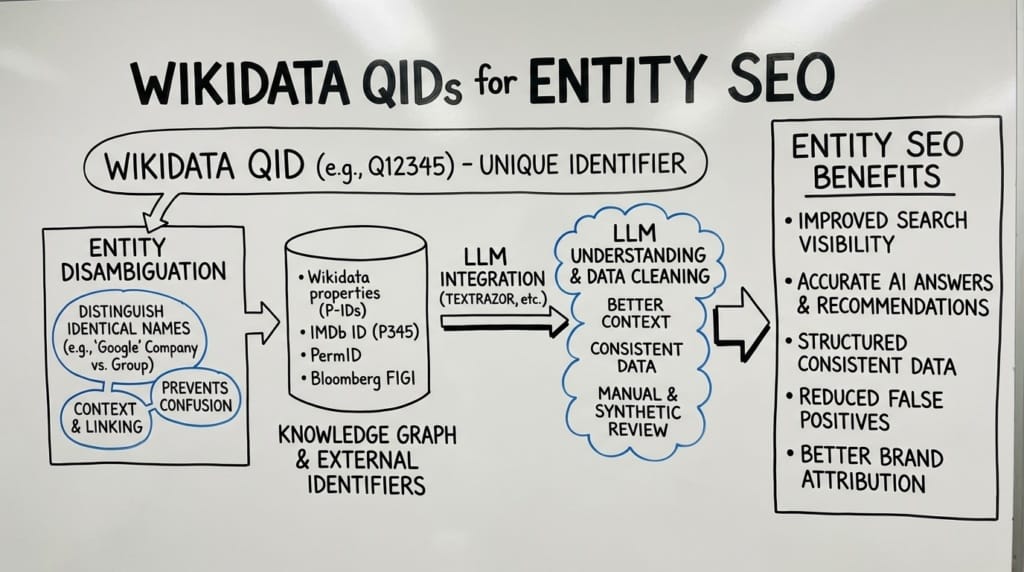
Wikidata QIDs are unique, alphanumeric identifiers (e.g., Q303) that serve as machine-readable anchors in knowledge graphs, enabling precise Entity Disambiguation for AI Retrieval Systems. By linking content to these stable nodes, businesses establish Entity Consistency, ensuring LLMs like Google Gemini and ChatGPT recognize their brand as a verified entity rather than a text string, which is essential for securing AI Citations in 2026.
Jump to Passage. . .
🌐 The Strategic Importance of Wikidata QIDs for AI Visibility
For Texas business owners operating in the 2026 digital economy, the days of relying solely on keyword density are over. Search engines have evolved into answer engines, and the currency of this new realm is the Entity. At the heart of this transformation lies the Wikidata QID (Qualified Identifier), a specific code that tells machines exactly who you are, distinguishing a "Plano Tech Solutions" company from a generic concept of tech solutions in Plano.
Understanding Wikidata QIDs and Knowledge Graphs is fundamental to modern visibility. A QID acts as a permanent fingerprint in the digital ecosystem. Unlike a URL that might change or a brand name that might be shared by a coffee shop in Austin and a software firm in Dallas, a QID is immutable. When you anchor your brand to a QID, you are speaking the native language of AI Retrieval Systems. These systems rely on structured data to parse the web, and they prioritize information that is explicitly defined within a Knowledge Graph.
Machine-readable nodes are the building blocks of these graphs. When Google's algorithms crawl your site, they are looking for connections—triples that define relationships (Subject-Predicate-Object). A QID allows you to define these explicitly. For instance, linking your CEO's name to their specific Wikidata item (e.g., Q12345) eliminates ambiguity. This process of Entity Anchoring is what builds LLM Trust. Without it, your brand is just unstructured text that large language models might hallucinate or ignore.
Constructing the Backbone of Knowledge Graphs
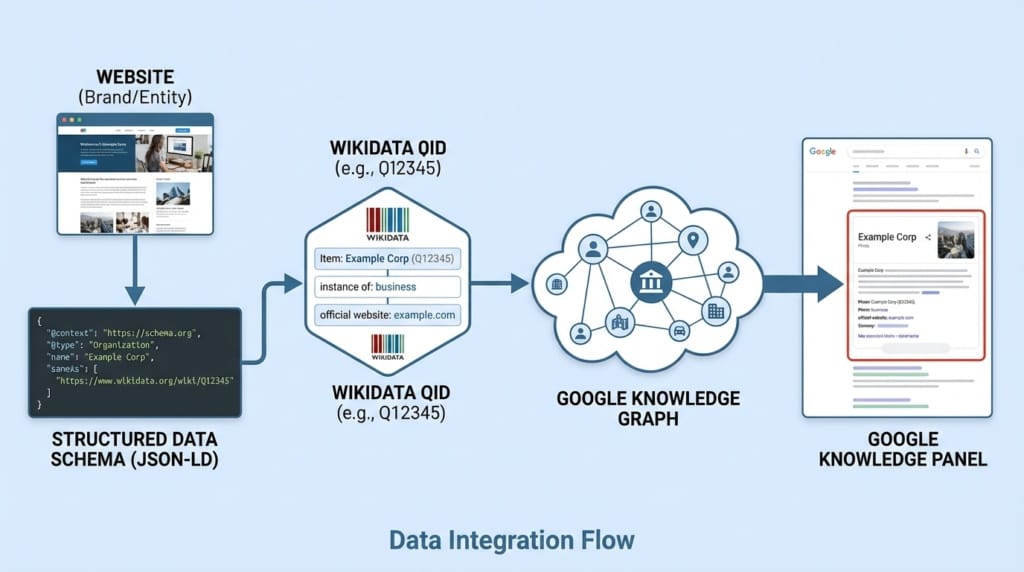
Knowledge Graphs are not built on keywords; they are built on entities and the relationships between them. Google's Knowledge Graph, which now informs the vast majority of AI Overviews, relies heavily on Wikidata as a structured data source. By establishing a Wikidata item for your business or utilizing existing QIDs for your products and services, you are effectively injecting your brand's DNA directly into the brain of the search engine.
This integration facilitates Semantic Interoperability. Your QID links to other databases like Wikipedia, OpenCorporates, and Google's own Knowledge Graph API. This web of interconnected data points creates a fortress of validity around your brand. According to recent industry analysis, Wikidata enables AI search optimization by providing the machine-readable triples that allow algorithms to confidently assert facts about your business, moving beyond simple text matching to true semantic understanding.
For a local Texas enterprise, this means that when a user asks an AI assistant for "top industrial suppliers in Houston," the system doesn't just look for those words on a page. It looks for entities classified as "industrial suppliers" located in "Houston" (Q16555) with high trust signals. If your entity is correctly anchored with QIDs, you bypass the noise of traditional SEO and compete on the level of factual authority.
📈 Boosting AI Citations with QID Optimization
The primary goal of Entity SEO in 2026 is not just ranking, but citation. AI Citations are the new gold standard, appearing in zero-click results provided by Gemini, ChatGPT, and Perplexity. To achieve this, you must achieve "Entity Saturation." This concept involves surrounding your primary brand entity with a dense network of related entities, all anchored by their respective QIDs.
Maximize AI Visibility with Entity Saturation
Research indicates that AI models favor content that demonstrates a deep semantic understanding of a topic. This is measured by the density and relevance of connected entities. A page that simply mentions "oil and gas" is less valuable to an AI than a page that links the concept to specific QIDs for "petroleum industry" (Q846626), "fracking" (Q663493), and "Permian Basin" (Q1638681). This structured depth signals expertise and authority.
The magic number appears to be 15. Pages that integrate 15 or more connected entities within their structured data and content narrative see a massive uplift in visibility. This isn't about stuffing keywords; it's about mapping the ecosystem of your topic. By explicitly tagging these entities in your schema markup using the about and mentions properties with their Wikidata URIs, you provide a roadmap for the AI to understand the context of your content.
Data verifies the power of this approach. Comprehensive guides that utilize clear entity structures and data tables backed by QIDs are significantly more likely to be referenced by answer engines. In fact, comprehensive guides with entity structures achieve 67% AI citation rates, outperforming unstructured opinion pieces by a wide margin. This suggests that the structure of your data is just as important as the quality of your prose.
Case Study: The Impact of Entity Consistency
Consider a mid-sized logistics firm in San Antonio. By auditing their digital footprint and ensuring their entity data was consistent across Wikidata, Crunchbase, and their own website schema, they were able to clarify their service area and core competencies to search engines. Before this optimization, they were often confused with a similarly named trucking company in California.
After implementing QID-backed schema and correcting their Knowledge Graph entry, the results were undeniable. Industry data shows that maintaining such entity consistency leads to 73% more AI selections for relevant queries. The AI could confidently select their brand as the correct answer for local logistics queries because the ambiguity was removed. The QID served as the source of truth, linking all disparate mentions into a single, verified node.
| Metric | Without QID Optimization | With QID Optimization |
|---|---|---|
| AI Citation Rate | Low (~18%) | High (~67%) |
| Entity Ambiguity | High Risk of Hallucination | Disambiguated Identity |
| Knowledge Panel Trigger | Unlikely | Highly Probable |
🛠️ Strategies for Effective QID Implementation
Implementing Wikidata QIDs into your SEO strategy requires a tactical approach. You do not need to be a Wikipedia editor to benefit from this technology, but you do need to understand how to leverage the open data ecosystem. For Texas businesses looking to secure their digital future, the process begins with creation and auditing.
Creating and Auditing QIDs for Immediate AI Benefits
Many business owners mistakenly believe they need a Wikipedia page to have a Wikidata item. This is false. Wikidata has a lower barrier to entry regarding notability, though strict verifiability rules still apply. If your business has a valid QID, you can immediately start using it in your website's structured data to signal authority.
Start by searching Wikidata to see if an item already exists for your brand, key executives, or proprietary products. If duplicates exist, they split your authority. Merging these duplicates is critical. If no item exists, and you meet the criteria (e.g., clearly identifiable, cited in public records), a compliant entry can be created. This entry should include core properties like "instance of" (P31), "official website" (P856), and "inception" (P571).
Once you have your QIDs, the next step is Wikidata Mining. Identify the QIDs for your industry, location, and services. Use these to enrich your content. For example, a commercial roofer in Dallas should identify the QIDs for "Dallas" (Q16557), "Roof" (Q83180), and "TPO" (Thermoplastic Polyolefin). Integrating these into your backend schema tells search engines exactly what you do and where you do it.
"knowsAbout": [

    { "@type": "Thing", "name": "Barbecue", "sameAs": "https://www.wikidata.org/wiki/Q131566" },

    { "@type": "Thing", "name": "Brisket", "sameAs": "https://www.wikidata.org/wiki/Q4968643" }

    ]
Technical Implementation of KnowsAbout Schema
The knowsAbout property is a powerful tool for establishing subject matter expertise. By populating this field with Wikidata URIs, you create a direct bridge between your content and the global Knowledge Graph. This is far more effective than simple tagging because it is language-agnostic. A QID is understood equally well by an AI trained in English, Spanish, or Mandarin, facilitating Multilingual Retrieval.
- Identify Core Topics: List the top 10-20 concepts central to your business.
- Find QIDs: Search Wikidata.org for the exact item matching each concept.
- Update Schema: Inject these URIs into your Organization or Person schema on your homepage and about page.
- Validate: Use the Rich Results Test to ensure Google can parse your new entity declarations.
⚠️ Challenges and Solutions in Entity SEO
While the benefits are substantial, the path to Entity SEO dominance is fraught with potential pitfalls. Mismanagement of Wikidata entries or improper schema implementation can lead to data conflicts that confuse rather than clarify. Texas brands must navigate these waters carefully to protect their digital reputation.
Overcoming Notability and Data Conflicts
The most common hurdle is the "Notability" requirement. Wikipedia is notoriously strict, often rejecting articles for small to medium-sized businesses. However, this should not deter you. You can build a robust Knowledge Graph presence without a Wikipedia article by focusing on Wikidata and other open knowledge bases. The key is to establish verifiable facts from independent sources.
Data conflicts occur when different sources provide contradictory information about an entity. If your website says you were founded in 2010, but a third-party directory says 2012, this discrepancy lowers your Entity Confidence Score. A unified QID helps resolve this by serving as the central reference point. However, you must actively monitor this. The importance of Wikipedia for brands and its sister project Wikidata cannot be overstated; they act as the primary validation layer for AI. Even without a full article, a well-maintained Wikidata item prevents the "hedging" behavior seen in AI responses when data is uncertain.
Preventing Discrepancies with 'Instance Of'
A frequent technical error is the misuse of the "instance of" (P31) property. This property defines what your entity is. Is your business an "enterprise" (Q6881511), a "corporation" (Q167037), or a "law firm" (Q1340655)? Selecting the wrong classification can lead to your business being excluded from relevant searches. For example, if you classify your consulting firm as a "software company," you may appear in tech listings but disappear from professional service queries where you actually belong.
Regular audits are essential. Check your Knowledge Panel and Wikidata item quarterly. Ensure that your "official website" link is current and that your "headquarters location" accurately reflects your Texas address. These small data points are the rivets that hold your Knowledge Graph node together.
🔮 The Future Outlook of Entity-first Indexing
As we look toward the latter half of 2026, the trajectory is clear: the search landscape is shifting entirely from strings to things. The traditional inverted index, which maps keywords to documents, is being superseded by the Knowledge Graph, which maps entities to answers. For Texas business owners, this means that the future of SEO is actually AEO (Answer Engine Optimization).
Preparing for the 2026 AI Search Revolution
The dominance of Large Language Models has accelerated this shift. These models "think" in concepts, not keywords. They traverse the web by hopping from node to node in a graph. If your business is a verified node, you are part of the conversation. If you are just text on a page, you are merely background noise. Experts predict that entity-first indexing will dominate AI search, rendering old-school tactics like keyword density increasingly irrelevant. The winners will be those who have effectively translated their brand into the structured language of machines.
This revolution also brings the concept of Semantic Search Accuracy to the forefront. AI users expect precise answers. When they ask, "Who is the best commercial plumber in Fort Worth?" they expect the AI to understand "best" based on entity attributes like awards, years in business, and customer ratings—all of which can be structured as data properties linked to a QID. By enriching your entity profile today, you are training the AI of tomorrow to recommend you.
For brands that cannot yet secure a Wikidata item, the immediate strategy is to use Schema.org as a proxy. Mark up your content as if the QID existed, referencing the QIDs of your location, industry, and founders. This builds the "shadow" of an entity that search engines can eventually solidify into a Knowledge Graph node. The future belongs to the structured, the verified, and the connected.
Frequently Asked Questions About Wikidata QIDs for Entity SEO
What is a Wikidata QID and why does it matter?
A QID is a unique identifier (e.g., Q123) from Wikidata that acts as a machine-readable tag for an entity. It matters because it disambiguates your brand for AI, ensuring search engines distinguish you from similar names.
How do I find the QID for my business?
Search for your business name on Wikidata.org. If an item exists, the QID is the code next to the title. If not, you may need to create a compliant entry or use QIDs for your industry and location instead.
Can I create a Wikidata item without a Wikipedia page?
Yes, Wikidata has different notability standards than Wikipedia. You can create an item if your business has credible, independent references, even without a full Wikipedia article.
How does schema markup work with QIDs?
You use the "sameAs" or "knowsAbout" properties in your website's JSON-LD schema to link to relevant Wikidata URLs. This tells Google explicitly which entities your content is associated with.
Will a QID guarantee a Knowledge Panel?
No, but it significantly increases the probability. A QID provides the structured data Google needs to generate a Knowledge Panel, acting as a primary trust signal for the Knowledge Graph.
What is entity saturation in SEO?
Entity saturation involves including a high density (15+) of related entities and their QIDs in your content and schema. This helps AI models understand the depth and context of your topic coverage.
The New Standard for Texas Business Visibility
The shift to Entity SEO is not a trend; it is the fundamental restructuring of how the web is indexed. For Texas business owners, leveraging Wikidata QIDs is the decisive step between being found and being forgotten in the AI age. By anchoring your brand identity with machine-readable precision, you ensure that when the world asks questions, your business is the answer.
Take action today by auditing your current entity status. Are you a verified node, or just text on a screen? The work you do now to structure your data will define your digital territory for years to come.
 SEO SOLUTIONS TEXAS BLOG
 SEO SOLUTIONS TEXAS BLOG
We are a results-driven digital marketing and AI SEO agency focused on increasing website traffic, improving online visibility, and generating high-quality leads for our clients.
🏆 Our Services:
Get Access To Our Texan Newsletter
Outrank. Outplay. Outperform.
We deliver elite Texas AI SEO and digital marketing strategies that amplify your presence across search engines, social media, and the platforms that matter most—so you get cited, attract ready-to-buy customers, and turn visibility into unstoppable brand growth.