Information Gain: The 2026 Blueprint for Dominating AI Search & LLM Citations
What Is Information Gain in AI SEO?
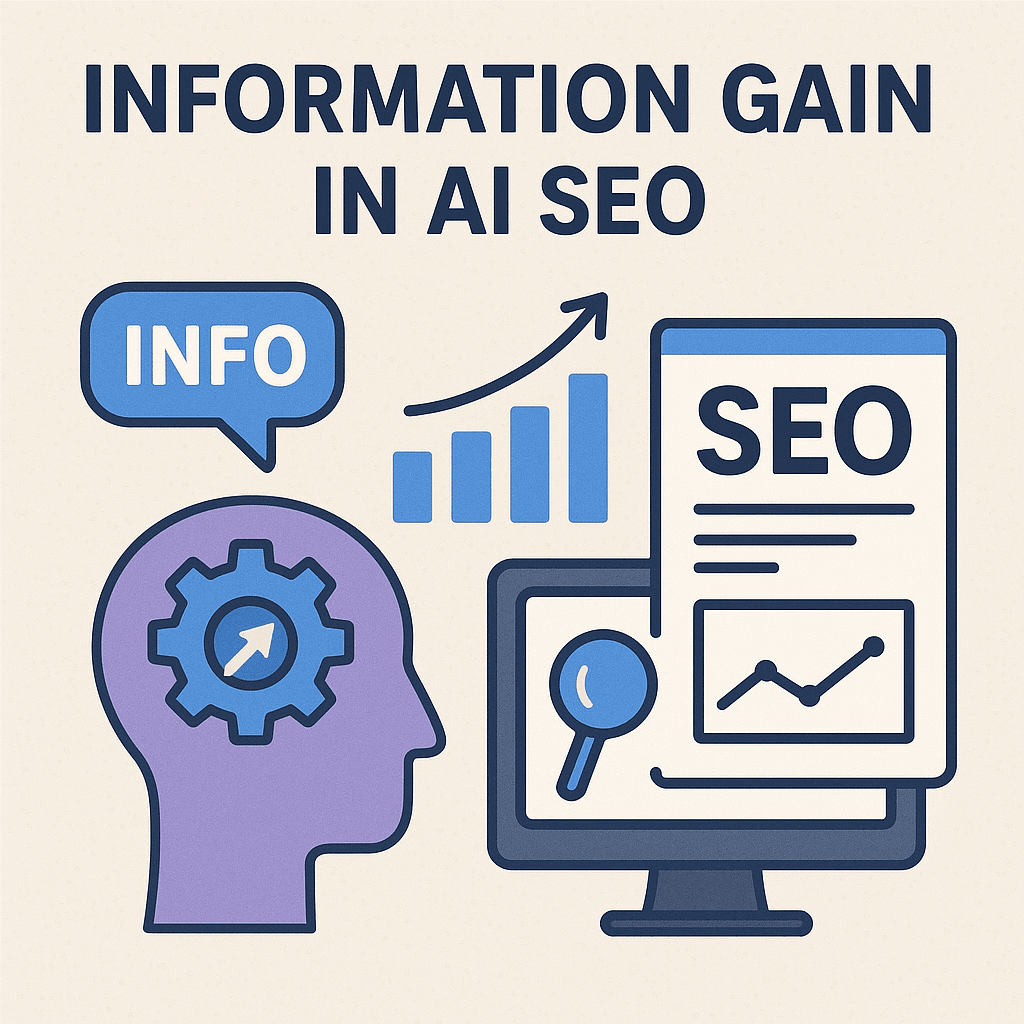
Information Gain in AI SEO refers to the specific measurement of new, non-redundant value a piece of content adds to the existing knowledge graph. Search engines and LLMs like ChatGPT and Google AI Overviews prioritize pages with high information gain scores—achieved through original data, expert insights, or unique perspectives—to synthesize answers, ensuring citations go to sources that differentiate rather than replicate the consensus.

Jump to Passage. . .
🚀 Harnessing Information Gain for Unmatched SEO Success
The digital ecosystem of 2026 has fundamentally shifted from a keyword-matching game to a battle for semantic distinctiveness. The days when rewriting the top three search results could secure a front-page spot are effectively over. With the dominance of Generative Engine Optimization (GEO), search algorithms have evolved to penalize redundancy and reward novelty with ruthless efficiency.
For businesses operating in Texas and beyond, this means the traditional "skyscraping" technique—where you simply make a guide longer than the competitor's—is obsolete. The core metric defining visibility now is Information Gain. This concept quantifies how much new information a specific URL contributes to a user's understanding compared to what the user has already seen. If your content merely echoes the consensus found in the Large Language Models (LLMs) training data, it is rendered invisible by the synthesis engines that power modern search.
To survive in this environment, brands must pivot from being content publishers to knowledge creators. The goal is no longer just to rank for a blue link but to be the primary source cited when an AI constructs an answer for a user. This requires a fundamental restructuring of how we approach SEO, prioritizing proprietary data, contrarian expert opinions, and "information moats" that AI cannot hallucinate or replicate without attribution.
📊 Understanding the Value Proposition of Information Gain SEO
Information Gain is not merely a theoretical concept; it is a quantifiable ranking factor that has reshaped the architecture of AI SEO. At its core, it addresses the "redundancy problem" that plagued search engines in the early 2020s. When a user searches for a topic, seeing ten variations of the same advice is a poor user experience. Google and other platforms now actively seek to diversify the SERPs and AI snapshots with content that offers a unique angle.
The Shift from Keywords to Contextual Uniqueness
The transition began in earnest with patent filings that signaled a move away from simple link authority. Specifically, Google's June 2022 patent incorporates 'Contextual Estimation of Link Information Gain', utilizing machine learning to assess content uniqueness relative to the user's previous interactions. This system predicts whether a new link will actually provide new knowledge or just repeat what the user just read.
For content creators, this means that "comprehensive guides" are often less valuable than deeply specific, narrow insights. If a generic guide covers 90% of a topic but offers nothing new, it has low information gain. Conversely, a short article that reveals a never-before-seen statistic or a counter-intuitive method has high information gain. This shift is critical for understanding What is Information Gain, and How Does It Impact AI Search? by redefining value not as length, but as additive contribution.
🛑 Overcoming Content Homogenization: A Strategic Imperative
The proliferation of generative AI tools has led to a tsunami of "grey goo" content—articles that are grammatically perfect but factually generic. Because LLMs are trained on the average of the internet, they output the average of the internet. When businesses use these tools without heavy human intervention, they contribute to content homogenization.
The Danger of the "Echo Chamber" Effect
In crowded niches, this homogenization is fatal. If ten competitors act as an echo chamber, repeating the same best practices, search engines have no incentive to rank one over the other based on content quality alone. They revert to domain authority, locking out smaller players. However, Information Gain provides the master key to break this deadlock. By injecting novelty, you disrupt the pattern.
Strategies to break homogenization include:
- Contrarian Viewpoints: Challenging the standard advice with evidence-based counter-arguments.
- Personal Narrative: Weaving in specific, unverifiable-by-AI personal experiences that add human context.
- Proprietary Data: Releasing statistics that do not exist in the public training data of the models.
This approach is essential because The SEO Theory that AI Made Mandatory dictates that without differentiation, your content is effectively invisible to the synthesis algorithms looking for fresh inputs.
🤖 The AI Synthesis Edge: Boosting Visibility Through Unique Content
The mechanics of visibility have changed. In traditional search, you fought for a click. In AI search, you fight for a citation. AI platforms like ChatGPT, Perplexity, and Google's Gemini-powered overviews function as synthesis engines. They ingest multiple sources, identify the consensus, and then look for outliers or specific details to enrich the answer.
Citation Optimization Logic
AI platforms prioritize content with high information gain for citations because their primary utility metric is "helpfulness." An answer that says "Experts agree on X, but recent data from [Your Brand] suggests Y" is far more helpful than a generic summary. This shift moves SEO from mere ranking competition to content differentiation. By becoming the source of the "Y" in that equation, you secure the citation.
Smaller brands specifically gain visibility by filling gaps that large incumbents ignore. While a massive publisher might cover the broad strokes of a topic, a specialized brand can provide the granular detail that an LLM needs to answer a specific long-tail query. This is where the concept of Adding Value to SEO Content becomes a technical requirement rather than just a quality guideline.
🔬 Technical Mechanics: Decoding the Algorithm
To truly optimize for Information Gain, one must understand how Machine Learning (ML) models quantify it. It is not a manual review process; it is a mathematical calculation involving semantic embeddings and vector space analysis.
How Uniqueness is Scored
When Google or an LLM crawls a new page, it converts the text into vector embeddings—numerical representations of the concepts within. It then compares this vector to the existing cluster of vectors for that topic.
| Content Attribute | Low Gain Signal | High Gain Signal |
|---|---|---|
| Data Source | Cited from other articles | Original, first-party data |
| Semantic Distance | Close to cluster center | Outlier / New cluster edge |
| Entity Relationships | Standard associations | Novel connections |
Google's AI Overviews use this comparative scoring to prioritize content that adds new dimensions. If the system detects that reading your article after reading the top result yields zero new entities or relationships, your Information Gain score approaches zero, and your likelihood of appearing in the AI snapshot vanishes.
🛡️ Building 'Information Moats': Original Research to Secure Authority
The most reliable way to force a high Information Gain score is through the creation of "Information Moats." These are assets that cannot be generated by an AI because they require physical-world interaction or private data access.
Strategies for Moat Construction
Original research and expert insights create these moats. When you publish a survey of 500 industry professionals, you create a dataset that the LLM must cite if it wants to be accurate. It cannot predict the results of a survey that hasn't happened yet.
- Proprietary Surveys: Conduct annual state-of-the-industry reports.
- Case Studies: detailed breakdowns of specific client wins with hard numbers.
- Expert Interviews: Transcribe and publish conversations with niche authorities.
These assets become the "ground truth" for the topic. As other sites cite your data, and as AI models ingest your unique entities, your authority compounds. This is why pages that offer original insights see increased visibility—they become the primary nodes in the knowledge graph.
🛠️ Practical Strategies for Implementation
Implementing an Information Gain strategy requires a shift in editorial process. It is no longer enough to give a writer a keyword and a word count. You must provide them with the source of the gain.
The "Gain-First" Workflow
- Identify the Consensus: Before writing, prompt an LLM: "What is the standard advice for [Topic]?" Read the output. That is what you must not write.
- Find the Gap: Identify what the consensus is missing. Is it outdated? Is it too theoretical? Does it ignore a specific segment?
- Inject the Gain: Interview an expert to fill that gap, or run a quick poll.
- Human-Edit for Density: Ensure the unique insights are prominent, not buried. Use clear headings that highlight the novelty (e.g., "Why the Standard Advice is Wrong").
Human-editing AI output with unique insights is also a valid strategy. You can use AI to build the skeleton, but a human expert must add the "meat"—the specific examples, the nuanced takes, and the recent developments that the training data cutoff missed.
📈 Emphasizing Benefits & SEO Impact
The ROI of investing in Information Gain extends beyond just surviving the AI shift. It actively drives higher quality traffic and stronger domain authority.
Rankings and Engagement
High-gain content rises in SERPs because Google's algorithm is tuned to surface diversity. If your page is the only one covering a specific angle, you effectively have zero competition for that specific intent. Furthermore, unique info boosts metrics like time-on-page and engagement. Users stop pogo-sticking (bouncing back to search) when they find something they haven't seen before.
Authority and Backlinks
Original research is a magnet for backlinks. Other writers need data to support their arguments. By providing that data, you earn high-quality citations naturally. In the AI era, these citations are the currency of trust. When an LLM sees your brand associated with unique, high-value data points across the web, it reinforces your entity's authority, making you a preferred source for future answers.
🔮 The Future of Search Is Distinctive
As we navigate 2026, the mandate is clear: differentiate or die. The flood of AI-generated content has devalued mediocrity to zero. Information Gain is the filter that separates the signal from the noise. By committing to original research, expert depth, and challenging the status quo, businesses can build a defensible position in the AI-driven search landscape. The algorithms are asking for something new; your success depends on your ability to provide it.
❓ Common Questions About Information Gain
What is a good Information Gain score?
There is no public "score," but high gain is achieved when your content contains entities, data, or perspectives not present in the top 10 ranking results for that query.
Does Google explicitly measure Information Gain?
Yes, Google holds patents for "Contextual Estimation of Link Information Gain" and uses ML models to assess how much new value a document adds relative to previous user clicks.
Can AI tools create high Information Gain content?
Generally no. Standard AI tools regurgitate training data. High gain requires external inputs like fresh data, personal experience, or expert interviews that the model doesn't already possess.
How does Information Gain affect AI Overviews?
AI Overviews prioritize high-gain content to avoid redundancy. They cite sources that provide specific answers, data points, or unique angles that enrich the generated summary.
Is Information Gain more important than keywords?
In 2026, yes. While keywords signal relevance, Information Gain signals value. Relevance gets you considered; value gets you ranked and cited by AI synthesis engines.
 SEO SOLUTIONS TEXAS BLOG
 SEO SOLUTIONS TEXAS BLOG
We are a results-driven digital marketing and AI SEO agency focused on increasing website traffic, improving online visibility, and generating high-quality leads for our clients.
🏆 Our Services:
Get Access To Our Texan Newsletter
Outrank. Outplay. Outperform.
We deliver elite Texas AI SEO and digital marketing strategies that amplify your presence across search engines, social media, and the platforms that matter most—so you get cited, attract ready-to-buy customers, and turn visibility into unstoppable brand growth.