Generative Engine Optimization (GEO): The 2026 Executive Playbook
What Is Generative Engine Optimization (GEO)?
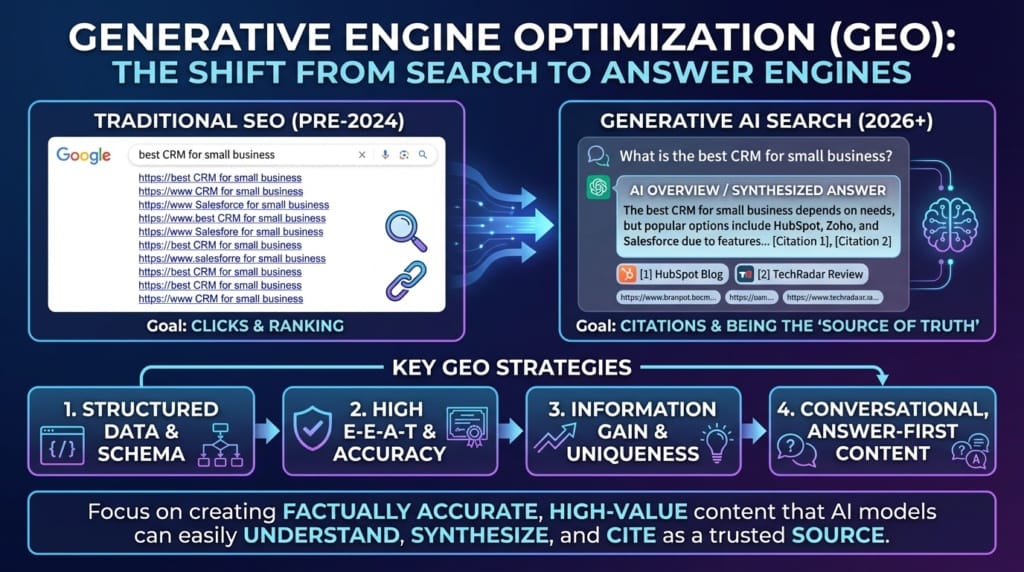
Generative Engine Optimization (GEO) is the strategic process of structuring digital content to maximize citation frequency and visibility within AI-powered answer engines like ChatGPT, Perplexity, and Google AI Overviews. Unlike traditional SEO which targets blue links, GEO focuses on providing high-information-gain data that Large Language Models (LLMs) treat as ground truth for synthesizing direct answers.
Jump to Passage. . .
🚀 The Shift From Blue Links to Answer Engines
The era of chasing ten blue links on a search results page is effectively over. In 2026, the battleground for digital visibility has shifted entirely to the synthesis layer. Your customers are no longer asking Google for a list of websites; they are asking AI agents for answers, comparisons, and strategic recommendations. If your brand data is not structured for these engines to extract, verify, and cite, you are invisible to the most valuable segment of the market.
This transition represents a fundamental change in how information is retrieved. We are moving from a retrieval-based economy to a generation-based economy. Business leaders in Texas and beyond must understand that Generative Engine Optimization (GEO) is not an optional add-on to SEO. It is the replacement for the top-of-funnel discovery layer. The goal is no longer just traffic; it is about becoming the cited authority in the answer that the user trusts.
📈 Maximize Discoverability with Generative Engines
The adoption rate of generative search technologies has outpaced every prediction made in the early 2020s. For enterprise leaders, the data is unequivocal. We are seeing a massive reallocation of resources as smart money moves away from legacy keyword stuffing toward entity-based optimization that LLMs can actually understand.
The Financial Impact of GEO Adoption
The return on investment for early adopters has been substantial. Companies that pivoted early to structure their data for AI retrieval are seeing conversion rates that dwarf traditional organic search. This is because the user intent in an AI conversation is far more specific and further down the funnel than a broad keyword search. According to the CMO Investment Report 2026, a staggering 97% of surveyed digital leaders reported a positive impact from AEO/GEO in 2025. This is not a marginal improvement; it is a complete redefining of what successful digital marketing looks like.
Future-Proofing Against the 2027 Shift
The trajectory is clear. We are approaching a tipping point where generative engine traffic will eclipse traditional search engine traffic. The same report indicates that 94% of these leaders plan to increase their investments in 2026. This signals a rapid enterprise adoption amid shifting search paradigms. Brands that fail to invest now risk falling behind as Generative Engine Optimization is projected to overtake traditional search traffic by 2027. The window to establish your brand as a primary entity in these Large Language Models is closing. Once an LLM associates a competitor with a specific solution, displacing that connection requires significantly more effort than simply outbidding them on a keyword.
🤖 Harness AI-driven Discovery Sessions
The behavior of the B2B buyer and the high-intent consumer has changed. They are using tools like Perplexity and ChatGPT to conduct deep research before they ever visit a vendor's website. These sessions are longer, more interactive, and result in higher qualification before a human ever gets involved.
The Explosion of AI Referrals
We are witnessing a seismic shift in referral traffic patterns. The volume of traffic coming from AI sources is growing exponentially as users become more comfortable with conversational interfaces. Recent data highlights this explosion. Complete Guide to GEO 2025 notes that AI-referred sessions increased by 527% between January and May 2025. This is not a gradual trend; it is a vertical takeoff. This surge is driven by the widespread adoption of tools like ChatGPT, which 43% of professionals now use for work, and Perplexity, which processes over 500 million queries monthly.
High-Intent Targeting in YMYL Sectors
The impact is most profound in sectors where accuracy and trust are paramount. In "Your Money or Your Life" (YMYL) industries like finance, legal, and healthcare, users prefer the synthesized, cited answers of an AI over a list of ads and SEO articles. High-intent pages in these sectors are seeing the fastest growth in AI penetration. Legal sectors have seen an 11.9x increase, while finance and health are seeing 2.9x penetration. Content must prioritize citations in synthesized AI responses over Google rankings to capture this value.
| Feature | Traditional SEO | Generative Engine Optimization (GEO) |
|---|---|---|
| Primary Goal | Ranking Position & Clicks | Citation & Answer Inclusion |
| Content Structure | Keywords & Length | Structured Data & Information Gain |
| Success Metric | Organic Traffic | Share of Voice in AI Answers |
| Target Audience | Browsers | Decision Makers & Researchers |
💡 Unlock New Channels with LLMs
Large Language Models are not just chat bots; they are the new operating system for the internet. They function as reasoning engines that can process vast amounts of data to provide a specific recommendation. For businesses, this means the "long tail" of search has effectively been compressed into direct answers. You need to be the entity that the LLM recommends when the user asks a complex question.
The Quality Over Quantity Equation
Do not be fooled by lower aggregate traffic numbers. The traffic that comes from LLMs is pre-qualified and ready to buy. The 2025 State of AI Discovery Report reveals that while AI traffic sits at 0.13% of total sessions, it is 4-9x concentrated on high-intent pages like industry and pricing pages. This indicates AI as an emerging high-value channel despite low volume. Users are not asking ChatGPT for entertainment; they are asking for solutions. E-commerce specifically saw a surge of 67% month-over-month during the holidays, proving that this behavior is directly tied to wallet-opening moments.
Dominance of Major Platforms
The landscape is currently dominated by a few key players, and your strategy must account for their specific algorithms. ChatGPT currently dominates with 84.2% of AI referrals, showing 3.26x year-over-year growth. However, tools like Copilot (25.2x growth) and Claude (12.8x growth) are expanding rapidly. This fragmentation means your data must be accessible and intelligible to multiple different models. SaaS, e-commerce, and finance companies must shift to GEO to establish "ground truth" authority in LLM synthesis, prioritizing verifiable accuracy over keyword relevance.
🛡️ Secure B2B SaaS Authority in AI Synthesis
For B2B SaaS companies, GEO is a defensive necessity. If an AI cannot find clear, authoritative data about your product, it will hallucinate. It might describe your product incorrectly, or worse, it might attribute your unique features to a competitor. Maintaining narrative control in an automated ecosystem requires a commitment to mathematical accuracy and content depth.
Combating Hallucinations with Ground Truth
The primary challenge with Generative AI is its tendency to make things up when it lacks data. Your job is to provide the data that fills that void. By publishing high-information-gain content—original research, unique data sets, and technical specifications—you force the model to cite you. The SaaS Playbook for GEO emphasizes that B2B SaaS loses narrative control if competitors are cited first. Strategies must focus on stability in AI retrieval and generation pipelines. This involves creating "Propensity models" of content that predict what questions a user will ask and providing the exact data point the AI needs to answer it.
The Importance of Mathematical Accuracy
LLMs are probabilistic, but they favor deterministic data. When you provide clear comparisons, specific integration capabilities, and precise pricing models, you increase the probability of your brand being the cited source. Vague value propositions get ignored. Specific technical claims get cited. Generative engines like ChatGPT, which reached 400M+ weekly users by Feb 2025, are reducing clicks by synthesizing answers. Your content must be the fuel for that synthesis.
- Publish Original Data: Release quarterly reports with unique statistics that LLMs must cite as the primary source.
- Structure Technical Docs: Use clear headers and bullet points in documentation to make it easy for Query Mappers to parse.
- Direct Comparisons: Create "Us vs. Them" pages that objectively compare features, giving the AI a balanced dataset to work with.
- Schema Implementation: Use Organization and Product schema to explicitly tell the AI who you are and what you do.
🛠️ Optimize Your Tech Stack for GEO Success
You cannot manage what you cannot measure. As GEO matures, enterprise tech stacks must evolve to include tools that can audit AI visibility. Traditional SEO tools are insufficient because they track rankings, not citations or sentiment. You need a new class of analytics to understand how your brand is being perceived by the machines.
Emerging GEO Technologies
The market is responding with sophisticated tools designed for the generative age. Enterprises are now prioritizing GEO tech stacks that include AI Visibility Auditors and Query Mappers. These tools allow you to reverse-engineer the prompts that lead to your brand being mentioned. As noted in Optimize Your Content for AI Search, brands are training models on proprietary data and monitoring performance for brand alignment. This reflects the maturation of GEO into a measurable practice alongside content depth.
Integrating Query Mappers and Auditors
Query Mappers help you understand the semantic relationship between different search intents. They show you how a question about "efficiency" leads to a recommendation for your software. AI Visibility Auditors, on the other hand, score your presence in AI Overviews and SGE (Search Generative Experience). They tell you not just if you appeared, but how you appeared—positive, negative, or neutral. This feedback loop is critical for refining your content strategy. SGE and AI Overviews demand multi-format optimization, requiring you to have video, text, and data available for the AI to assemble.
❓ Common Questions About Generative Engine Optimization (GEO)
How does GEO differ from SEO?
GEO targets AI citation and answer synthesis in LLMs like ChatGPT, while SEO targets ranking positions in traditional search engine results pages (SERPs).
What is Information Gain in GEO?
Information Gain refers to adding unique, new data or perspectives to the web that didn't exist before, forcing AI models to cite you as the primary source.
Which platforms should I optimize for?
Prioritize ChatGPT, Perplexity, Google AI Overviews (SGE), Claude, and Microsoft Copilot, as these control the vast majority of AI referral traffic.
Is GEO relevant for B2B companies?
Yes, highly. B2B buyers use AI for research and comparison. GEO ensures your product is recommended during the evaluation phase of the buyer journey.
How do I measure GEO success?
Success is measured by "Share of Voice" in AI answers, citation frequency, and the sentiment of the AI's description of your brand, rather than just clicks.
🔮 The Future of Search Is Answer-First
The transition to Generative Engine Optimization is not a fad; it is the natural evolution of information retrieval. We are moving away from a world where users hunt for information and into a world where answers are delivered instantly. For business leaders, the mandate is clear: adapt your digital infrastructure to speak the language of Large Language Models.
By focusing on high-intent data, structuring your content for machine readability, and investing in the right tech stack, you can secure your place as a foundational entity in the AI era. The 97% of leaders already seeing results are not waiting. They are building the ground truth of tomorrow. The only question remaining is whether your brand will be the answer the AI gives, or the competitor it forgot to mention.
 SEO SOLUTIONS TEXAS BLOG
We are a results-driven digital marketing and AI SEO agency focused on increasing website traffic, improving online visibility, and generating high-quality leads for our clients.
🏆 Our Services:
Get Access To Our Texan Newsletter
Outrank. Outplay. Outperform.
We deliver elite Texas AI SEO and digital marketing strategies that amplify your presence across search engines, social media, and the platforms that matter most—so you get cited, attract ready-to-buy customers, and turn visibility into unstoppable brand growth.