How AI Can Identify Gaps In Your Local Competitor Analysis: The Commercial Broker's Guide
How can AI identify gaps in your local competitor analysis?
AI can identify gaps in your local competitor analysis using a strategic auditing process that leverages machine learning platforms to expose vulnerabilities in rival search visibility. This methodology identifies missing schema markup, uncovers content depth gaps, and maps local targeting strategy weaknesses to capture high-intent commercial traffic.
Jump to Passage. . .
Surveying The Digital Oil Field With AI Intelligence
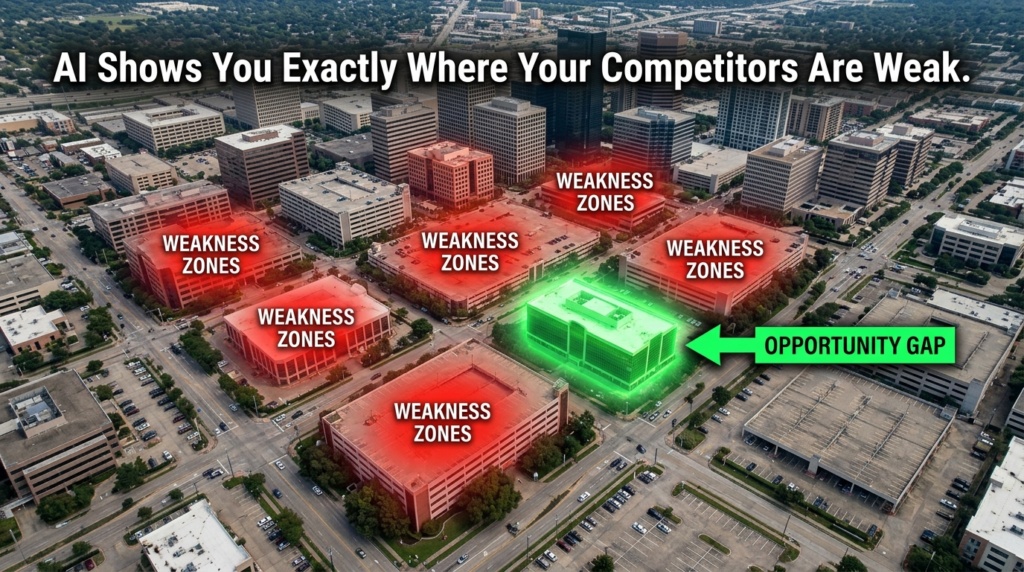
Understanding how AI can identify gaps in your local competitor analysis transforms standard market research into an aggressive acquisition strategy. Operating a commercial real estate brokerage in Houston requires knowing exactly where competitors drill and where they leave massive reservoirs untouched. Conventional search optimization acts like a ground-level survey team that only sees what sits directly in front of them. Artificial intelligence operates like a high-altitude drone equipped with thermal imaging. It scans the entire competitive landscape to expose structural weaknesses, technical flaws, and content voids that rivals do not even know they have.
The commercial property market moves aggressively. Securing prime digital real estate demands the same ruthless efficiency as locking down a Class A office tower lease. Competitors constantly optimize their digital assets to capture high-value leads. Manual audits cannot process the sheer volume of data required to find their blind spots. Deploying AI tools strips away the guesswork and delivers a precise coordinate map of every vulnerability in their local targeting strategy. This intelligence allows brokers to bypass saturated keywords and strike directly at high-intent categories where the competition remains completely invisible.
Relying on manual competitor analysis in a machine-driven search environment is like prospecting for oil with a divining rod. You need seismic data to find the hidden reserves.
This guide breaks down exactly how to deploy these advanced reconnaissance tools. You will learn to map the digital oil field, identify structural weaknesses in rival domains, and aggressively capture the commercial search traffic they abandon.
AI Overview Fluctuations Prove Traditional Local Pack Advantages Are Rapidly Disappearing
AI Overview integrations create ranking fluctuations where businesses appear in AI Overviews without traditional local packs. This fundamental shift eliminates the historic geographic positioning that previously protected local market leaders from outside competition. Smart operators must monitor these AI-driven search changes weekly to protect their commercial visibility.
AI Overview Impact
AI Overview technology bypasses standard proximity signals entirely. A competitor with a weak physical presence can suddenly dominate search results if their content satisfies the machine learning model. This disruption mirrors a sudden zoning change that instantly devalues a prime corner lot. The old rules of proximity no longer guarantee visibility. When search engines synthesize answers directly from multiple sources, they prioritize semantic relevance over a physical street address. Brokers who fail to adapt their content for these AI summaries will watch their organic lead volume evaporate overnight.
Local Pack Erosion
Traditional local packs rely heavily on Google Business Profile proximity and review velocity. Machine learning models now prioritize deep contextual relevance over mere physical location. This erosion means your closest geographic rival might not be your biggest digital threat. AI auditing tools reveal exactly which non-local competitors steal your traffic through superior entity optimization. As the local pack shrinks in prominence on the results page, the businesses relying solely on map pins lose their primary acquisition channel. You must expand your digital footprint beyond the map to survive this erosion.
Visibility Without Geography
Securing visibility without relying on geography requires a fundamental shift in strategy. AI platforms analyze the exact semantic relationships that trigger AI Overview inclusion. Brokers who optimize for these specific contextual triggers secure top positioning regardless of their physical distance from the searcher. This creates a massive competitive advantage in sprawling markets like Houston. You can effectively lease digital space in sub-markets where you hold no physical office. Breaking free from geographic constraints allows aggressive brokerages to capture leads across the entire metropolitan area.
How AI Mapping of Traffic-Driving Pages Delivers Immediate Keyword Gap Domination
Input your domain and 2-5 competitor domains into AI tools to scan topics, headings, content depth, and intent match. This automated process instantly reveals content format mapping, traffic-driving pages, topic and keyword focus, and content depth gaps across the entire market. Brokers use this exact intelligence to prioritize high-intent categories over low-value vanity metrics.
Traffic Page Identification
Identifying which competitor pages capture the most lucrative commercial leases requires precision targeting. Platforms like Similarweb track exactly where rivals generate their most valuable traffic. This data acts like a pipeline map showing exactly where the money flows. You stop guessing what works and start engineering superior versions of proven assets. If a competing brokerage generates massive traffic from a specific industrial warehouse guide, the AI highlights this exact page. You can then reverse-engineer their success and build a more comprehensive resource to siphon their audience.
Keyword Gap Prioritization
Keyword gap analysis isolates the exact search terms your competitors ignore. AI algorithms cross-reference thousands of commercial real estate queries against rival domains in seconds. This reveals untapped reservoirs of demand. You can then deploy targeted content to capture these terms before competitors even realize the demand exists. Finding a keyword gap is like discovering an unlisted commercial property in a prime district. The AI does the heavy lifting of sorting through massive datasets to hand you these exclusive opportunities on a silver platter.
High-Intent Targeting
Traffic volume means nothing if the visitors do not sign leases. AI tools segment keywords based on conversion probability and commercial intent. Targeting high-intent categories ensures your marketing budget focuses exclusively on prospects ready to transact. This surgical approach maximizes return on investment while competitors waste resources on unqualified traffic. By analyzing the exact phrasing used by decision-makers, artificial intelligence ensures your content intercepts the searcher at the exact moment they need a commercial broker.
| Intelligence Platform | Primary Reconnaissance Function | Commercial Real Estate Application |
|---|---|---|
| SEMrush | Keyword gap analysis and ranking tracking | Identifying unexploited property search terms |
| Ahrefs | Backlink profiling and content scanning | Discovering where rivals secure digital authority |
| Similarweb | Traffic insights and UX engagement metrics | Benchmarking property portfolio user retention |
| Firecrawl | Deep text scraping and data extraction | Pulling exact property descriptions from rivals |
Why Local Competitor Content Depth Analysis Still Reveals Massive Opportunities After Basic Keyword Research
Advanced AI competitor analysis utilizes platforms like Ahrefs for content scanning while tools like Firecrawl scrape full competitor page text. This deep scanning proves that most local players maintain shallow coverage that fails to answer complex commercial queries. Extracting these specific question gaps allows aggressive businesses to engineer significantly superior content.
Subtopic Exposure
Basic keyword research only scratches the surface of search intent. AI tools dig deeper to expose missing subtopics within your competitors' core service pages. If a rival claims to offer industrial warehouse leasing but fails to mention loading dock specifications or clearance heights, the AI flags this omission. You then build a comprehensive page that captures the traffic they abandoned. This level of detail acts like a core sample from a drilling site. It shows exactly what layers of information exist and where the valuable data remains untouched by the competition.
Question Gap Detection
Commercial clients ask highly specific questions before committing to a broker. AI models analyze search patterns to identify questions that local competitors fail to address. Searchapi.io fetches top organic results to validate exactly which queries lack adequate answers. Answering these specific questions establishes immediate authority and captures prospects early in their decision process. When a corporate relocation manager searches for tax implications of Houston office leases, and your site is the only one providing a deep technical answer, you win the client.
Competitor Depth Scoring
Modern SEO requires quantifiable metrics. AI platforms assign objective depth scores to competitor content based on semantic richness and topical coverage. This scoring system shows exactly how much detail you need to add to your own pages to outrank them. It provides a clear blueprint for content creation that eliminates subjective guesswork. Instead of wondering if your property guide is long enough, the AI tells you exactly which entities and LSI keywords must be included to achieve a superior depth score.
How Does AI Detect Gaps in Local Targeting Strategies and Neighborhood-Specific Content?
Effective local analysis examines neighborhood or landmark-specific pages, structured data implementation, and mobile-first optimization. AI intelligence maps exactly how competitors target specific geographic zones and where their local targeting strategy falls short. This geographic data allows brokers to dominate specific sub-markets with hyper-relevant content.
Neighborhood Page Analysis
Houston contains dozens of distinct commercial districts. AI auditing reveals exactly which neighborhoods your competitors actively target and which ones they ignore. If a major rival dominates the Energy Corridor but completely neglects the Ship Channel, you immediately know where to deploy your resources. This intelligence prevents costly battles in saturated zones. You can quietly build a massive digital presence in highly profitable secondary markets while your competitors exhaust their budgets fighting over the primary downtown sectors.
Landmark Schema Implementation
Search engines rely on structured data to understand local context. AI tools scan competitor code to detect missing or broken landmark schema markup. When rivals fail to properly tag their proximity to major transit hubs or industrial ports, they lose critical relevance signals. You exploit this by implementing flawless schema that clearly defines your territory. This technical advantage operates invisibly in the background. Your competitors will wonder why you consistently outrank them for location-specific queries while their own heavily funded campaigns fail to gain traction.
Geographic Keyword Mapping
Mapping geographic keywords requires analyzing how competitors connect locations to services. AI systems visualize these connections to expose gaps in their local targeting strategy. You might discover that competitors rank for general office space but completely miss specific medical office leasing terms in key suburbs. This granular mapping dictates exactly where you should plant your digital flags. It allows you to build a highly targeted portfolio of neighborhood pages that collectively generate massive organic traffic.
- 📍 Neighborhood Page Architecture: Analyzing how rivals structure content for specific districts.
- 🏗️ Landmark Schema Integration: Detecting missing structured data for major transit hubs.
- 📱 Mobile-First Optimization: Evaluating how geographic content renders on mobile devices.
- 🗺️ Geographic Keyword Density: Measuring the exact ratio of location terms to commercial intent phrases.
On-Page SEO Pattern Recognition Changes Everything About Local Competitor Gap Identification
Artificial intelligence systematically analyzes metadata optimization, schema markup, internal linking, and page structure for on-page SEO patterns. This technical reconnaissance exposes structural weaknesses that human auditors consistently miss during manual reviews. Fixing these specific architectural flaws provides a massive visibility advantage in highly competitive commercial markets.
Metadata Optimization Gaps
Metadata serves as the primary hook for search engine crawlers. AI tools analyze thousands of competitor title tags and meta descriptions to identify optimization patterns. They reveal exactly which emotional triggers and commercial terms drive the highest click-through rates. You use this data to engineer metadata that consistently steals clicks from higher-ranking rivals. If the AI detects that competitors use generic titles for their property listings, you can deploy dynamic, highly specific metadata that immediately captures the searcher's attention.
Schema Implementation Audit
Structured data forms the backbone of modern search visibility. AI platforms conduct exhaustive audits of competitor schema markup to identify missing entity declarations. Many commercial brokers fail to properly implement local business or real estate listing schema. Identifying and correcting these specific technical omissions immediately elevates your baseline authority. This is equivalent to ensuring your property meets all municipal building codes while your competitors operate with multiple technical violations. Search engines reward the technically sound structure.
Internal Linking Patterns
Internal links distribute ranking power throughout a domain. AI visualization tools map the exact internal linking architecture of top competitors. This analysis reveals which pages they prioritize and how they funnel authority to their core conversion assets. You replicate their successful patterns while avoiding their structural bottlenecks. By building a superior internal linking web, you ensure that every piece of content you publish actively supports your most important commercial leasing pages.
How Technical Performance Benchmarking Against Local Rivals Builds Unbeatable Visibility Advantages
Advanced benchmarking software compares page speed, mobile-friendliness, and UX using tools like Google PageSpeed Insights. This automated technical comparison reveals critical performance gaps that directly impact mobile-first indexing and AI Overview inclusion. Optimizing these specific technical parameters ensures your digital assets outperform slower competitor properties.
PageSpeed Comparison
Commercial clients expect immediate access to property data. AI monitoring tools track competitor page load times down to the millisecond. If a rival's property portfolio takes four seconds to load, they are losing valuable leads. You exploit this by engineering lightning-fast digital assets that provide a frictionless user experience. Speed is a primary ranking factor. A fast website acts like a well-paved highway leading directly to your brokerage, while a slow competitor site acts like a congested toll road that frustrates potential clients.
Mobile Experience Audit
Mobile-first indexing dictates that search engines primarily evaluate the mobile version of a website. AI systems simulate mobile user behavior across competitor domains to identify rendering flaws and navigation issues. Many commercial real estate sites still deliver clunky mobile experiences. Providing a seamless mobile interface instantly captures the traffic they frustrate. When a CEO is touring neighborhoods and searching for properties on their phone, your flawless mobile interface will win their business over a competitor's broken layout.
UX Gap Analysis
User experience directly impacts conversion rates. Platforms analyze deep insights into competitor bounce rates and session durations. AI models correlate this engagement data with specific design elements to identify UX gaps. You leverage this intelligence to build intuitive property search interfaces that keep high-value prospects engaged longer. Superior UX signals to search engines that your site is the ultimate destination for commercial real estate queries, cementing your position at the top of the rankings.
- ⏱️ Time to Interactive: Measuring exactly when a property listing becomes fully clickable.
- 📱 Mobile Render Speed: Tracking how fast image-heavy portfolios load on cellular networks.
- 🖱️ Cumulative Layout Shift: Identifying frustrating page jumps that cause users to abandon the site.
- 🔍 First Contentful Paint: Benchmarking the initial visual response of competitor landing pages.
What Happens When You Shift From Defensive Optimization to AI-Powered Aggressive Gap Strategies
Modern search dominance requires a complete shift from defensive incremental optimization to aggressive strategy focused on high-intent categories and commercial value. Utilizing intelligence platforms like Crayon and Brand24 transforms passive monitoring into active market acquisition. This high-velocity approach captures market share before competitors can react to the changing digital search environment.
Defensive vs Aggressive Models
Defensive optimization focuses on maintaining existing rankings. This approach acts like a landlord merely fixing leaks instead of acquiring new properties. Aggressive gap strategies use AI to constantly hunt for new vulnerabilities in rival domains. You actively dismantle their traffic sources by launching superior content targeted exactly at their weakest points. An aggressive posture ensures you dictate the pace of the market. You force competitors to constantly respond to your moves rather than allowing them to execute their own strategies.
High-Velocity Workflows
Speed dictates success in digital acquisition. AI automation workflows accelerate the research phase from weeks to minutes. This high-velocity workflow allows you to identify a competitor weakness on Monday and launch a targeted counter-campaign by Wednesday. Rivals relying on manual analysis simply cannot match this operational tempo. By the time they realize you have targeted their keyword gap, you have already established unshakeable authority and captured the associated lead flow.
Compounding Visibility Gains
Executing an AI-driven gap strategy generates compounding returns. Each vulnerability you exploit builds your domain authority and starves competitors of traffic. As you systematically capture their neglected subtopics and technical flaws, your overall market visibility expands exponentially. This relentless pressure eventually forces competitors out of the most lucrative commercial search categories. The digital oil field belongs to the broker with the best data and the fastest execution capabilities.
| Strategic Element | Traditional Manual Audits | AI-Powered Reconnaissance |
|---|---|---|
| Execution Speed | Weeks of manual spreadsheet formatting | Instantaneous data extraction and mapping |
| Analysis Depth | Surface-level keyword volume metrics | Deep semantic entity and subtopic scoring |
| Strategic Focus | Defensive maintenance of current rankings | Aggressive acquisition of competitor gaps |
Securing Your Claim In The New Digital Territory
The commercial real estate market no longer rewards passive digital strategies. Understanding how AI can identify gaps in your local competitor analysis provides the exact coordinates needed to strike where rivals are weakest. The tools available today strip away the fog of war. They reveal the precise technical flaws, content voids, and structural errors that cost your competitors millions in lost lease value.
The choice is simple. You can continue relying on manual surveys and outdated proximity signals, or you can deploy an automated drone fleet to map the entire competitive oil field. Will you wait for competitors to fix their vulnerabilities, or will you use AI intelligence to aggressively capture their market share today?
Common Questions
What is the main benefit of AI competitor analysis?
AI tools process massive amounts of data instantly to reveal hidden competitor weaknesses. This allows you to target high-intent commercial keywords and technical flaws that manual audits completely miss.
How does AI improve local targeting strategy?
AI maps exactly which geographic zones and neighborhoods competitors target or ignore. It analyzes structured data and keyword usage to help you dominate specific, highly profitable local sub-markets.
Which tools are best for keyword gap analysis?
Platforms like SEMrush and Ahrefs excel at identifying keyword gaps. They compare your domain against multiple rivals to expose lucrative search terms your competitors currently fail to rank for.
Why is content depth important in local SEO?
Shallow content fails to answer specific user queries. AI scanning reveals the exact subtopics and questions competitors skip, allowing you to create comprehensive pages that capture higher quality traffic.
How do AI tools evaluate mobile-first indexing?
AI systems benchmark your site against rivals using metrics from Google PageSpeed Insights. They identify slow loading times and poor mobile UX that negatively impact search visibility and user retention.
What role does schema markup play in AI search?
Schema markup provides explicit context to search engines. AI audits expose where competitors lack proper structured data, giving you the opportunity to implement superior code for better local pack visibility.
 SEO SOLUTIONS TEXAS BLOG
 SEO SOLUTIONS TEXAS BLOG
We are a results-driven digital marketing and AI SEO agency focused on increasing website traffic, improving online visibility, and generating high-quality leads for our clients.
🏆 Our Services:
Get Access To Our Texan Newsletter
Outrank. Outplay. Outperform.
We deliver elite Texas AI SEO and digital marketing strategies that amplify your presence across search engines, social media, and the platforms that matter most—so you get cited, attract ready-to-buy customers, and turn visibility into unstoppable brand growth.