How do AI search engines choose which Texas businesses to cite? The 2026 Guide
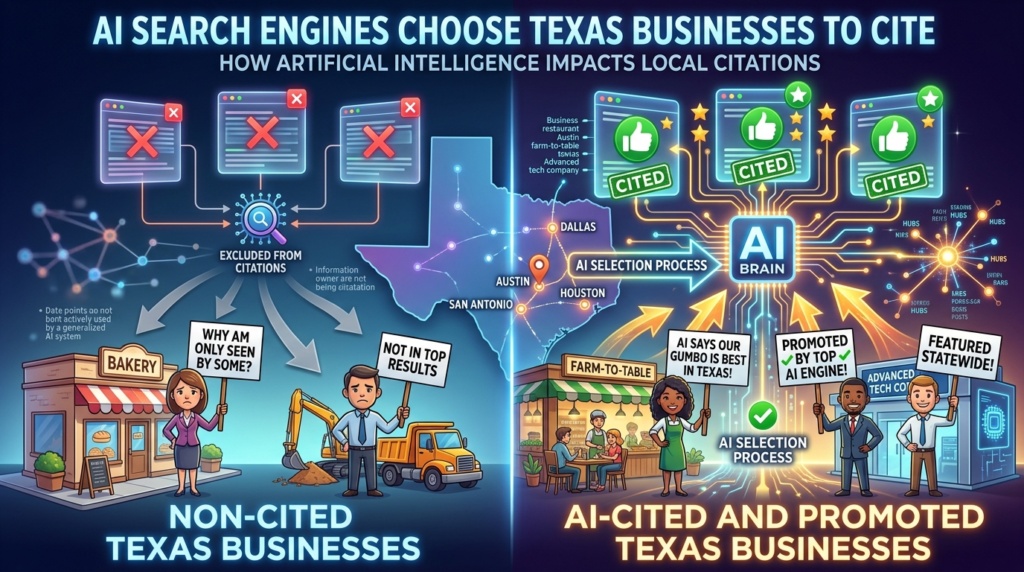
How AI search engines choose which Texas businesses to cite?
AI search engines choose which Texas businesses to cite by evaluating real-time data freshness, proprietary research, and structured schema markup. Retrieval-Augmented Generation models scan local knowledge graphs to extract verifiable facts, prioritizing entities with high E-E-A-T signals over traditional keyword-stuffed websites.
Jump to Passage. . .
🚗 Bypassing the I-35 Gridlock of Traditional SEO
Generative Engine Optimization replaces legacy search tactics by delivering direct answers to users, bypassing traditional ranking algorithms entirely. Austin startups utilizing this methodology secure immediate visibility in AI overviews rather than fighting for diminishing organic click-through rates.
Operating a startup in the Silicon Hills means moving fast, but many marketing departments remain stuck in the slow lane of legacy search engine optimization. Traditional search optimization operates exactly like Interstate 35 at rush hour. Hundreds of companies cram into the same ten organic slots, burning resources while traffic crawls to a halt. Generative Engine Optimization acts as the Mopac Express Lane. By optimizing for artificial intelligence citations rather than traditional blue links, your brand bypasses the congestion completely.
The shift is no longer theoretical. Industry analysis reveals 61.3% of responses now originate from generative engines like ChatGPT, Perplexity, and Gemini. This massive behavioral shift fundamentally alters how consumers discover local B2B software providers, marketing agencies, and professional services. When a user asks an AI for the best project management tool for a Texas-based distributed team, the engine does not provide a list of links. It provides a definitive, synthesized answer.
Failing to adapt carries severe financial consequences. Unoptimized domains face severe visibility drops as zero-click answers satisfy user intent immediately without requiring a website visit. Transitioning your digital strategy toward the citation economy ensures your Austin business remains the authoritative source these language models trust.
🧠 How AI Search Engines Select Citation Sources
Generative engines select citation sources based on semantic density, verifiable statistics, and concise answer formatting. Algorithms prioritize content structured in short explanatory blocks that directly address specific user queries without surrounding narrative fluff.
Understanding the mechanics of Retrieval-Augmented Generation (RAG) is critical for modern visibility. When a user queries an AI platform, the system does not simply guess the answer based on its base training data. Instead, it actively retrieves information from an updated index of trusted web sources, reads that information in real-time, and generates a response citing those specific sources.
Search auditors emphasize this shift, noting the citation economy replaces legacy top-ten ranking models. To win in this new environment, your content must be highly structured and mathematically relevant to the query. Language models convert text into vector embeddings, placing concepts into a multi-dimensional space. The closer your content's vector sits to the user's query vector, the higher your probability of citation.
Vector Embeddings Explained
Vector databases measure the semantic distance between words. If an enterprise buyer searches for "scalable cloud infrastructure Austin," the AI looks for content that tightly clusters those specific concepts alongside authoritative proof points. Loose, conversational blog posts fail this mathematical test. Dense, fact-rich technical documentation passes it effortlessly.
| Metric Category | Legacy SEO Focus | Generative AI Focus |
|---|---|---|
| Primary Goal | Click-through rate (CTR) | Direct inline citation |
| Content Structure | Long-form narratives | Dense 40-60 word fact blocks |
| Authority Signal | Inbound backlinks | Proprietary data and E-E-A-T |
| Lifespan | Evergreen (Years) | Highly Fresh (90 Days) |
📊 The Role of Proprietary Data in AI Rankings
Exclusive research metrics and original frameworks secure the highest citation priority in generative search environments. Large Language Models trust unique, mathematically verifiable data points over generic industry summaries to build authoritative responses.
Generic advice holds zero value in a generative landscape. If your website simply repeats the same best practices found on fifty other domains, the AI has no mathematical incentive to cite you. Testing confirms proprietary research data achieves maximum visibility because it provides exclusive fuel for the language model's response generation.
Texas businesses must transition from content curators to data creators. A local cybersecurity firm should not write a generic post about "Why Phishing is Bad." Instead, they should publish "Analysis of 5,000 Phishing Attempts on Austin Tech Startups in Q1 2026." The latter contains specific, extractable numbers that an AI engine will eagerly cite when a user asks about local cyber threats.
Original Frameworks
Beyond raw data, named methodologies perform exceptionally well. Creating a branded framework gives the AI a specific noun to reference. When you define a unique process and explain its steps clearly, models like Claude and Perplexity will extract your exact methodology to answer complex user queries.
⏱️ Why Freshness Outperforms Evergreen Content
Retrieval-Augmented Generation systems heavily favor content published within the last 90 days to ensure absolute accuracy. Historical evergreen content loses citation viability rapidly as models seek real-time updates to satisfy immediate query intents.
The concept of building a timeless piece of content and letting it gather traffic for years is dead. Modern language models are acutely aware of temporal relevance. Strategic audits show content under three months dominates modern AI overviews. If a user asks about compliance laws for Texas healthcare startups, the AI will bypass a massive, well-linked guide from 2023 in favor of a brief, factual update published last week.
This creates a necessary operational shift for marketing teams. Instead of constantly churning out net-new topics, resources must be allocated to an aggressive updating schedule. High-value pages must be refreshed quarterly with new statistics, recent case studies, and updated schema timestamps to trigger re-crawling by AI bots.
- 📅 Quarterly Data Refreshes: Update all numerical claims and statistics every 90 days.
- 🔄 Timestamp Modification: Ensure your CMS updates the "last modified" schema tag.
- 🗑️ Pruning Outdated Claims: Remove references to obsolete tools or past years.
- 🔗 Internal Link Injection: Connect older posts to your freshest proprietary research.
🏗️ Structuring Multimodal Content for AI Crawlers
AI bots require explicit schema markup attached to text, images, and video assets to understand contextual relationships. Proper JSON-LD implementation allows generative models to extract specific media elements for rich, multi-format conversational answers.
Search is no longer a text-only experience. Users frequently ask voice assistants complex questions, and AI engines respond with a blend of text summaries, charts, and video timestamps. Texas businesses must structure their content to serve this multimodal reality. Modern workflows show AI handles 60% of structural creation while humans focus on the differentiating elements that secure the actual citation.
Implementing structured data is non-negotiable. Schema markup acts as a direct translation layer between your website and the AI crawler. When you wrap a pricing table or a step-by-step process in JSON-LD code, you remove the computational guesswork for the language model. It knows exactly what the data represents and can confidently serve it to the user.
Essential Schema Types
Certain schema architectures yield higher citation rates than others. Focus your development resources on implementing the structures that directly align with how AI answers user questions.
- FAQPage Schema: Maps direct questions to concise answers, perfect for voice search extraction.
- HowTo Schema: Breaks processes into sequential steps, highly favored for tutorial queries.
- Dataset Schema: Flags proprietary research and original statistics for data-driven prompts.
- ProfilePage Schema: Establishes the E-E-A-T credentials of your authors and experts.
⚙️ Technical Fixes to Unblock AI Web Crawlers
Unrestricted server access for AI-specific user agents ensures your Texas business enters the primary training and retrieval pipelines. Blocking bots like GPTBot or relying heavily on client-side JavaScript renders entire domains invisible to generative citation engines.
Many Austin startups accidentally sabotage their AI visibility at the server level. During the initial wave of AI scraping anxiety, many IT departments hastily updated their robots.txt files to block all AI crawlers. While this protects intellectual property from being used in base model training, it completely eliminates your brand from RAG-based real-time search citations.
You cannot be cited if you cannot be read. You must audit your server configurations to ensure the specific bots powering modern search engines have full access to your public-facing marketing assets. This technical pivot marks the rise of GEO as the primary growth driver for technical SEO teams.
Monitoring Crawl Activity
Technical teams must actively monitor log files to verify AI bot access. You should regularly monitor crawl activity through Google Search Console to detect rendering anomalies or sudden drops in indexation that correlate with AI engine updates.
| Bot Name | Associated Engine | Action Required |
|---|---|---|
| GPTBot | OpenAI / ChatGPT | Allow in robots.txt |
| PerplexityBot | Perplexity AI | Allow in robots.txt |
| Google-Extended | Gemini / AI Overviews | Allow for RAG visibility |
| ClaudeBot | Anthropic | Allow in robots.txt |
🎯 Transitioning From Clicks to the Citation Economy
Brand equity and direct inline citations replace traditional website traffic metrics as the primary indicators of search marketing success. Businesses must optimize their content to answer queries directly within the AI interface rather than attempting to force users to click through to a landing page.
The hardest adjustment for Austin marketing directors is letting go of the click-through rate obsession. Zero-click searches are the new default. When a user asks an AI engine for information, they want the answer immediately, not a link to an article containing the answer. If your business provides the data that powers that answer, your brand name appears as the authoritative source.
This requires a fundamental shift in reporting. Instead of tracking sessions and bounce rates, modern teams track citation share of voice. You must actively audit your brand using tools like Perplexity to identify which competitors are currently dominating the answers for your core commercial queries. If a competitor is cited for "best commercial real estate software Dallas," you must analyze their source page to find the semantic gaps you can fill with better, fresher data.
Structuring for the 11-Word Query
Voice search and conversational AI have changed how people ask questions. Queries have expanded from fragmented keywords like "Austin IT support" to complete sentences averaging 10-11 words, such as "Which IT support companies in Austin specialize in healthcare compliance?" Your H2 and H3 headings must exactly mirror these conversational formats, followed immediately by a direct, factual answer block.
🔮Securing Your Austin Startup Visibility
Securing long-term visibility in generative search requires continuous data production, strict adherence to technical schema standards, and a relentless focus on content freshness. Texas businesses that abandon legacy keyword tactics in favor of entity-dense, verifiable knowledge graphs will dominate their respective market segments.
The evolution from traditional search to generative AI answers is complete. The Mopac Express Lane is open, but it requires a different type of vehicle. You cannot drive a keyword-stuffed, five-year-old blog post into an AI overview and expect a citation. You need high-performance, structured data.
Start by auditing your current top-performing pages. Strip out the marketing fluff, inject proprietary statistics, update the publish dates, and wrap the core facts in JSON-LD schema. By aligning your digital presence with the exact extraction requirements of modern language models, your Texas business will transition from chasing clicks to defining the answers.
❓ Common Questions
How do AI search engines choose which Texas businesses to cite?
AI engines cite businesses that provide fresh, proprietary data structured with schema markup. They prioritize mathematically verifiable facts and high E-E-A-T signals over traditional keyword density.
Does traditional SEO still work in 2026?
Traditional SEO still drives some legacy traffic, but AI citations now account for over 60% of search responses. A hybrid approach blending technical SEO with Generative Engine Optimization is required.
How often should I update content for AI visibility?
Content should be updated every 90 days. AI models heavily favor extreme freshness, often ignoring evergreen content older than three months in favor of recent data.
What is the most important schema for AI citations?
FAQPage, HowTo, and Dataset schemas are critical. These structures allow AI bots to extract direct answers, procedural steps, and proprietary statistics without parsing complex HTML.
Should I block AI bots in my robots.txt file?
No. Blocking bots like GPTBot or PerplexityBot removes your site from the Retrieval-Augmented Generation process, making your business invisible in modern AI search citations.
How do I measure success without traditional clicks?
Success is measured through citation share of voice. Track how often your brand name and data points are referenced directly within AI-generated responses for your core industry queries.
 SEO SOLUTIONS TEXAS BLOG
 SEO SOLUTIONS TEXAS BLOG
We are a results-driven digital marketing and AI SEO agency focused on increasing website traffic, improving online visibility, and generating high-quality leads for our clients.
🏆 Our Services:
Get Access To Our Texan Newsletter
Outrank. Outplay. Outperform.
We deliver elite Texas AI SEO and digital marketing strategies that amplify your presence across search engines, social media, and the platforms that matter most—so you get cited, attract ready-to-buy customers, and turn visibility into unstoppable brand growth.