Local Business Growth Texas: The 2026 Economic Blueprint
📈 What Drives Local Business Growth Texas in 2026?
Local business growth Texas accelerates through 3.3 million small businesses employing 4.9 million workers. The SBA Office of Advocacy reports these firms generate 74.2% of new jobs statewide. Despite a $2.7 trillion Texas GDP, operators face severe labor quality challenges documented in the Texas Main Street Sector Report.
Jump to Passage. . .
🚀 The Stat That Rewrites Everything You Know About Local Business Growth Texas
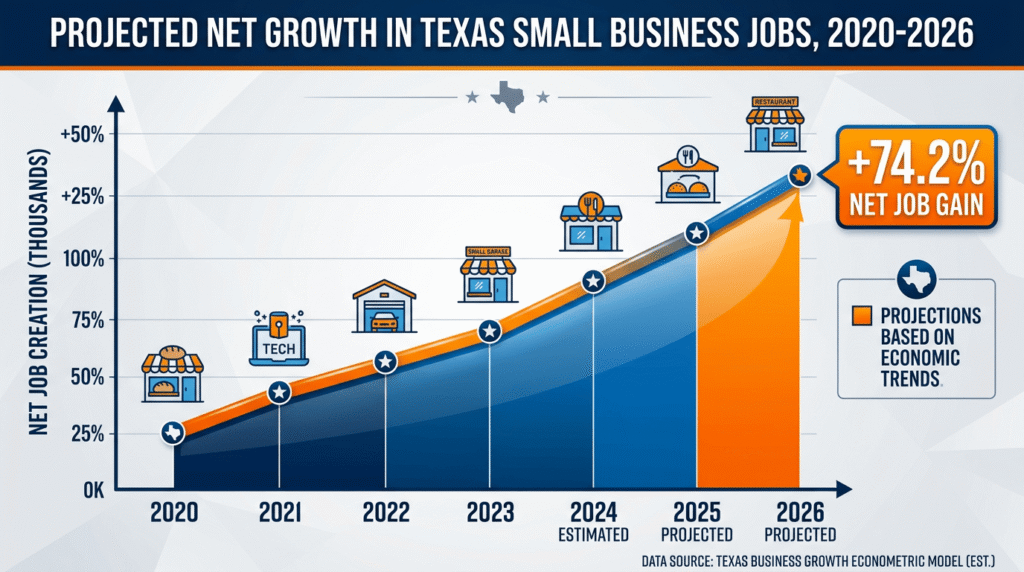
Economic expansion relies heavily on the momentum of independent enterprises. When analyzing the raw data behind state-level prosperity, corporate relocations often dominate the headlines. However, the actual engine of economic stability operates on a much smaller, more localized scale. Texas small businesses created 386267 net jobs between March 2022 and March 2023. This single metric fundamentally changes how economists view regional development, as these independent ventures accounted for an astonishing 74.2% of all net job gains across the state.
According to recent SBA data, this disproportionate contribution to the labor market proves that local operators outpace massive conglomerates in actual community impact. The sheer volume of hiring indicates a robust underlying demand for localized services, retail, and specialized B2B solutions. When nearly three-quarters of all new employment stems from small-scale operations, municipal governments and commercial lenders must pivot their focus toward supporting these localized job creators rather than exclusively courting massive corporate headquarters.
This explosive hiring phase does not exist in a vacuum. The momentum requires a constant influx of capital, favorable zoning laws, and a consumer base willing to spend locally. The Texas 2024 Small Business Profile highlights that this job creation spans multiple geographic regions, from the dense urban corridors of Dallas and Houston to rapidly expanding secondary markets like Lubbock and Tyler. The decentralized nature of this growth provides a buffer against localized economic downturns, creating a highly resilient statewide economy.
🏢 Why 501,398 New Business Applications in 2023 Still Face a 20% First-Year Failure Rate
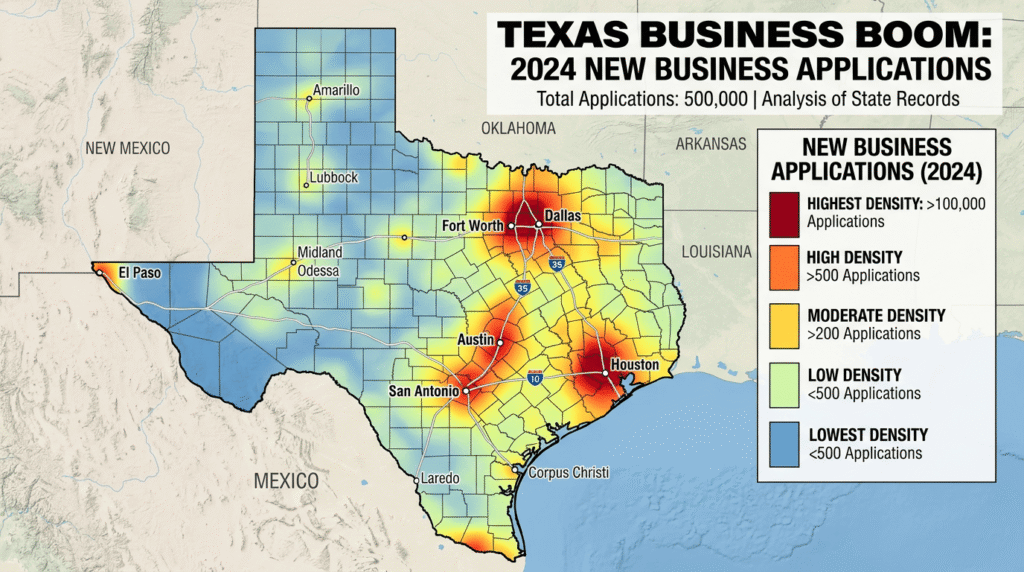
The entrepreneurial spirit within the state remains unmatched historically. Official records show 501398 new business applications filed in a single year, pushing Texas to rank 14th nationally in applications per capita. This surge in filings tracked by the U.S. Census Bureau Business Formation Statistics demonstrates an aggressive appetite for commercial independence. However, launching a venture and sustaining it require entirely different skill sets.
Despite the favorable tax environment and massive population growth, early-stage viability remains a complex hurdle. The Kauffman Foundation reports a 79.6% first-year survival rate for Texas startups. While this figure represents strong viability compared to historical national averages, it still leaves approximately one in five new enterprises closing their doors within twelve months. Understanding the anatomy of this 20% failure rate provides a critical roadmap for incoming founders.
Early-stage closures rarely stem from a lack of market demand. Instead, the primary culprits involve severe undercapitalization, aggressive expansion before establishing product-market fit, and sudden regulatory compliance burdens. Many Texas small businesses face unexpected complexity around municipal zoning, localized permitting, and commercial insurance requirements. Founders who treat the initial twelve months as a survival phase rather than an aggressive scaling phase consistently fall into the successful 79.6% cohort.
To combat early failure, successful operators implement strict capital preservation strategies. They utilize official census records to identify saturated markets and pivot their service offerings accordingly. By analyzing localized demographic shifts, founders can align their initial product launches with neighborhoods experiencing rapid residential growth, thereby securing a built-in customer base during their most vulnerable months.
- 🎯 Capital Buffering: Maintaining six months of operating expenses in liquid accounts to survive initial revenue fluctuations.
- 🎯 Compliance Auditing: Securing all municipal permits and state licenses prior to signing commercial leases.
- 🎯 Phased Hiring: Utilizing independent contractors during the first two quarters before committing to full-time payroll taxes.
- 🎯 Hyper-Local Marketing: Focusing initial customer acquisition budgets strictly within a five-mile radius of the physical location.
👥 How Texas Small Businesses Employs 4.9 Million People and Still Struggles to Hire
The sheer scale of the independent commercial sector is difficult to overstate. Currently, 3.3 million small businesses operate within the state, comprising an overwhelming 99.8% of all commercial entities. These organizations are not just storefronts. They are the primary economic engine for millions of families. Together, they employ 4.9 million workers, representing 44.9% of the state's total private-sector employment.
Within this massive ecosystem, there are 479866 small employer firms. The average small employer business maintains a roster of approximately ten employees. This structural composition means that the state's economic health relies heavily on the ability of micro-enterprises to maintain payroll, manage benefits, and retain talent. Yet, despite offering competitive wages and flexible working conditions, these firms face unprecedented hiring friction.
The National Federation of Independent Business has extensively documented this paradox. While consumer demand necessitates rapid hiring, the applicant pool lacks the specific technical skills required by modern local enterprises. From advanced diagnostic capabilities in auto repair to specialized software proficiency in local accounting firms, the skills gap severely limits operational capacity. Owners frequently report turning away lucrative contracts simply because they lack the qualified manpower to fulfill the obligations.
📊 What the NFIB Small Business Optimism Index of 101.1 Actually Means for Your Business
Sentiment indicators provide a highly accurate preview of future economic activity. The NFIB Small Business Optimism Index for Texas recently reached 101.1, sitting a full 3.2 points above the national average. This metric is not based on vague feelings. It derives from hard data regarding capital outlay plans, inventory investments, and hiring expectations reported directly by owners on the ground.
When the index crosses the 100-point threshold, it signals a transition from defensive posturing to offensive expansion. For the local operator, a 101.1 score indicates that competitors are likely preparing to upgrade equipment, expand their physical footprints, and increase marketing spends. Standing still in a high-optimism environment effectively guarantees a loss of market share. Furthermore, 17% of Texas business owners currently rate the health of their business as excellent, which is 6 points above the national average.
This upper echelon of highly confident operators shapes the competitive landscape. They are the firms securing prime commercial real estate, locking in the best local talent through aggressive compensation packages, and setting the baseline for customer expectations. The NFIB sector analysis confirms that this optimism translates directly into localized economic velocity. Money moves faster when owners believe their next quarter will outperform their last.
| Metric | Texas Performance | National Average | Variance |
|---|---|---|---|
| NFIB Optimism Index | 101.1 | 97.9 | +3.2 Points |
| Excellent Health Rating | 17% | 11% | +6% |
| Poor Health Rating | 6% | 5% | +1% |
📈 Can 3.3 Million Small Businesses in Texas Sustain Another 5.9% Growth Year?
Historical data provides a compelling argument for sustained expansion. The state witnessed a massive jump from 3.16 million small businesses in 2020 to 3.35 million in 2021. This 5.9% single-year growth rate established a new baseline for commercial formation. The momentum has not slowed, with nearly 500,000 new applications recorded in 2024 alone. The question facing economists is whether the infrastructure can support this relentless volume of new market entrants.
The Office of the Texas Governor projects that the state will house over 3.5 million startups and small businesses by the end of 2025. This growth requires massive logistical support. Commercial real estate developers must construct flexible, mixed-use spaces to accommodate these new entities. Regional banks must streamline their underwriting processes to deploy capital efficiently. Furthermore, B2B service providers, from commercial insurance brokers to managed IT services, must scale their operations to support the influx of new clients.
Sustaining a 5.9% growth rate relies heavily on internal migration. As professionals relocate to Texas from higher-tax jurisdictions, they bring both consumer spending power and entrepreneurial ambitions. These new residents frequently launch consulting firms, specialized medical practices, and boutique retail operations. By utilizing state government projections, local municipalities can accurately predict infrastructure demands, ensuring that power grids, water systems, and broadband networks can handle the commercial density.
⚠️ Why Labor Quality Tops Every Challenge in the Texas Main Street Sector Report
The most pressing threat to local business growth Texas is not taxation, regulation, or consumer demand. It is the severe lack of qualified human capital. The Texas Main Street Sector Report isolates labor quality as the absolute top issue for business owners. More concerningly, NFIB data reveals that labor quality is the only operational issue that is meaningfully worse in Texas than in the rest of the United States.
Jeff Burdett, State Director for Texas at the NFIB, notes that while "Texas remains one of the best places to own, operate and grow a small business," the operational realities on the ground are incredibly strained. The state's practical approach to governing creates an ideal environment for expansion, but that expansion violently collides with a limited talent pool. When businesses secure new contracts, their immediate bottleneck is finding the personnel to execute the work to standard.
Peter Hansen, Director of Research and Policy Analysis at the NFIB, summarizes the dilemma perfectly: "When you see more economic or business growth and need more workers, it makes you worry about labor quality. It is an extraordinarily tight labor market." Workers feel the impact of inflation and demand higher starting wages, while consumers continue to spend consistently, forcing businesses to hire regardless of the applicant's skill level. This dynamic creates a dangerous cycle of high turnover and reduced service quality.
💰 How $2.7 Trillion Texas GDP Creates Rocket Fuel for Local Business Expansion
To comprehend the sheer volume of opportunity available to local operators, one must look at the macroeconomic environment. The Texas GDP reached approximately $2.7 trillion in 2024, a significant jump from $2.6 trillion the previous year. If Texas were an independent sovereign nation, its economy would rank roughly eighth in the world, surpassing established global powers like Canada and Russia. This massive concentration of wealth creates an unparalleled ecosystem for B2B and B2C commerce.
This $2.7 trillion economic engine requires constant maintenance, development, and servicing. The SBA Texas 2024 Small Business Profile clearly identifies which sectors are capturing the largest share of this capital flow. Construction leads the state with 416401 small businesses, employing 503,806 workers. This sector thrives directly on the population influx, building the residential subdivisions and commercial centers required by the growing workforce.
Following closely behind is the professional, scientific, and technical services sector, which boasts 407259 firms and employs 434,387 individuals. These are the architects, software developers, legal consultants, and engineers who provide the intellectual framework for the state's physical expansion. Transportation and warehousing also represent a massive segment with 383,947 small firms, managing the complex logistics of moving goods across the eighth-largest economy on earth.
| Industry Sector | Total Small Firms | Total Employees | Economic Function |
|---|---|---|---|
| Construction | 416,401 | 503,806 | Infrastructure & Housing |
| Professional Services | 407,259 | 434,387 | B2B Consulting & Tech |
| Transportation | 383,947 | Data Varies | Logistics & Supply Chain |
🏆 The Exact Survival and Hiring Tactics Used by Texas’ Top 17% of Business Owners
The 17% of operators who rate their business health as excellent do not possess secret market knowledge. They execute fundamental business practices with ruthless consistency. While the majority of the market complains about the tight labor pool and inflation, this elite cohort adapts their operational models to thrive within those exact constraints. Their success provides a replicable framework for any local enterprise looking to scale.
First, they reject the concept of competing on price. In an inflationary environment with high labor costs, racing to the bottom on pricing guarantees insolvency. Instead, the top 17% aggressively raise their prices to protect their profit margins. They justify these increases by delivering exceptional, highly reliable service that their understaffed competitors cannot match. Consumers in a $2.7 trillion economy are willing to pay a premium for certainty and quality.
Second, they treat employee retention as their primary marketing strategy. Replacing a skilled worker in Texas currently costs significantly more than retaining one. These owners offer transparent career progression, profit-sharing models, and flexible scheduling that larger corporations struggle to implement. By reducing their turnover rate to near zero, they maintain institutional knowledge and avoid the massive hidden costs of constant recruitment and onboarding.
- ⚙️ Margin Protection: Implementing dynamic pricing models that automatically adjust based on localized supply chain costs.
- ⚙️ Vendor Consolidation: Building deep relationships with a few key local suppliers to guarantee inventory allocation during shortages.
- ⚙️ Cross-Training: Ensuring every critical operational task can be performed by at least three different employees to prevent bottlenecks during sudden absences.
- ⚙️ Cash Flow Discipline: Negotiating net-15 payment terms with clients while securing net-45 terms with vendors to maintain positive working capital.
🎯 Securing Your Position in the Texas Economic Engine
The trajectory of local commerce in this state requires operators to transition from reactive management to proactive strategy. The data clearly shows that the environment supports massive expansion, evidenced by the 386267 net jobs created and the relentless influx of new applications. However, the structural challenges regarding labor quality and early-stage survival demand operational excellence. Success is no longer guaranteed simply by opening your doors in a growing market.
Founders and managers must audit their current practices against the benchmarks set by the top 17% of performers. This means optimizing capital reserves, building internal talent pipelines, and fiercely protecting profit margins against inflationary pressures. The $2.7 trillion Texas GDP offers enough capital for any well-run enterprise to thrive, provided the foundation is solid.
Will your operation be part of the 79.6% that survives and scales, or will poor labor management and thin margins force you into the failure statistics? The economic environment is set. The execution is entirely up to you.
❓ Frequently Asked Questions About Local Business Growth Texas
What is the current small business survival rate in Texas?
The Kauffman Foundation reports a 79.6% first-year survival rate for Texas startups, indicating strong early-stage viability compared to national averages.
How many small businesses operate in Texas today?
There are over 3.3 million small businesses currently operating in Texas, making up 99.8% of all commercial enterprises in the state.
What is the biggest challenge for Texas business owners?
Labor quality remains the absolute top issue. NFIB data shows finding qualified workers is the only challenge meaningfully worse in Texas than the US average.
Which industries lead Texas small business growth?
Construction leads with 416,401 firms, followed closely by professional, scientific, and technical services at 407,259 operating businesses.
How many jobs do Texas small businesses create?
Texas small businesses created 386,267 net jobs between March 2022 and March 2023, accounting for 74.2% of all net job gains statewide.
How does the Texas GDP impact local business?
The $2.7 trillion Texas GDP creates massive B2B and consumer demand, effectively functioning as the 8th largest economy in the world to support local scaling.
 SEO SOLUTIONS TEXAS BLOG
 SEO SOLUTIONS TEXAS BLOG
We are a results-driven digital marketing and AI SEO agency focused on increasing website traffic, improving online visibility, and generating high-quality leads for our clients.
🏆 Our Services:
Get Access To Our Texan Newsletter
Outrank. Outplay. Outperform.
We deliver elite Texas AI SEO and digital marketing strategies that amplify your presence across search engines, social media, and the platforms that matter most—so you get cited, attract ready-to-buy customers, and turn visibility into unstoppable brand growth.