⚙️ What are semantic SEO strategies for dominating AI search models?
What are semantic SEO strategies for dominating AI search models?: Search Optimization Technology
Generative Engine Optimization represents the fundamental shift from traditional keyword matching to entity-based knowledge mapping. Modern search systems utilize Large Language Models to interpret user intent through complex semantic relationships rather than isolated search strings.
Major platforms including Google AI Overviews, Perplexity, and ChatGPT evaluate domain expertise by analyzing interconnected content networks. Organizations must develop comprehensive hub-and-spoke models that demonstrate deep topical authority to secure citations within these generative responses.
Jump to Passage. . .
The integration of machine learning tools like KIME and SE Ranking allows technical marketers to measure LLM intent depth. Tracking visibility across these AI-driven interfaces is now mandatory for maintaining digital market share in 2026.
🔧 Building the Engine: Why Your Website Needs a Complete System Upgrade
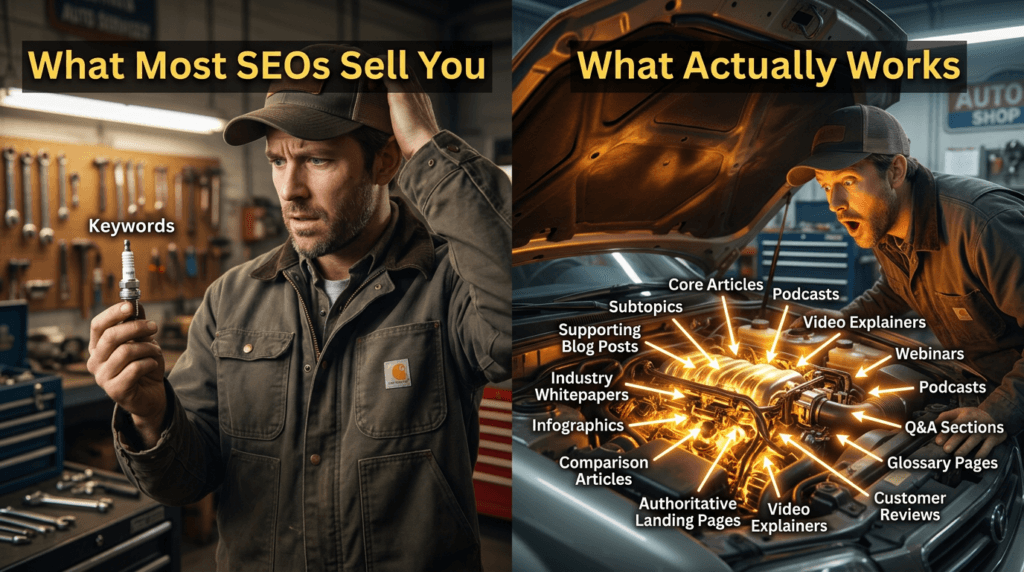
💡 If you run a commercial contracting business in San Antonio, you already know that you cannot power a heavy-duty F-250 with a single spark plug. You need a complete, interconnected engine block firing in perfect sequence. For years, website owners treated search engine optimization like buying individual spark plugs. They would buy one keyword, stick it on a single webpage, and expect the website to haul heavy traffic loads. That approach is completely obsolete. If you are asking what are semantic SEO strategies for dominating AI search models, you are asking how to build the entire engine.
🏗️ Semantic SEO is the architectural blueprint of your website's knowledge. Instead of trying to rank for a single phrase like "commercial roof repair," you are building a massive, interconnected web of information that proves to an artificial intelligence system that you are the ultimate authority on commercial roofing. This involves mapping out related concepts, answering complex sub-questions, and linking everything together with precise logic. When you build this system correctly, you stop chasing individual clicks and start capturing entire markets.
⚙️ The transition from traditional search to AI-driven search requires a fundamental shift in how we structure information. We are no longer organizing content for human readers scanning for bolded words. We are organizing data for advanced machine learning algorithms that read your entire website in milliseconds to determine if your business actually understands the mechanics of your industry. This guide will walk you through the exact blueprints needed to construct a website that dominates these new generative search models.
🧠 Understanding Semantic SEO for AI Dominance
🎯 To dominate modern search platforms, you must first understand how artificial intelligence evaluates your website. Traditional search engines functioned like simple filing cabinets. You handed them a folder labeled with a specific keyword, and they placed it in the corresponding drawer. Modern AI search models function more like expert investigators. They do not just look at the label on the folder. They read the entire document, cross-reference it with everything else you have ever written, and verify your claims against known industry facts.
🔍 This investigative process is driven by what industry engineers call Google's query fan-out. When a potential client searches for a solution, the AI does not just process that one specific question. It secretly runs dozens of hidden sub-queries in the background. It asks about pricing, materials, local regulations, and long-term maintenance. If your website only answers the primary question, the AI moves on to a competitor who answers the entire fan-out. This is why AI Overviews and semantic authority are completely transforming the digital landscape. In fact, AI Overviews appear in roughly 15% of all Google searches as of mid-2025. Furthermore, Google uses over 200 ranking factors with thousands of annual algorithm changes, making isolated keyword targeting completely ineffective.
📊 To capitalize on this technology, your website must prioritize Generative Engine Optimization (GEO). This is the technical practice of structuring your content so that Large Language Models (LLMs) can easily extract and cite your information. When a user asks an AI a question, the AI does not provide a list of blue links. It generates a custom answer and cites the sources it used to build that answer. Your goal is to become the cited source. This requires a level of topical depth that cannot be faked or shortcut.
🏛️ Building Topical Authority through Clustering
📐 The most effective way to prove your expertise to an AI model is by constructing topical clusters. Think of topical clusters like a master-planned subdivision. You do not just drop houses randomly in a field. You build a main boulevard, connect it to neighborhood streets, and link those to individual driveways. In the digital world, this structure is known as hub-and-spoke models. This architectural framework organizes your knowledge into easily digestible, highly authoritative networks that AI models crave.
🏢 The foundation of this model is the pillar page. A pillar page acts as the main boulevard. It is a massive, comprehensive document (usually 2,500+ words) that covers a broad topic from a high level. For a contractor, this might be a complete guide to commercial HVAC systems. However, the pillar page does not go into granular detail on every single sub-topic. Instead, it links out to the "spokes." The spokes are highly specific, deeply technical articles (800-1,200 words) that cover one narrow aspect of the broader topic, such as "how to calculate BTUs for industrial warehouses."
- 🏗️ Pillar Pages: Broad, authoritative overviews that serve as the central hub of your topic.
- 🔗 Spoke Articles: Deep, narrow explorations of specific sub-topics related to the pillar.
- 🕸️ Strategic Interlinking: Every spoke must link back to the pillar, and the pillar must link to every spoke.
- 📚 Citation-Focused Clusters: Content designed specifically to provide definitive answers that AI models can quote.
📈 When an AI crawler enters this structure, it immediately recognizes the depth of your expertise. It sees that you do not just have one page about HVAC systems. You have an entire library of interconnected knowledge. This is why brands Pivoting to topic clusters see marked increase in citation frequency across ChatGPT, Perplexity, and Google AI Overviews. The AI trusts your domain because you have thoroughly mapped the entire semantic neighborhood.
🤖 Leveraging AI and Machine Learning
⚡ You cannot build a modern, AI-optimized website using manual tools from 2015. To dominate artificial intelligence search models, you must use artificial intelligence to build your strategy. Machine learning algorithms can process millions of data points in seconds, uncovering hidden user intents and semantic relationships that a human researcher would never find. This is the core of true AI SEO.
🧠 One of the most powerful applications of this technology is keyword clustering. In the past, marketers would export a list of 10,000 keywords and manually group them by hand. Today, machine learning models analyze the SERP (Search Engine Results Page) intent behind every single query. The AI can tell you that "roof repair cost" and "commercial roofing estimates" share the exact same user intent, meaning they should be targeted on the same page. This prevents you from cannibalizing your own content and ensures you are matching the exact LLM intent depth required to rank. Data shows that 51% of marketers use AI tools to optimize content, making this a baseline requirement for competitive industries.
🛠️ Furthermore, you must understand how Large Language Models (LLMs) process context. They use vast neural networks to predict the next logical word in a sequence based on training data. By using AI tools to analyze your competitors' content, you can identify the exact semantic gaps in their strategies. If every competitor talks about "installation" but none talk about "municipal permitting," your AI tools will flag this as a massive opportunity to capture unique citations.
📊 Monitoring Visibility in AI Platforms
📡 Building the engine is only the first step. You must have a dashboard to monitor its performance. Traditional tracking metrics like "rankings" and "clicks" are becoming secondary to a new metric: citations. When users ask questions in ChatGPT or Perplexity, they do not click through to websites as often as they used to. They read the generated answer. Your success is now measured by how often your brand is cited as the source of that generated answer.
🧭 To track this effectively, you need specialized software. Tools like KIME are specifically designed to monitor Generative Engine Optimization. KIME tracks your brand visibility and citation frequency across various LLMs, identifying topic gaps where your competitors are being cited instead of you. You can pair this data with Google Analytics 4 (GA4) to measure the actual organic sessions and engagement resulting from your semantic clusters.
| 🛠️ Tool Name | 🎯 Primary Function | 📈 Key Metric Tracked |
|---|---|---|
| KIME | LLM Visibility Monitoring | Citation Frequency |
| SE Ranking | Topical Authority Audits | Semantic Gap Analysis |
| Google Analytics 4 | Traffic & Engagement | Cluster Organic Sessions |
⏱️ The speed of implementation and feedback in the AI era is remarkably fast. When you deploy a properly structured hub-and-spoke model, the results are highly measurable. In fact, new topic clusters show measurable LLM mention changes in 30-45 days. This rapid feedback loop allows you to audit your clusters for vocabulary gaps every month and constantly refine your semantic signals.
📈 Proven Strategies with Case Studies
🏆 Theoretical knowledge is useless without practical application. Let us examine exactly how these semantic SEO strategies perform in the real world. Many businesses hit a natural ceiling when they rely solely on foundational, older SEO tactics. They build a good website, write some decent content, and traffic flatlines because they have not adapted to the layered complexities of AI search.
📊 A perfect example of this evolution is the transition made by Thatware.co. Between February 2023 and 2024, they utilized a foundational semantic approach, successfully achieving 45,272 organic sessions. However, they hit a hard ceiling. Their reach was capped because they were not addressing the hidden sub-queries generated by AI models. To break through this barrier, they executed a massive pivot toward advanced AI SEO. They implemented predictive intent modeling and built deeply layered topic clusters for their specific service areas.
🚀 The results of this shift were staggering. By utilizing AI-driven clustering performance, their organic sessions skyrocketed to 81,691. This represents an 80%+ year-over-year growth from February 2024 to 2025. They expanded their impressions, secured top-10 rankings across new verticals, and captured massive amounts of long-tail traffic. The core takeaway from this case study is that machine learning based keyword clustering unlocks hidden market demand without diluting your core domain authority.
⚠️ Avoiding Common SEO Mistakes
🚧 Building a high-performance semantic engine requires precision. One wrong connection can short-circuit the entire system. Many contractors and business owners attempt to implement topical clusters but fail because they carry over outdated habits from the keyword-stuffing era. To ensure your Generative Engine Optimization succeeds, you must actively avoid these critical structural failures.
❌ The most destructive mistake is relying on isolated keyword targeting. This assumes that AI and LLMs match text strings exactly like traditional search engines did in 2015. It completely ignores entity mapping and the reality of sub-query fan-out. The cost of this mistake is severe: you will experience incredibly low citation rates in generative results because your authority signals are too thin. You fix this by building strict pillar-cluster hierarchies that cover user intents across every stage of the purchasing funnel.
- 🛑 Creating Shallow Clusters: Publishing 50 articles of 300 words each mimics topical coverage but lacks the semantic proof of expertise required by AI evaluators.
- 🛑 Neglecting Internal Linking: If your spoke pages are not properly linked back to the pillar page, search crawlers cannot recognize the semantic connection.
- 🛑 Ignoring AI Monitoring: Focusing exclusively on traditional SERPs will blind you to massive citation shifts happening inside ChatGPT and Perplexity.
- 🛑 Keyword Stuffing: Forcing exact-match phrases into sentences destroys readability and triggers spam filters in modern natural language processors.
🛠️ To avoid shallow content, you must layer your clusters with deep, verifiable facts. Include strict definitions, step-by-step processes, tangible benefits, and real-world case studies. Use Google's query fan-out documentation to understand exactly how the search engine breaks down complex topics, and ensure your content structure mirrors that exact breakdown.
🔮 Preparing for the Future of SEO
🔭 The digital landscape is not just shifting; it has already transformed. The strategies that work today are the baseline requirements for tomorrow. As artificial intelligence continues to integrate into every aspect of consumer behavior, the value of deep, semantic authority will compound exponentially. Businesses that invest in building these knowledge engines now will create an insurmountable moat against their competitors.
💰 The financial scale of this shift is massive. The global SEO services market is worth $108.28 billion in 2026, and the global SEO market is projected to reach $143.9 billion by 2030. This incredible 10%+ compound annual growth rate is being fueled almost entirely by semantic search and AI integration. Major corporations are pouring billions into topical authority strategies because they understand that generative engines will soon mediate the vast majority of consumer research.
🌐 As we look ahead, expect AI Overviews to grow far beyond their current 15% search prevalence. This will force a complete industry pivot toward citation-focused clusters over traditional traffic metrics. You must stay informed by following authoritative resources like Search Engine Land to track these algorithmic shifts. The brands that maintain 5-10 deeply interlinked, highly technical pages around a central theme will be the ones gaining the quotes, the trust, and ultimately, the contracts.
🏁 Firing on All Cylinders: Your Blueprint for Search Dominance
Your website is no longer a static brochure; it is a dynamic, interconnected knowledge engine. We have mapped the blueprint for dominating AI search models, moving from the outdated practice of isolated keyword targeting to the sophisticated architecture of semantic SEO and topical clusters. You now understand the critical mechanics of hub-and-spoke models, the necessity of machine learning for keyword clustering, and the exact metrics needed to track your citation visibility across LLMs.
The data is undeniable. The pivot toward Generative Engine Optimization is the only viable path forward in a market projected to hit $143.9 billion by 2030. You have the structural plans, the case studies proving an 80% growth potential, and the technical understanding of how AI evaluates domain expertise. The only question remaining is execution. Will you continue buying single spark plugs, or are you ready to build the engine that will drive your business for the next decade?
❓ Common Questions About What are semantic SEO strategies for dominating AI search models?
What is semantic SEO in simple terms?
Semantic SEO is optimizing content for meaning and context rather than exact keywords. It builds relationships between topics, helping AI understand your overall expertise.
How do topical clusters work for AI search?
Topical clusters organize content into a main pillar page connected to specific sub-topic pages. This hub-and-spoke model proves deep authority to AI algorithms.
What is Generative Engine Optimization (GEO)?
GEO is the process of structuring your website content specifically to be cited by AI models like ChatGPT and Google AI Overviews when they generate answers.
Why is Google's query fan-out important?
Query fan-out means Google runs multiple hidden sub-queries for every user search. Your content must answer all these sub-queries to rank in AI overviews.
How long does it take to see results from topic clusters?
When implementing properly structured topic clusters, businesses typically see measurable changes in LLM mentions and citations within 30 to 45 days.
What tools track AI search visibility?
Tools like KIME track citation frequency across LLMs, while SE Ranking audits semantic gaps, and GA4 measures the resulting organic cluster traffic.
 SEO SOLUTIONS TEXAS BLOG
 SEO SOLUTIONS TEXAS BLOG
We are a results-driven digital marketing and AI SEO agency focused on increasing website traffic, improving online visibility, and generating high-quality leads for our clients.
🏆 Our Services:
Get Access To Our Texan Newsletter
Outrank. Outplay. Outperform.
We deliver elite Texas AI SEO and digital marketing strategies that amplify your presence across search engines, social media, and the platforms that matter most—so you get cited, attract ready-to-buy customers, and turn visibility into unstoppable brand growth.