AI Personalization for Higher Conversions: Ultimate Guide for 2026
What is AI Personalization for Higher Conversions?
AI personalization for higher conversions uses machine learning to analyze behavioral signals and deliver tailored customer experiences. By leveraging unified customer data, businesses can deploy predictive product recommendations and dynamic content. This targeted approach significantly improves engagement, directly increasing sales and reducing customer churn across digital platforms.
Jump to Passage. . .
🎯 Unlock AI's Conversion Potential
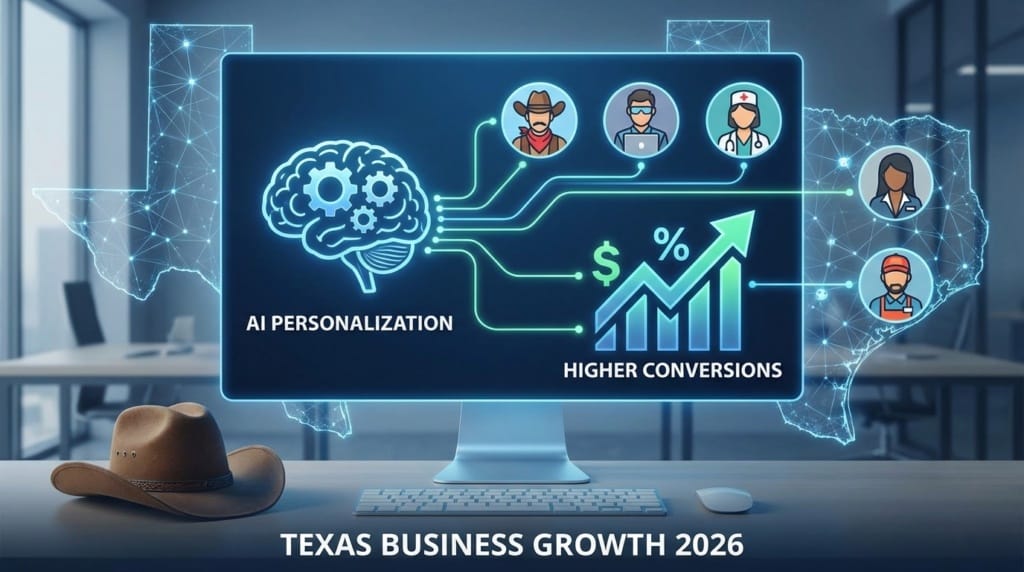
Running a successful business in Texas means knowing your customers better than the competition. The traditional approach of treating every website visitor the same simply no longer works. Modern buyers demand relevance. When you tailor the digital experience to the individual, the financial impact is undeniable. Data shows that AI personalization delivers 1.7X higher conversion rates compared to static, one-size-fits-all websites.
This massive lift happens because artificial intelligence processes thousands of data points in milliseconds. Instead of guessing what a buyer wants, your website adapts in real-time. If a customer frequently browses industrial equipment, the homepage automatically highlights heavy machinery rather than office supplies. This level of relevance removes friction from the buying journey. According to recent AI-powered marketing insights, companies implementing these systems see profound revenue growth that compounds over time.
To achieve these results, businesses must move beyond basic demographic targeting. True AI personalization analyzes active behavior. It looks at time spent on specific pages, past purchase history, and even the time of day a user logs in. By feeding this information into an AI engine, your marketing becomes proactive rather than reactive. You stop selling and start assisting, which naturally leads to higher conversion rates.
📊 Decoding Multi-Signal Strategies
Sales teams have historically relied on volume to hit their numbers. The old playbook involved sending thousands of generic emails and hoping for a 3% response rate. That approach is now obsolete. The modern standard is signal-based personalization. This method triggers outreach based on specific actions or events, such as a prospect downloading a whitepaper, a company securing funding, or a key executive changing jobs.
When you stack these signals, the results become exponential. Multi-signal stacked personalization achieves 25-40% reply rates. This means a sales representative can send a fraction of the emails but generate significantly more qualified meetings. For example, reaching out because a prospect visited your pricing page is a single signal. Reaching out because they visited your pricing page, recently hired a new IT director, and use a competitor's software is a stacked multi-signal approach.
Implementing this requires sophisticated tools that monitor the digital footprint of your target accounts. The latest State of AI Sales Prospecting 2026 report highlights that teams using these advanced signal-tracking platforms are fundamentally changing the ROI of outbound sales. They spend less time researching and more time having meaningful conversations with buyers who are actually ready to purchase.
| Metric | Traditional Cold Outreach | Multi-Signal AI Personalization |
|---|---|---|
| Average Reply Rate | 3% to 5% | 25% to 40% |
| Volume Required | Extremely High | Low to Moderate |
| Buyer Perception | Spam or Annoyance | Helpful and Timely |
| Primary Trigger | Static Lead List | Real-Time Behavioral Events |
🔮 The Future of AI Recommendations
E-commerce and B2B catalogs can easily overwhelm buyers. When presented with too many options, customers often experience decision paralysis and leave the site without purchasing. AI solves this by acting as a digital concierge. Predictive product recommendations boost conversions by 20% by showing the customer exactly what they need before they even search for it.
These predictive models analyze vast amounts of historical data alongside real-time behavioral signals. If a customer in Houston buys a specific type of commercial HVAC filter every three months, the AI will automatically recommend that exact filter, along with compatible maintenance supplies, right as the three-month mark approaches. This is not just convenient for the buyer. It is a highly effective revenue generation strategy for the business.
AI assistants are changing how people navigate websites. Instead of clicking through complex menu categories, users simply type or speak their needs into a conversational interface. The AI assistant instantly curates a personalized selection of products. This seamless discovery process builds immense trust and significantly accelerates the path to purchase.
💡 Retain with AI: Churn Down by 28%
While most companies focus their AI efforts on acquiring new customers, the most profitable application is often found in customer retention. Acquiring a new customer costs significantly more than keeping an existing one. Implementing AI-driven personalization reduces churn by 28%, protecting your recurring revenue and maximizing customer lifetime value.
Customer churn reduction happens when AI identifies at-risk accounts before they actually cancel or leave. Machine learning algorithms monitor usage patterns, login frequencies, and support ticket sentiment. If a long-term software client suddenly stops logging in, or if an e-commerce customer stops opening promotional emails, the AI flags the account. It then triggers an automated, highly personalized win-back sequence.
This sequence might include a targeted discount, an invitation to a VIP training webinar, or an alert for a human account manager to make a personal phone call. By addressing the root cause of the disengagement proactively, businesses can salvage relationships that would otherwise be lost to competitors. Personalization proves to the customer that you value their specific business, not just their wallet.
📈 Consumer Expectations: A New Norm
Personalization is no longer a luxury feature reserved for massive tech conglomerates. It is the baseline standard for doing business. Currently, 71% of consumers expect personalized experiences when interacting with a brand. If your website, emails, and sales pitches feel generic, you are actively alienating a massive portion of your target market.
Buyers have been conditioned by platforms like Netflix, Amazon, and Spotify. They expect every digital interaction to remember their preferences, anticipate their needs, and respect their time. When a business fails to meet this expectation, the buyer assumes the company is outdated or simply does not care. This perception directly impacts conversion rates and brand loyalty.
To meet these expectations, Texas businesses must audit their current customer touchpoints. Are your email newsletters identical for every subscriber? Does your homepage look the same to a first-time visitor as it does to a five-year loyal customer? If the answer is yes, you have a critical gap in your digital strategy that AI personalization can fill.
🛠️ Thrive with AI-Powered Tools
Transitioning to AI personalization requires the right infrastructure. You cannot deliver dynamic content or predictive recommendations if your customer data is scattered across disconnected spreadsheets and legacy software. Building a modern technology stack is the first step toward achieving higher conversions.
The foundation of this stack is unified customer data. A Customer Data Platform (CDP) aggregates information from your website, CRM, email marketing software, and point-of-sale systems. This creates a single, comprehensive profile for every buyer. Once the data is centralized, AI tools can analyze it and execute personalized campaigns across all channels.
Choosing the right tools depends on your specific business model, but several core categories are essential for a complete AI-powered marketing strategy. Implementing these systems correctly ensures that your personalization efforts are scalable and measurable.
- 🚀 Customer Data Platforms (CDPs): Essential for creating a 360-degree view of the customer by unifying data from all touchpoints.
- 🚀 Dynamic Content Engines: Software that automatically changes website text, images, and offers based on the visitor's profile.
- 🚀 AI Sales Prospecting Platforms: Tools that monitor buyer signals and automate personalized outreach sequences.
- 🚀 Predictive Analytics Software: Systems that forecast future buying behavior and calculate customer churn risk.
- 🚀 Conversational AI Bots: Advanced chat interfaces that guide users through product discovery and resolve support queries.
🚀 Trends Transforming Personalization
The landscape of digital marketing is shifting rapidly toward micro-segmentation. In the past, marketers divided their audience into three or four broad personas. Today, AI allows businesses to create hundreds of micro-segments based on incredibly specific behavioral signals. This hyper-segmentation ensures that every piece of communication is hyper-relevant to the recipient.
Another major shift is the rise of conversational AI as a primary revenue driver. Shoppers are increasingly relying on AI assistants to help them make purchasing decisions. By integrating these smart assistants into your website, you create a responsive, co-created shopping experience. Experts are actively preparing for conversational AI experiences because visitors referred by these AI assistants convert at significantly higher rates than traditional search traffic.
We are also seeing the implementation of real-time dynamic pricing. AI algorithms can adjust pricing and bundle offers on the fly based on inventory levels, competitor pricing, and the individual customer's perceived value. When executed transparently and fairly, this maximizes margins while still providing a personalized offer that the customer finds compelling.
| Era | Targeting Method | Technology Used |
|---|---|---|
| Past (2015-2020) | Broad Demographics | Basic CRM & Email Tags |
| Recent (2021-2024) | Rule-Based Personas | Marketing Automation |
| Current (2025-2026) | Micro-Segmentation | Machine Learning & CDPs |
| Future (2027+) | Individual Predictive | Autonomous AI Agents |
⚖️ The Privacy-Personalization Balance
Effective AI personalization requires vast amounts of customer data. This reality brings privacy concerns in AI to the forefront of business strategy. Consumers want personalized experiences, but they are also highly protective of their personal information. Balancing these two competing desires is one of the biggest challenges facing marketers today.
The solution lies in transparency and first-party data. Relying on third-party cookies purchased from data brokers is no longer a viable or ethical strategy. Instead, businesses must build trust by clearly explaining what data they collect and exactly how it benefits the consumer. When a customer understands that sharing their preferences results in better product recommendations and exclusive discounts, they are usually willing to participate.
Compliance with data protection regulations is mandatory. Texas businesses must ensure their AI systems anonymize sensitive data where appropriate and provide users with clear options to opt-out of tracking. A privacy-first approach to AI personalization actually strengthens brand loyalty, as it demonstrates respect for the customer's digital boundaries.
🤝 Human Roles in an AI-Driven World
As AI systems become more sophisticated, the role of human employees is evolving. There is a common fear that AI will completely replace sales and marketing teams. However, the most successful companies view AI as an augmentation tool, not a replacement. AI handles the heavy lifting of data analysis and initial outreach, freeing humans to do what they do best: build relationships.
Consider the rise of AI Sales Development Reps (SDRs). These AI agents can monitor thousands of accounts, detect buying signals, and send highly personalized introductory emails at scale. But once a prospect replies with a complex question or requests a negotiation, a human account executive steps in. This hybrid model maximizes efficiency without sacrificing the human touch required to close high-value deals.
The transition is happening quickly. Gartner predictions indicate that AI agents will outnumber human sellers by 10x by 2028. To stay competitive, businesses must train their teams to manage and collaborate with these AI systems. The future belongs to professionals who know how to leverage AI personalization for higher conversions while maintaining authentic human connections.
- 🎯 AI Responsibilities: Data processing, signal detection, initial outreach, predictive scoring, and dynamic content delivery.
- 🎯 Human Responsibilities: Strategy formulation, complex negotiations, empathy-driven relationship building, and creative problem solving.
- 🎯 Shared Success: AI provides the context and the lead, while the human provides the trust and the final close.
❓ Common Questions About AI Personalization for Higher Conversions
What is AI personalization in marketing?
It is the use of machine learning to analyze customer data and automatically deliver tailored content, product recommendations, and messaging to individual users in real-time.
How does AI improve conversion rates?
AI improves conversions by removing friction. It shows users exactly what they want based on behavioral signals, preventing decision paralysis and making the buying process seamless.
What are predictive product recommendations?
These are AI-generated suggestions that anticipate what a customer will want to buy next based on their past behavior and the purchasing patterns of similar users.
Can AI personalization reduce customer churn?
Yes. AI analyzes engagement data to identify at-risk customers before they leave. This allows businesses to send automated, personalized win-back offers to save the relationship.
What is signal-based personalization?
It is a sales strategy where outreach is triggered by specific buyer actions, like visiting a pricing page or downloading a guide, resulting in much higher reply rates.
Do consumers actually want AI personalization?
Yes. Data shows 71% of consumers expect personalized interactions. They prefer brands that remember their preferences and provide highly relevant shopping experiences.
What tools do I need for AI personalization?
You need a Customer Data Platform to unify your data, alongside dynamic content engines and predictive analytics software to execute personalized campaigns across your channels.
 SEO SOLUTIONS TEXAS BLOG
We are a results-driven digital marketing and AI SEO agency focused on increasing website traffic, improving online visibility, and generating high-quality leads for our clients.
🏆 Our Services:
Get Access To Our Texan Newsletter
Outrank. Outplay. Outperform.
We deliver elite Texas AI SEO and digital marketing strategies that amplify your presence across search engines, social media, and the platforms that matter most—so you get cited, attract ready-to-buy customers, and turn visibility into unstoppable brand growth.