Why Most Texas Businesses Will Disappear from AI Search by 2027 (And Don’t Know It Yet)
What Explains Why Most Texas Businesses Will Disappear from AI Search?
Most Texas businesses will disappear from AI Search because algorithms now prioritize verified semantic entities over traditional keyword optimization. While the Texas Small Business Optimism Index shows strong economic confidence, companies lacking structured data and knowledge graph integration become invisible to generative engines filtering unverified local entities.
Jump to Passage. . .
How AI Search Algorithms Threaten Texas Business Visibility
I sit across from local founders every week in Dallas and Austin. We look at their analytics dashboards together. They point to steady foot traffic and solid word-of-mouth referrals. They feel secure. But when we dig into their organic digital footprint, a terrifying trend emerges. Their top-of-funnel web traffic is slowly flatlining. The culprit is the rapid transition from the traditional ten blue links to zero-click generative engines. This shift is exactly why most Texas businesses will disappear from AI Search over the next few years.
For two decades, local search engine optimization relied on a simple formula. You built a website, stuffed it with geographic keywords, acquired some local backlinks, and waited for the phone to ring. That era is definitively over. Generative engines do not crawl the web looking for keyword density. They synthesize answers directly on the results page using a knowledge graph. If your company is not structured as a recognized, verifiable entity within that graph, you simply do not exist to the algorithm.
Understanding the Looming AI Paradigm Shift
The transition to entity-based ranking fundamentally changes how consumer discovery works. When a user asks an engine for the best commercial roofer in Houston, the system does not look for websites mentioning those words. It looks for a "commercial roofer" entity located in "Houston" that has verified relational connections to "trust," "expertise," and "positive sentiment." This requires a completely different technical architecture beneath your website.
Many owners fail to grasp the severity of the conversion collapse from zero-click searches. When the engine provides the phone number, address, and a summary of your services directly in the chat interface, the user never visits your website. If your digital presence is built solely to convert website clicks, your lead generation pipeline will dry up. You must optimize for the AI Overview itself. This is the core reason why most Texas businesses will disappear from AI Search. They are optimizing for a user journey that no longer happens.
The Texas Business Ecosystem: Uniquely Optimistic But Vulnerable
There is a dangerous paradox happening right now across the Lone Star State. Our economic confidence is blinding us to a massive technological vulnerability. According to the optimism index data, the Texas Small Business Optimism Index hit 101.1 for summer 2025. That sits a full 3.2 points above the national average. We are booming. But that boom is masking a critical infrastructure gap.
When you look at the Texas Small Business Economic Trends (SBET) Report, the confidence is staggering. A full 17 percent of Texas small business owners rate their business health as excellent, compared to just an 11 percent national average. The National Federation of Independent Business (NFIB) tracks this closely. Their Small Business Economic Trends survey reveals that our state's practical approach to governing and low regulatory burden keeps owners focused on growth. However, this operational focus comes at the expense of digital modernization.
| Ranking Factor | Traditional SEO | AI Search Requirements |
|---|---|---|
| Primary Target | Keyword Density | Semantic Entity Verification |
| User Journey | Click to Website | Zero-Click Resolution |
| Trust Signal | Inbound Backlinks | Knowledge Graph Inclusion |
| Content Structure | HTML Pages | JSON-LD Schema Markup |
The NFIB Research Center data shows we are winning on Main Street. But Main Street is moving into the machine learning layer. If your company is not structured as a digital entity, your brick-and-mortar optimism will not save your bottom line. You will simply stop receiving phone calls from new residents who rely entirely on generative engines to navigate their new cities.
Labor Quality as a Double-Edged Sword
You cannot discuss the future of Texas commerce without addressing the elephant in the room. We are growing so fast that we cannot find enough skilled hands to do the work. The data backs up what I hear from every client. A massive 28 percent of Texas small businesses cite labor quality as their single top problem. We are hiring out of desperation, which means internal training and technical upskilling take a back seat to simply keeping the doors open.
This labor crisis directly accelerates why most Texas businesses will disappear from AI Search. When you are struggling to hire frontline workers, you are certainly not hiring advanced technical SEO specialists or data architects. Your marketing is likely being handled by an overworked office manager or an outsourced agency still using tactics from 2018. They are writing blog posts for keywords while the algorithms have moved on to parsing relational databases.
The lack of technical labor means most local companies have massive knowledge graph gaps. A knowledge graph gap occurs when the algorithm knows your business name but cannot definitively connect it to a specific owner, a verified address, or a distinct service category. When the engine encounters a gap, it drops your business from the results to avoid providing a bad user experience. You lose the lead instantly.
Why Texas Businesses Can't Ignore AI
The sheer volume of commerce in our state makes standing out incredibly difficult. Texas is an entrepreneurial powerhouse. We currently boast 2.87 million non-employer firms, ranking us second highest in the entire United States. That is nearly three million solo operators, freelancers, and micro-businesses all fighting for the same digital oxygen.
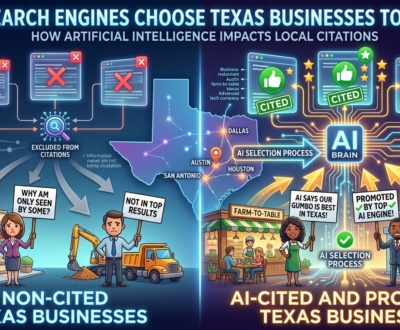
Think about the competitive density in a market like Houston or Dallas. If a user asks an engine for "reliable HVAC repair near me," the system has to filter through thousands of potential options. How does it choose? It defaults to the entities with the cleanest, most verified data structures. It ignores the noise. If you are one of those 2.87 million firms and you have not optimized for the machine layer, you are the noise.
To avoid becoming invisible, you must understand what makes an entity "verified" in the eyes of a generative algorithm. The system looks for specific, interconnected signals.
- Consistent NAP-W Data: Your Name, Address, Phone, and Website must match exactly across all tier-one data aggregators.
- Comprehensive Schema Markup: Your website code must include LocalBusiness JSON-LD schema that explicitly defines your entity type.
- Authoritative Mentions: The algorithm needs to see your brand mentioned in context on high-trust local domains, like the Chamber of Commerce or local news outlets.
- API Integration: Direct connections between your booking software and major search platforms signal operational legitimacy.
This density is exactly why most Texas businesses will disappear from AI Search. The algorithms are designed to reduce user overwhelm. They will gladly filter out 90 percent of the market if those businesses fail to provide machine-readable confidence signals.
Strategic Recommendations for AI Adaptation
Understanding the threat is only the first step. You must take immediate, structural action to secure your digital footprint. The transition window is closing rapidly. By 2027, generative engines will be the default interface for local discovery. You need to stop thinking about your website as a digital brochure and start treating it as an API endpoint for search algorithms.
The process of building entity authority requires discipline. You cannot hack this with cheap content. You must build a web of trust that a machine can crawl and verify mathematically. Here is exactly how we approach this with local clients.
- Deploy Advanced Structured Data: Move beyond basic schema. Implement nested schema that links your business entity to your founder's entity, your specific service areas, and your verified customer reviews.
- Claim Your Knowledge Panel: Force the creation of a Google Knowledge Panel by securing mentions in authoritative databases like Wikidata and Crunchbase.
- Optimize for Conversational Queries: Stop targeting two-word phrases. Build FAQ sections that directly answer the complex, multi-sentence questions users ask voice assistants.
- Centralize Your Review Management: AI engines use sentiment analysis on your reviews to determine quality. Actively manage and respond to reviews across Google, Yelp, and industry-specific platforms to feed the algorithm positive semantic data.
Implementing these steps prevents the exact scenario of why most Texas businesses will disappear from AI Search. It forces the machine to recognize your company as a permanent, verified fixture in the local economy.
Using TexStats to Navigate Economic Challenges
We cannot afford to lose our local business infrastructure to algorithmic shifts. The stakes are simply too high for our state economy. When we look at the data from the Texas Comptroller, the true scale of this issue becomes clear. Small businesses employ 44% of Texas workforce, which amounts to a staggering 5.1 million people relying on Main Street for their livelihood.
The TexStats Regional Data Dashboard provides incredible granularity on this impact. Take a region like Upper East Texas, for example. In these specific regional pockets, small business dominance is absolute. If these local economic engines fail to adapt to AI Search, entire regional supply chains and employment networks will suffer. The Texas Comptroller data proves that our state's resilience is tied directly to the success of these independent operators.
You must use this regional data to your advantage. If you operate in a highly concentrated small business zone, your local AI Search strategy needs to be hyper-specific. Use your geographic data in your schema markup. Mention your specific county, your proximity to local landmarks, and your involvement in regional commerce. The algorithms reward hyper-local relevance. Do not try to be a "Texas business" to the machine. Be a verified "Upper East Texas commercial contractor." Specificity is safety.
Securing Your Digital Footprint Before the 2027 Shift
The window for easy adaptation is closing. We are moving from an internet of pages to an internet of entities. The algorithms are getting smarter, faster, and much more ruthless about filtering out unverified data. Your current optimism and strong sales figures are a testament to your hard work, but they are lagging indicators. They tell you about yesterday's success, not tomorrow's visibility.
Understanding why most Texas businesses will disappear from AI Search is your competitive advantage. While your competitors are busy buying generic blog posts and tweaking their title tags, you can be building a robust, machine-readable entity architecture. You can secure your place in the knowledge graph. The transition requires technical effort, but the payoff is absolute market dominance. Will you let an algorithm erase your hard work, or will you structure your business to thrive in the generative era?
Critical Questions About Why Most Texas Businesses Will Disappear from AI Search
What exactly is AI Search?
AI Search uses large language models to generate direct answers instead of providing a list of links. It relies on verified entities rather than keyword matching.
How does entity-based ranking work?
Algorithms identify your business as a distinct concept (an entity) and map its relationships to locations, services, and trust signals in a knowledge graph.
Why are Houston businesses specifically at risk?
Houston has massive entrepreneurial density. AI engines aggressively filter out unverified businesses to reduce noise, making invisible any company lacking structured data.
What is a knowledge graph gap?
A gap occurs when search engines cannot mathematically verify your business details across trusted databases, causing them to drop you from generative results.
How can I verify my business as an entity?
You must deploy correct JSON-LD schema markup, maintain perfect NAP data consistency, and secure mentions in high-authority local and industry databases.
Will traditional SEO still work in 2027?
Traditional keyword SEO will yield diminishing returns. If you do not optimize for zero-click generative answers, your top-of-funnel lead generation will collapse.
 SEO SOLUTIONS TEXAS BLOG
 SEO SOLUTIONS TEXAS BLOG
We are a results-driven digital marketing and AI SEO agency focused on increasing website traffic, improving online visibility, and generating high-quality leads for our clients.
🏆 Our Services:
Get Access To Our Texan Newsletter
Outrank. Outplay. Outperform.
We deliver elite Texas AI SEO and digital marketing strategies that amplify your presence across search engines, social media, and the platforms that matter most—so you get cited, attract ready-to-buy customers, and turn visibility into unstoppable brand growth.